6.4 When independent decision-making fails: The pest control game
Imagine that Ana and Ben now face another problem.
Each must decide how to deal with pest insects that destroy the crops they cultivate in their adjacent fields. Each has two feasible strategies:
- The first strategy is to use an inexpensive chemical called Toxic Tide. It kills every insect for miles around. Toxic Tide leaks into the water supply that both Ana and Ben use.
- The second strategy is to use integrated pest control (IPC), in which beneficial insects are introduced to the farm. Beneficial insects eat pest insects. IPC is more costly than Toxic Tide.
If just one person chooses Toxic Tide, the damage is quite limited. If they both choose Toxic Tide, water contamination becomes a serious problem, and they need to buy a costly filtering system. Figure 6.5 (A) describes their interaction.
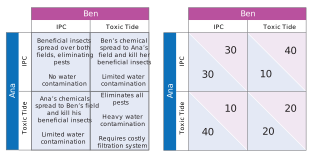
Figure 6.5 (A) and (B) Social interactions in the pest control game. The numbers capture the benefits of higher monthly profits and the costs of environmental damage.
The players and their strategies
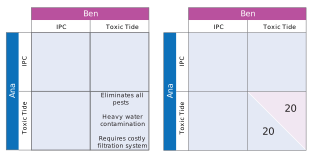
A description of the outcome when both play Toxic Tide, and the payoffs they receive at that outcome
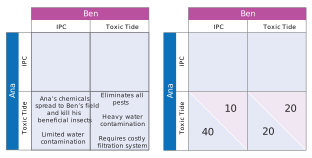
A description of the outcome when Ana plays Toxic Tide and Ben plays IPC, and the payoffs they receive at that outcome
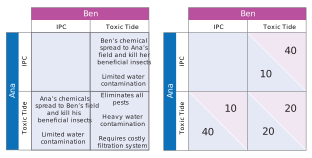
A description of the outcome when Ana plays IPC and Ben plays Toxic Tide, and the payoffs they receive at that outcome
A description of the outcome when both play IPC, and the payoffs they receive at that outcome
Both Ana and Ben are aware of these outcomes. They know that their payoff (the income from selling their crops, minus the costs of their pest control method and of any water filtration required) depends on their own decision and on the other person’s choice. This is a strategic interaction. Figure 6.5 (B) shows the payoffs.
Again, we can use the dot-and-circle method to determine how Ana and Ben will play this game (draw the dots and circles in the table for yourself). Ana’s best responses are:
Dominant strategy
A strategy is dominant if it yields the highest payoff for the player, no matter what strategies the other players choose.
- If Ben chooses IPC: Toxic Tide (cheap eradication of pests, little water contamination)
- If Ben chooses Toxic Tide: Toxic Tide (IPC costs more and cannot work because Ben’s chemicals will kill beneficial insects).
- dominant strategy
- A strategy is dominant if it yields the highest payoff for the player, no matter what strategies the other players choose.
Therefore, whatever her opponent chooses to do, Ana’s best response is to choose Toxic Tide. When a player has a strategy that is a best response to all of the opponent’s strategies, we say that the player has a dominant strategy.
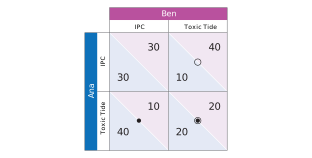
Figure 6.6 The dominant-strategy equilibrium in the pest control game: both players play Toxic Tide because it is a dominant strategy for both of them.
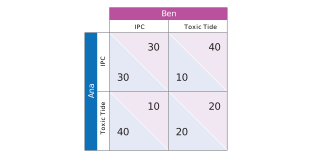
The pest-control game
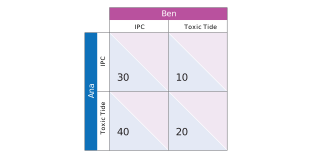
Focusing on Ana’s payoffs
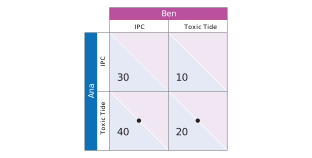
Toxic Tide is Ana’s dominant strategy
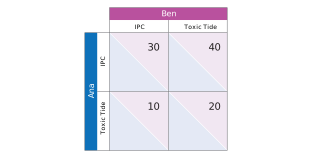
Focusing on Ben’s payoffs
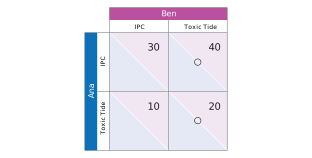
Toxic Tide is Ben’s dominant strategy
The dominant-strategy and best-response equilibrium: (Toxic Tide, Toxic Tide)
You can likewise check that Toxic Tide is a dominant strategy for Ben. Therefore, we predict that both Ana and Ben will use Toxic Tide. Both players using Toxic Tide is the dominant-strategy equilibrium of the game, denoted (Toxic Tide, Toxic Tide).
- prisoners’ dilemma
- A prisoners’ dilemma is a game that has a dominant strategy equilibrium and an alternative outcome that gives a higher payoff to all players. So the dominant strategy equilibrium (and the best-response equilibrium) is not efficient.
- free-riders
- Someone who benefits from the contributions of others to some cooperative project without contributing themselves is said to be free riding, or to be a free rider.
- external effects
- An external effect occurs when a person’s action confers a benefit or imposes a cost on others, and this cost or benefit is not taken into account by the individual taking the action. External effects are also called externalities.
The predicted outcome is not good for either player. Both receive a payoff of 20. They would have been better off if both had played IPC, with payoffs of 30 each. The pest control game, with its undesirable outcome, is a type of game called the prisoners’ dilemma.
Everyday Economics 6.6
Do you free-ride on the actions of others? Do others free-ride on your actions? For example, many of us free-ride on the actions of contributors to Wikipedia: we do not contribute ourselves, but we benefit from the work of others, and we cannot stop others from benefiting from Wikipedia. Have you ever been in a study group where one person did significantly less work than the others but still received the same grade? Or lived with roommates where one person consistently avoided cleaning the bathroom? These are small-scale prisoners’ dilemmas: everyone benefits from a clean shared space or a well-prepared group presentation, but each person individually does better by not contributing and hoping others will. If everyone reasons that way, the group outcome is worse than it needs to be. What strategies have you tried to overcome this kind of free-rider problem? Did they work?
Prisoners’ dilemma games surround us in the social dilemmas we introduced at the start of this chapter, from the drying up of the Great Salt Lake to global climate change, which we confront in detail in Chapter 7. You likely participate in smaller-scale social dilemmas, too. For example, if you live with roommates or family, you know how difficult it can be to keep a kitchen or bathroom clean. When one person cleans, everyone benefits, but it is hard work: whoever cleans up bears this cost. The others are sometimes called free-riders.
Economic interactions among self-interested players can yield desirable outcomes (as in the soy–corn game) or undesirable outcomes (as in prisoners’ dilemmas, such as the pest control game). Prisoners’ dilemma games model situations in which players reach undesirable outcomes because they do not take into account the costs and benefits of their actions for others. That is, they do not account for the external effects of their decisions. If Ana chooses IPC, Ben will choose Toxic Tide because it is better for him. He ignores the external costs that his decision imposes on Ana, ignoring the fact that he is free-riding on Ana’s efforts.
Dominant-strategy equilibrium vs. best-response equilibrium
These two ideas are related but not the same. A player has a dominant strategy when a single action is their best response to every strategy the other player might choose, so they do not even need to predict what the other player will do. In a best-response equilibrium (also called a Nash equilibrium), each player is simply choosing a best response to what the other player actually does; their best action might have been different had the other player chosen differently.
Every dominant-strategy equilibrium is also a best-response equilibrium, but not every best-response equilibrium involves dominant strategies. In the pest control game, Toxic Tide is a dominant strategy for both players, so (Toxic Tide, Toxic Tide) is both a dominant-strategy equilibrium and a best-response equilibrium, which is why we can be especially confident the players will reach it. We explore games that have a best-response equilibrium but no dominant strategy in Chapter 7.
- external cost, negative externality, external diseconomy
- A negative external effect: that is, a negative effect of an economic decision on other people, that is not taken into account by the decision-maker. It may be described as an external cost, or a negative externality, or an external diseconomy. See also: external effects.
- external benefit, positive externality, external economy
- A positive external effect: that is, a positive effect of an economic decision on other people, that is not taken into account by the decision-maker. It may be described as an external benefit, a positive externality, or an external economy. See also: external effects.
In prisoners’ dilemma games like the pest control game, Ben’s choice to use Toxic Tide imposed an external cost on Ana. External costs are often contrasted with external benefits. Ana could not force Ben to pay for the external cost he imposes on her by his choice to use Toxic Tide. Similarly, Ana imposes an external cost on Ben by using Toxic Tide. At the dominant-strategy equilibrium, both players impose external costs on each other that could be avoided by adopting IPC instead. In the next section, we explore why it’s hard for them to achieve this alternative mutually beneficial outcome.
Extension 6.4 The prisoners’ dilemma
The name of this game comes from a story about two prisoners, Thelma and Louise, whose strategies are either to Accuse (implicate) the other person in a crime that the prisoners may have committed together, or Deny that the other prisoner was involved. Thelma and Louise are interviewed separately and cannot communicate, so they play a simultaneous game.
If both Thelma and Louise Deny, they will receive a 1-year sentence for a less serious crime.
If one person Accuses the other person, while the other Denies, the accuser will be freed immediately (a sentence of 0 years), and the other person gets a long jail sentence (10 years). If both Thelma and Louise choose Accuse (meaning that each implicates the other), they both get a jail sentence. This sentence is reduced from 10 years to 5 years because of their cooperation with the police. Figure E6.4 shows the payoffs of the game.
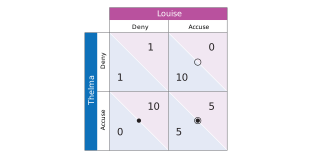
Figure E6.4 Prisoners’ dilemma (payoffs are years in prison), each player’s best responses shown by dots (Thelma) and circles (Louise), and the best-response equilibrium (and dominant-strategy equilibrium) at (Accuse, Accuse) shown by a dot and a circle coinciding in that cell.
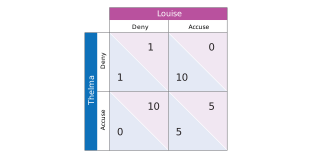
The players, their strategies, and the payoffs they receive
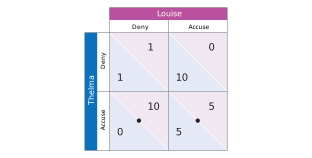
Thelma’s best responses (dots) to Louise
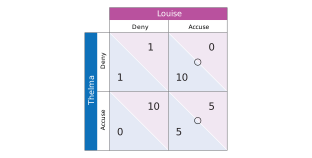
Louise’s best responses (circles) to Thelma
Both players’ best responses and the best-response equilibrium
The payoffs are the years in prison, so Thelma and Louise prefer lower numbers.
In a prisoners’ dilemma, the dominant-strategy equilibrium outcome (in this example, both Accuse) is worse for both than the opposite outcome (both Deny).
Our story about Thelma and Louise is hypothetical, but the prisoners’ dilemma applies to many real-world problems. In economic examples, the mutually beneficial strategy (Deny) is generally called Cooperate, while the dominant strategy (Accuse) is called Defect. Note that “Cooperate” is simply a name for the beneficial strategy; it does not mean that the players have reached an agreement on how to play. Even if players can discuss their strategies beforehand, the rules of the game require them to make independent decisions.
Exercise 6.4 Dominant strategies and the prisoners’ dilemma
Refer to the game between Arkady and Barbara in Exercise 6.3.
- Does either Arkady or Barbara have a dominant strategy? Explain, using appropriate comparisons of payoffs in the payoff table.
- Is there a dominant strategy equilibrium in the game? If yes, what is it? Explain.
- Is the game between Arkady and Barbara a prisoners’ dilemma game? Why or why not?
Question 6.4
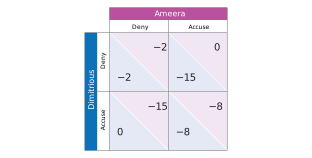
Question Figure 6.4
Dimitrios and Ameera are being questioned by the police on their suspected involvement in a series of illegal trades. The figure above shows the payoffs as the cost of each strategy (in terms of the years of jail sentences they will receive), depending on whether they accuse the other or deny their own involvement. The negative numbers signify losses, so a person who goes to jail for 8 years gets a payoff of −8 because they experience a loss of 8 years of life.
The first number in each cell is the payoff to Dimitrios, while the second number is the payoff to Ameera. Assume that this is a simultaneous one-shot game. Based on this information, we can conclude that _____. (Select all that apply.)
- Ameera’s dominant strategy is Accuse, not Deny. If Dimitrios denies, Ameera gets −2 (Deny) versus 0 (Accuse); if Dimitrios accuses, Ameera gets −15 (Deny) versus −8 (Accuse). Accuse is better regardless of Dimitrios’s choice.
- Dimitrios’s dominant strategy is Accuse. If Ameera denies, Dimitrios gets −2 (Deny) versus 0 (Accuse); if Ameera accuses, Dimitrios gets −15 (Deny) versus −8 (Accuse). Accuse yields the higher payoff regardless of Ameera’s choice, so it is dominant.
- Because both players have the dominant strategy Accuse, the game does have a dominant-strategy equilibrium: (Accuse, Accuse), with payoffs (−8,−8).
- Both players’ dominant strategy is Accuse, so the predicted outcome is (Accuse, Accuse), where Dimitrios receives −8: that is, 8 years in prison. This is the prisoners’ dilemma outcome: both are worse off than if both had denied (−2 each).
Question 6.5
Which of the following is an example of an external effect? Select all that apply.
- Giving a friend a slice of pizza is a direct, voluntary transfer between two people who are both party to the exchange. An external effect falls on someone who is not part of the decision; here there is no uncompensated third party.
- Letting your house deteriorate lowers your neighbors’ property values. They are not part of your maintenance decision and are not compensated, so this is an external effect (an external cost)—the kind of spillover the chapter describes in the pest control game.
- Colliding with a pedestrian is a direct, immediate physical consequence of the action on a specific person, rather than a side effect that spills over onto a bystander not involved in the activity.
- Loud music wakes a neighbor who is not involved in your choice to play it and is not compensated for the disturbance. This uncompensated spillover onto a third party is an external effect (an external cost), like noise pollution.

