10.4 How do people find jobs in a modern economy?
- network
- A network is a structure composed of interconnected people (or objects) and the connections among them.
As we saw in Figure 10.1, people looking for work often learn about vacant positions by asking their friends and family if they know of any available work.
Employers often instruct workers to use their social network—a specific kind of network composed of family, friends, and other social and professional acquaintances—to help them fill a job opening. In this section, we discuss why firms and workers often use social networks to make matches. We also explain how social networks in the labor market can perpetuate inequalities in wages and employment. In Data Extension 10.4, we examine how economists can use social networking sites to understand how such connections operate in practice.
The benefits of hiring and searching within social networks
Imagine you’re a manager at a firm, and you are tasked with hiring someone for an open position. You place an ad for the job on an employment website and are flooded with hundreds of applications. You’ve just made a lot of work for yourself: It will take a lot of time to sort the applications, select people to interview, conduct the interviews, and make a final decision.
Everyday Economics 10.14
Have you ever worked alongside a friend or family member? If so, how do you think your productivity was affected?
But you can use a shortcut: Ask people you know and people in the firm if they know any of the applicants and/or know anyone who might be interested in and qualified for the job. Firms can benefit from hiring through social networks, which reduces uncertainty about the worker’s quality and makes the hiring process more efficient. It also increases the likelihood that the new hire will fit the firm’s culture. People also work better and stay at a job longer when they work with people they know.

Many workers, even those who are currently employed, attend networking events, which are designed to help people make new social and professional connections.
Workers looking for a job also benefit from using their social networks. They use their connections to learn about job openings and to increase their chances of getting hired. If you’re looking for work, you may ask friends, family members, or professional acquaintances to let you know if they hear of any job openings, either at their firm or elsewhere. Because they know you, they may feel comfortable passing on information or recommending you for positions you might be interested in.
- principle of individual and societal interests
- Individuals doing the best they can often does not lead to the best outcomes for all people or for the environment.
In this way, workers and firms do the best they can by drawing on social networks. Doing so reduces costs for firms and workers alike, and promotes better matches. But, illustrating the individual and societal interests principle, the connection between social networks and jobs can also perpetuate inequality.
Social networks and inequality
Everyday Economics 10.15
This post at the National Bureau of Economic Research summarizes a 2014 paper that finds similar patterns in marriage markets: In recent decades, people have been increasingly likely to marry those who are similar to themselves in terms of education and income, thereby contributing to rising inequality between households. Think of some married couples you know. Do they have similar educational and economic backgrounds? What role might neighborhoods populated by people of similar income, race, and education play in this trend?
So long as hiring processes are primarily driven by the decisions of people and not by impersonal rules or processes, workers and employers will benefit from using their social networks. However, in the United States, members of some groups have, on average, social networks that are more useful in the labor market than others due to three facts:
- group or categorical inequality
- Inequality between particular social groups (identified, for instance, by a category such as race, nation, caste, gender, or religion). Also known as group inequality.
- People’s social networks tend to be shaped by where they live, where they go to school, and where they work.
- Neighborhoods tend to be populated by people of similar income, race, and education, which reflects an aspect of categorical inequality that we studied in Sections 5.2 and 5.3.
- Employers and managers are disproportionately white, well-educated, male, and from middle- or upper-income families.
Vicious and virtuous circles of labor market outcomes lead to inequality
The combination of these three facts creates feedback cycles that tend to keep people and their children in similar social networks and economic positions. Figure 10.8 models two such feedback cycles: a vicious circle and a virtuous circle. The left side of Figure 10.8 models how people who grow up in lower-income neighborhoods can get trapped in a vicious circle. Because people in lower-income neighborhoods are less likely to have good, stable, high-wage jobs, and because their social networks are primarily populated with others in their neighborhood or similar neighborhoods, they have a harder time securing good jobs and wages. Their children are more likely to be born into this situation, and the cycle goes on. For people born into higher-income neighborhoods, the same process provides advantages via a virtuous circle (right side of Figure 10.8).
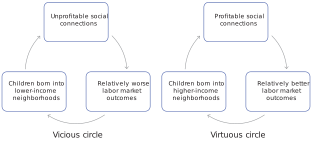
Figure 10.8 Vicious and virtuous circle of segregation and social connections.

Few social connections to people with good jobs
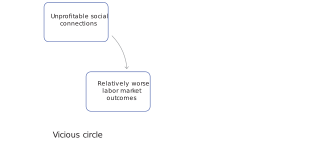
Fewer social connections to people with good jobs leads to relatively worse labor market outcomes
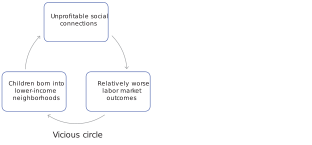
The vicious circle
The virtuous circle
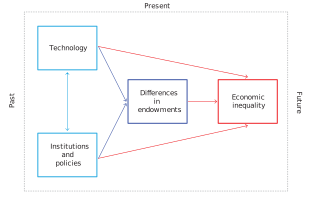
Figure 5.9 This figure illustrates how institutions, policies, and technology affect our endowments, including how our social networks are formed. These in turn affect economic inequality.
Workers who use social networks in the labor market can unwittingly perpetuate inequality. Given that our neighborhoods and social networks tend to be filled with people similar to us, and that business owners and managers are disproportionately from certain groups, members of those groups will have a substantial advantage in the labor market. In this case, people doing the best they can perpetuates group inequality, illustrating the principle of individual and societal interests. Importantly, workers using their social networks in the labor market are not intentionally trying to perpetuate group inequality, which is an unintended outcome of them doing the best they can given the situation.
Much of the groundbreaking work done by Chetty and his colleagues is based on large data sets, which can be found at the website Opportunity Insights, which we encourage you to play around with.
- intergenerational inequality
- The extent to which differences in parental generations are passed on to the next generation, as measured by the intergenerational elasticity or the intergenerational correlation. See also intergenerational mobility, intergenerational elasticity.
- endowment
- A person’s endowments are the things they have that enable them to receive income. They include physical wealth (for example: land, housing, machinery); financial wealth (for example: savings, stocks/shares, bonds); intellectual property (for example: patents, copyrights); knowledge, skills, abilities, and experience that affect labor income; citizenship and rights to work. They can include characteristics such as nationality, gender, race, and social class, if these affect their income.
When combined with spatial and social segregation, social connections can contribute to intergenerational inequality because social connections are part of our endowment. The vicious and virtuous circles in Figure 10.8 illustrate how this part of our endowment can differ between people and across groups. As we saw in Figure 5.9, differing endowments play a critical role in the persistence of inequality. Social connections can therefore help to explain the racial inequalities we observe in employment and wages, which contribute to higher intergenerational inequality. The economist Raj Chetty and his colleagues have shown that where you grow up matters a lot for your economic outcomes as an adult. Those who grow up in good neighborhoods have, on average, higher college attendance rates, higher income, and lower rates of teen pregnancy. They classify good neighborhoods as those with lower segregation (by race and/or income), lower levels of inequality, better-quality public schools, and low crime rates.
In summary: Regardless of a worker’s personal qualities or preferences, the situation they are born into can have substantial effects on their ability to learn about and get hired for a good, well-paid job. Your family and the neighborhoods in which you grow up shape your social network, which affects your outcome in the labor market.
Data Extension 10.4 Which nodes in our network are most important for finding a job?

Imagine our social networks mapped out like other networks, with nodes and lines. Our strong ties are those directly connected to us. Our weak ties are those that are a few nodes away.
For a long time, people thought strong ties were more important than weak ties in helping people find new jobs. This conventional wisdom was upended by the work of the sociologist Mark Granovetter, who suggested that weak ties are more important than strong ties because weak ties connect us to people and firms we don’t normally interact with much.1 They also connect us to certain information—such as job openings—that we can’t get from close friends and family. Weak ties act as a bridge between different groups of people, giving workers access to a wider set of information and opportunities.
Everyday Economics 10.16
Why is it hard for social scientists to test the idea of weak ties versus strong ties using an experiment? How would such an experiment need to be designed? How do people typically make new social connections? Can this process be easily replicated in an experiment?
Although there has been some research on this topic, it’s not been possible to experimentally test the role of weak ties in the labor market. However, the rise of social media networks gave social scientists an opportunity to test the theory in new ways. In 2022, a team of social scientists tested Granovetter’s theory by running an experiment on LinkedIn, the largest business and employment-focused social media site in the world.2
Like many social media sites, LinkedIn has an algorithm that recommends new connections to its users. The researchers altered the algorithm to randomly vary whether users were recommended more strong ties or more weak ties. Using LinkedIn’s data, they followed the behavior of the users to trace the effects of these changes on employment and job search behavior. Twenty million people took part in the experiment without knowing, with 2 billion new connections made because of the changes to the algorithm.
The researchers looked at the average effect on the number of job applications a LinkedIn user submits through the website due to making a new connection and compared the new connections by strong and weak ties. For each new weak tie, a user submitted about 0.15 new applications. If you participated in the study, then for each set of ten new weak-tie connections you made, you submitted on average 1.5 new job applications. In contrast, a new strong tie connection had either zero or a slightly negative effect on the number of job applications you submitted.
Granovetter was also aware that using social networks in hiring and job search can perpetuate inequalities. In this video, he talks about what led him to focus on the importance of weak ties in the labor market, which can perpetuate inequalities.
Given the huge number of people who participated in the experiment, this is powerful evidence in favor of Granovetter’s theory that weak ties are more important in the labor market than strong ties.
Exercise E10.2 Strong vs. weak connections
If you’ve ever used social connections to get a job, were they weak ties or strong ties? Ask other people you know the same question. What were their responses?
Question 10.6
Which of the following is a reason why hiring through social networks is advantageous to employers? Choose all that apply.
- Hiring through social networks often narrows the pool rather than increases it, because referrals usually come from a more limited circle.
- Social networks help employers find candidates who are more likely to fit into the firm’s culture.
- In many cases, relying on existing networks reduces diversity, because employees’ networks tend to be demographically similar to themselves.
- Recommendations and referrals reduce uncertainty about a candidate’s quality, because employers can get more trusted information about applicants.
Exercise 10.6 Who you know: Networking and job opportunities
- Looking at your own employment history, how important would you say social connections have been? If you have a limited employment history, ask someone you know with more experience.
- Relying on social networks can reinforce inequality in the labor market. What are some policies that firms or governments can implement to reduce inequalities in hiring?
Exercise 10.7 Exploring economic connectedness and opportunity
Go to the Social Capital Atlas, created by a team of economists led by Raj Chetty. Click the “Explore the Data” button. At the top of the page, you will see four possible options for “view”: County, ZIP code, High School, and College. Click on the ZIP code option. If you scroll over the map, it will show a measure of “economic connectedness” for that ZIP code, which is the percentage of the friends of a person with low income who have high incomes.
- Looking at the overall map of the United States, does it look like the country’s social networks are segregated by income?
- Choose a ZIP code associated with your childhood. (If there is no data for the ZIP code, use County.) What is the economic connectedness for that ZIP code? Is the number consistent with your experience of that area? Why or why not?
- In their summary of the research that led to the creation of this map, the authors note that “places with greater economic connectedness have much higher levels of upward income mobility.” Is that conclusion consistent with our model in Figure 10.8? Why or why not?
- Considering this data and the fact of ongoing racial segregation in neighborhoods, would eliminating all racial bias ensure that everyone has equal opportunity in the labor market? Why or why not?
-
Granovetter, Mark S. “The Strength of Weak Ties.” American Journal of Sociology 78, no. 6 (1973): 1360–1380; Granovetter, Mark. 2018. Getting a Job: A Study of Contacts and Careers. University of Chicago Press. ↩
-
Rajkumar, Karthik, Guillaume Saint-Jacques, Iavor Bojinov, Erik Brynjolfsson, and Sinan Aral. “A Causal Test of the Strength of Weak Ties.” Science 377, no. 6612 (2022): 1304–1310. ↩

