3.5 Varieties of capitalism: Institutions, government, and politics
Some countries took a long time to start growing even after capitalism became common.
The institutions of capitalism combine with one another, with governments, and with other institutions in different ways across countries. Understanding these differences can help us understand why not every capitalist country has the same economic success story as Britain, the United States, Japan, or other countries that achieved significant growth (Figure 3.1).
When is a capitalist economic system dynamic?
The existence of capitalist institutions is not enough, in itself, to create a dynamic economy—that is, an economy in which firms continuously innovate, new entrants compete, and inefficient firms exit, producing sustained growth in living standards. Economic and political conditions influence how dynamic a capitalist economic system is. The potential advantages of the institutions of capitalism will be realized if:1 2
- rule of law
- There is rule of law when all people and institutions in a country are subject to the same laws: “All are equal in the eyes of the law.”
- Private property is secure. Private property is secure when law enforcement agencies and courts are able to enforce contracts and maintain the rule of law. Law enforcement agencies prevent the government from taking property arbitrarily and deter the theft of property.
- Markets for firms’ output are competitive. Firms have incentives to produce efficiently, to expand, and to innovate when markets are competitive.
- Firms’ survival depends on their economic performance, not on connections to government or privileged birth. People become owners or managers because they are good at delivering high-quality goods and services at a competitive price.
Failures in one or more of the three institutions of capitalism can mean that individuals and groups gain more from influencing the government and/or from criminal activity than they can from the direct creation of economic value.3
A leak of confidential documents from the ride-hailing company, Uber, shows how its expansion into cities across the world was fueled not only by rapid technical and operational innovation, but also by aggressive (and sometimes illegal) competition, and by constant political lobbying.
Capitalism is dynamic when the discipline imposed by market competition—produce and sell good products profitably or fail—is ever-present. Competition is a mechanism for weeding out underperforming firms and individuals. To survive, firms in a capitalist system may have incentives to reduce the competition they face. Also, if the owners and managers of firms in a capitalist economy are initially wealthy or well connected politically, their firms may survive despite their failures. But there are no guarantees: staying ahead of the competition means constantly innovating.
Everyday Economics 3.4
Identify one rule or regulation in your country that limits what firms can do—for example, a minimum wage, emission standard, or product safety law. Who benefits from this rule? Who wants to weaken or eliminate it, and why? How does this connect to the idea from Chapter 2 that the rules of the game are themselves objects of conflict?
These conditions emphasize the essential role of government in a capitalist economic system. The government is an economic actor, like firms and families. Its taxes, spending, laws, wars, and other activities are as much a part of economic life as the investment, production, buying, and selling activities of families and firms. Also like firms and families, governments enable people to do things together that they could not do individually. A fundamental role of the government is to enable us to interact under a set of laws—a legal framework—that regulate what we do.
- power
- The ability to do and get the things we want in opposition to the intentions of others.
Governments establish, enforce, and change the laws and regulations that influence how the economy works, regardless of the extent to which governments are directly involved in the economy. They adjudicate disputes over ownership and enforce property rights. They establish the regulations that prevent firms from undermining market competition by cooperating in an unlawful way—for example, by colluding—or by engaging in unfair competitive practices. A government with the power to make and enforce a legal framework is essential for the dynamism of a capitalist economic system.
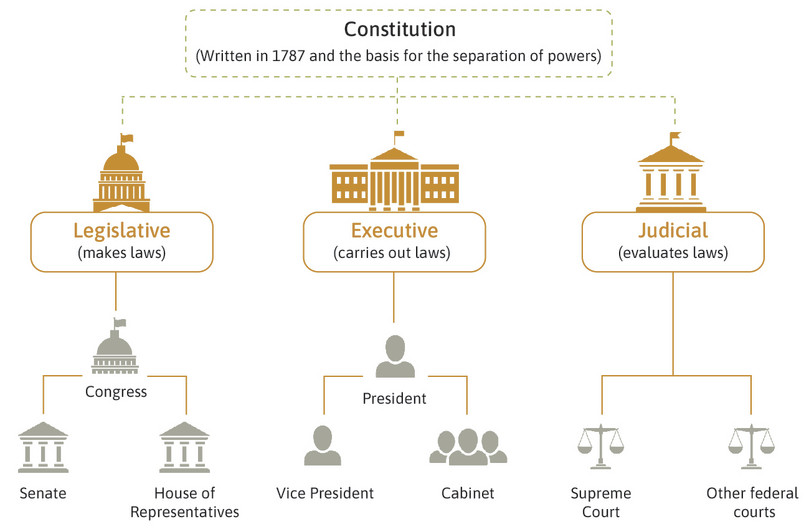
The three branches of the United States government. In the United States, the executive branch of the government ensures the effective enforcement of laws through law enforcement agencies, while the judicial branch adjudicates disputes through the administration of justice in the courts. The third branch, the legislative—composed of the House and Senate, known collectively as the Congress—formulates the laws and policies that regulate economic activity.
Political systems
- political system
- A political system determines how governments will be selected and how those governments will make and implement decisions that affect all or most members of a population.
- democracy
- A political system that ideally gives equal political power to all citizens; it is defined by individual rights such as freedom of speech, assembly, and the press, and by fair elections in which virtually all adults are eligible to vote and the government leaves office if it loses.
- autocracy
- A political system in which one person, typically together with a small inner circle of elites, makes governmental decisions with few or no limitations. A dictatorship is a form of autocracy.
Capitalism can coexist with different political systems. A political system, such as democracy or autocracy, determines how governments are selected and how those governments make and implement decisions that affect the population. In many countries today, capitalism and democracy coexist, with each system influencing the other. Capitalism emerged before democracy in Britain, the Netherlands, the United States, and most of today’s high-income countries. In no country were most adults eligible to vote before the end of the nineteenth century (New Zealand was the first, in 1893). Even in the recent past, capitalism coexisted with undemocratic rule, as in Chile from 1973 to 1990, Brazil from 1964 to 1985, and Japan until 1945. Contemporary China’s economic system incorporates elements of capitalism with strategic state intervention, but its system of government is not a democracy by our definition.
China is now at the forefront of technology for electric cars and solar panels. Thomas Friedman—a columnist and author—explains in this New York Times podcast (especially minutes 10:30 to 12:45) how the Chinese government has played an important role in creating conditions of intense competition among new firms, with the goal of incentivizing the development of new technologies.
Like capitalism, democracy comes in many forms. The head of state may be elected directly by the voters or appointed by an elected body, such as a parliament. Some democracies strictly limit the ways in which individuals can influence elections or public policy through financial contributions; in others, individuals can influence elections and policy to a large extent through contributions to electoral campaigns, lobbying, and even bribery.
The differences among democracies partly explain governments’ differing roles in a capitalist economy. For example, the Japanese and South Korean governments play a central role in setting the direction of the economy’s industrial sector. On the other hand, the amount of tax collected (both locally and nationally) in these countries is low compared with the taxes collected in some rich countries in northern Europe, where tax revenue is equal to almost half of GDP. For example, in Sweden and Denmark the tax system is used to reduce income inequality more than in Japan and South Korea.
Question 3.6
Which of the following reasons explain why firms can grow and decline rapidly in capitalist economies? Choose all that apply.
- Firms can expand rapidly by hiring labor and acquiring capital goods. (See section 3.3.)
- Firms often need external financing (such as, loans, investment, and government subsidies) to grow.
- Firms don’t die simply because new competitors enter; they die if they fail to stay competitive and make profits by innovating or adopting new technologies.
- Firms in a capitalist economic system are not necessarily supported by the government; growth depends on market success.
Question 3.7
Which of the following statements describe the government’s essential roles in ensuring the proper functioning of capitalist economies? Choose all that apply.
- Government protection of property rights and enforcement of contracts are key to the functioning of capitalist institutions. Markets require the security of private property: Buyers will not want to pay for goods unless they can have the right to own them. Firms will not innovate if they cannot sell the goods they produce.
- In a dynamic capitalist economic system, firms fail if they underperform. If governments were to guarantee profitability, owners and managers would not have incentives to deliver high-quality goods and services at a competitive price.
- Capitalist institutions provide incentives for innovation and technology adoption when firms are managed based on merit and market success, not through political connections or privilege.
- Regulation ensures fair competition among firms in the market and protects consumers.
Question 3.8
Which of the following statements about the relationship between capitalism and democracy are correct? Choose all that apply.
- Capitalist economic systems exist under both democratic and autocratic regimes (China, Chile from 1973 to 1990, Japan until 1945).
- Capitalist institutions developed in Britain and the United States before democracy was widespread.
- Both autocracies and democracies can have high levels of inequality if governments don’t implement policies to redistribute income. Sweden and Japan are both democratic systems, but Sweden uses the tax system to redistribute income to a greater extent than Japan does.
- Different democracies can produce different varieties of capitalism depending on institutional features such as firms’ influence on government policy (for example, through lobbying or bribery) and the role of the government in the economy (for example, taxation in European countries or industrial planning in South Korea).
- Capitalist institutions have developed in autocratic regimes (for example, China, Chile from 1973 to 1990, Japan until 1945).
Exercise 3.8 Competition and government regulation
- Why is competition important for capitalist economies?
- What can governments do to ensure that markets for firms’ outputs are competitive?
- Provide an example of a real-world policy or regulation that aims to promote competition.
Data Extension 3.5 Divergence in GDP per capita: Economic and political systems
Figure E3.2 tracks the GDP of selected countries during the twentieth century. We can see that in 1928, GDP per capita in the Soviet Union was a third of that in Argentina, but higher than GDP in Brazil and South Korea. At that time, the Soviet Union had a communist centrally planned economic system. Communist central planning produced steady but unspectacular growth for nearly 50 years, with Soviet GDP outstripping Brazil’s GDP by a wide margin and even overtaking Argentina before Communist Party rule ended in 1990.
One reason central planning was abandoned was its failure—as illustrated by the case of East Germany in Data Extension 3.4—to deliver the improvements in living standards achieved by some capitalist economies. The transition to a new economic system in the former Soviet Union following the collapse of communism proved very costly. Dismantling the planned economy and creating functioning market-economy institutions (including the rule of law) in the successor economies was accompanied by a deeper and more prolonged decline in per capita output than observed during the Second World War, the global financial crisis of 2007–2009, or the COVID-19 pandemic.
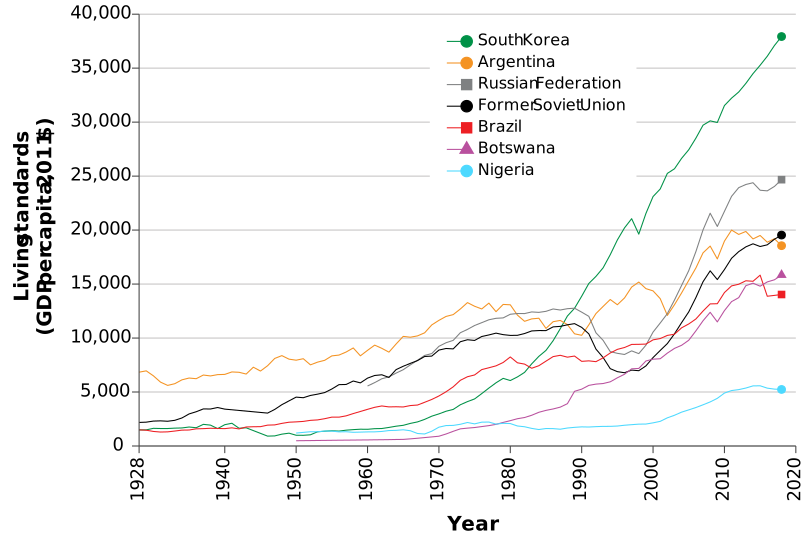
Figure E3.2
Divergence of GDP per capita among latecomers to the capitalist revolution (1928–2018).
Note: Former Soviet Union series excludes Russian Federation post 1992.
Jutta Bolt and Jan Juiten van Zanden. 2013. “The First Update of the Maddison Project Re-Estimating Growth Before 1820”. Maddison Project Working Paper WP-4 (January).
You can explore the data for other countries yourself, by following the link to Our World in Data (OWiD).
The star performer in Figure E3.2 is South Korea. In 1950, its GDP per capita was the same as Nigeria’s, but by 2013 South Korea was six times richer than Nigeria by this measure.
- developmental state
- A government that takes a leading role in promoting the process of economic development through its public investments, subsidies of particular industries, education, and other public policies.
South Korea’s economic take-off occurred under institutions and policies sharply different from those prevailing during the take-off in Britain. The most important difference is that the Korean government (along with a few large corporations) played a larger role in directing the process of development than the British government did during Britain’s take-off. In South Korea, the government explicitly promoted some industries, required firms to compete in foreign markets, and provided high-quality education for its workforce. The term developmental state refers to governments that play a leading role in economic take-off, such as those of South Korea, Japan, and China. 4
In Africa, the success of Botswana in achieving sustained growth contrasts sharply with Nigeria’s relative failure to do so. Both are rich in natural resources (diamonds in Botswana, oil in Nigeria), but differences in the quality of their institutions—the extent of corruption and misdirection of government funds, for example—may help explain their contrasting trajectories.
Exercise E3.3 Institutions and growth: South Korea vs Nigeria
- Referring to Figure E3.2, describe how South Korea and Nigeria’s GDP per capita evolved over time.
- Research and briefly describe two specific policies or strategies adopted by the South Korean government that helped promote economic growth.
- Research and describe one key policy failure or institutional weakness in Nigeria that may have contributed to its weaker economic performance.
- Based on your findings, explain how government policy and institutions can shape outcomes in capitalist economies.
-
János Kornai. 2013. Dynamism, Rivalry, and the Surplus Economy: Two Essays on the Nature of Capitalism. Oxford University Press. ↩
-
Dolores Augustine. 2013. “Innovation and Ideology: Werner Hartmann and the Failure of the East German Electronics Industry.” In The East German Economy, 1945–2010: Falling Behind or Catching Up? Cambridge University Press. ↩
-
Daron Acemoglu and James A. Robinson. 2012. Why Nations Fail: The Origins of Power, Prosperity, and Poverty. Crown. ↩
-
The World Bank. 1993. The East Asian miracle: Economic growth and public policy. New York, NY: Oxford University Press. ↩

