6.2 Coordinating economic interactions
Devising policies to promote people’s well-being requires knowing the difference between situations in which self-interest can promote general well-being (like buying a shirt) and cases in which it leads to undesirable results (like the drying up of the Great Salt Lake).
To analyze and compare these different types of problems, we return to game theory, as introduced in Chapter 1 and Chapter 2.
Social and strategic interactions
Imagine two farmers, Ana and Ben, who face a problem: should they grow soy or corn? We assume they can grow both crops, but they can grow only one at a time. For simplicity, we assume that Ana and Ben are the only farmers in their local economy.
- interdependence principle, principle of interdependence
- The outcomes people obtain in economic interactions depend on the actions that they and others take in response to each other and on what they believe about the future.
- strategy
- An action (or action plan) that a person may choose, while being aware that the outcomes for themselves and others depend on their own strategy and the strategies chosen by others.
- payoff table, game table
- A table whose rows and columns list the actions (or strategies) available to the players; each cell gives the payoffs each player receives for that combination of actions.
- simultaneous game
- A game in which the players choose their strategies simultaneously: for example, the prisoners’ dilemma. See also: sequential game.
Ana’s land is equally suitable for growing soybeans and corn. Ben’s land is good for producing soy but less suitable for corn. They both sell whichever crop they produce in local agricultural markets. On market day, if they bring less soy to the market, the price of soy will be higher. Likewise, the price of corn depends on how much corn they have grown. Ana and Ben’s interaction, therefore, demonstrates the interdependence principle in action: what each person gets depends on what they do and on what other people do.
The farmers choose what to grow independently, which means they do not meet to discuss their strategy or course of action. This assumption may seem odd in an example with just two farmers, but understanding what happens when two players act independently provides insight into the problems that arise when many people interact.
Figure 6.1 illustrates the farmers’ interaction using a game table: a table with rows and columns that depicts the players, their strategies, and how each player’s payoff depends on the strategies chosen. Game tables are different from the game trees you learned previously, but they convey similar information. Game tables summarize each player’s possible actions and payoffs. Generally, we use game trees to depict sequential games and game tables to depict simultaneous games, in which players make their choices at the same time or independently commit to their choices. We call Ana and Ben’s interaction the “corn–soy game.”
Everyday economics 6.2
Gluts occur when a lot of a commodity is produced, and the price decreases. Sometimes the price is so low that it drives the producers, such as farmers, out of business. A shortage occurs when too little of a commodity is produced, and the price increases. Gluts often occur because people make plans about the future based on current information. For example, corn and soy farmers in the US have responded to increases in the prices of those crops—driven by regulations on biofuels and exporters seeking to ship soybeans to other countries—in the hope that the same price will hold next year and they can make more profit. But if everyone plants more of the same crop, the price will go down due to a glut.
Ana’s strategies are the rows of the table, and Ben’s strategies are the columns. We call Ana the row player and Ben the column player. When an interaction is represented in a table like Figure 6.1, each entry describes the outcome of a hypothetical situation. For example, the upper-left cell poses a hypothetical question and summarizes the answer.
- Question: Suppose that Ana (row) plants soy and Ben (column) plants soy. What will the market outcomes be, and what will each person get?
- Answer: Because they both plant the same crop, there is a glut, meaning that a lot of the crop is produced. When farmers grow a lot of one crop, the market price will be low. Because the price is low, they each make low profits. Because neither of them produces corn, there is a shortage of corn (and the price of corn will be high).
There are four possible hypothetical situations, each with specific outcomes. Figure 6.1 summarizes what will happen in each case.
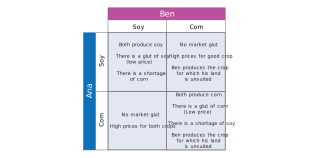
Figure 6.1 Planting soy or corn (the corn–soy game): a social interaction between Ana and Ben when planting soy or corn.
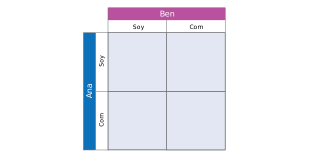
The players and their strategies
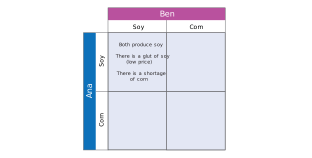
Outcome when both plant soy (Soy, Soy)
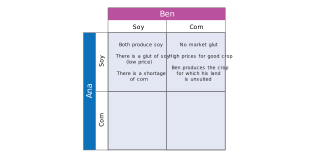
Outcome when Ana plants soy and Ben plants corn, (Soy, Corn)
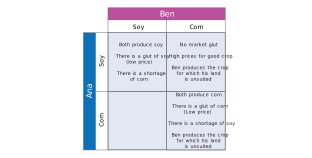
Outcome when both plant corn (Corn, Corn)
Outcome when Ana plants corn and Ben plants soy (Corn, Soy)
To simplify the model and isolate the strategic logic more clearly, we make the following assumptions:
- There are no other people involved or affected in any way.
- The choice of which crop to grow is the only decision that Ana and Ben need to make.
- The players interact just once. (In other words, they play a one-shot game.)
- The game is a simultaneous game. That is, the players make their decisions simultaneously, without knowing what the other player will do.
- The players know exactly what will happen in each possible outcome.
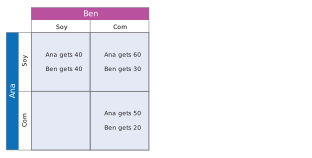
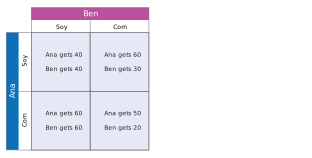
Figure 6.2 shows the payoffs for Ana and Ben in each of the four hypothetical situations—specifically, the income (in thousands of dollars per month) they will receive if the hypothetical row and column actions are taken. Remember that their incomes come from selling the crops they produce, so they depend on market prices, which in turn depend on the total amount of each crop brought to market.
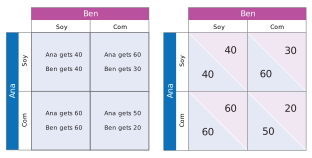
Figure 6.2 (A) and (B) Coordinating economic interactions: the corn–soy game. (A) the payoffs from crop choice and (B) the payoffs to the players in the corn–soy game depicted with each player’s color highlighted and their payoff in the corresponding triangle in each cell. The player’s payoff is their monthly income in thousands of dollars.
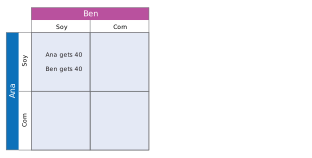
The payoffs for (Soy, Soy)
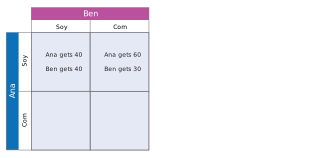
Adding the payoffs for (Soy, Corn)
Adding the payoffs for (Corn, Corn)
Adding the payoffs for (Corn, Soy)
The completed payoff table
Everyday Economics 6.3
Think about choosing a major at your college or university. If many students choose the same major, there may be a “glut” of graduates competing for similar jobs, which drives down salaries in that field. If you expect many of your classmates to choose a business major, it might pay to consider engineering or nursing instead. You are playing a coordination game with thousands of other students you will never meet, mediated by the price signal of wages. What signals do you use when choosing your courses or major? Are those signals like the market prices Ana and Ben respond to? If so, how?
- Because the price falls when the market is flooded with a single crop (a glut), the total payoffs to Ana and Ben are lower when both produce the same crop than when they produce different crops.
- Because Ben’s land is less suitable for corn, the highest payoffs are obtained when Ben specializes in soy and Ana specializes in corn.
Having established the rules of the game—who can do what, when they can do it, and how each player’s actions determine their payoff—we can consider what the players will choose and what the outcome might be.
Exercise 6.2 Python or C++? A game of specialization and strategy
Ana and Ben are coders who each work on contracts independently. Ana is better at Python than C++; Ben is better at C++ than Python. A client offers them a project that may require both Python and C++ programming. They can only choose one language each.
- Draw a game table showing the four possible combinations of language choices (Python or C++) that Ana and Ben could each make. In each cell, write a brief description explaining the expected outcome for each player (you do not need to use specific numbers). Consider how a “glut” in one language (both choosing the same language) will affect each player’s payoff. You do not need to use specific numbers, but if you find it helpful, assign illustrative payoffs to each cell so that the ranking of outcomes reflects two ideas: (i) the project is best when both languages are used, and (ii) each coder is more productive in their stronger language.
- If the client needs only one language—either Python or C++—how will the nature of the interaction between Ana and Ben change? Would this still be a strategic interaction? Explain.
Question 6.1
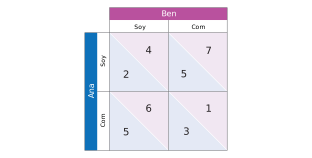
In a simultaneous one-shot game like the one summarized below, players …
- In a simultaneous game, players choose at the same time, so they cannot observe what others do before deciding. The chapter notes players “make their choices at the same time or independently commit to their choices.”
- Because choices are simultaneous, a player cannot wait to see another’s action and then change their own; that describes a sequential game (a game tree like in Chapters 1 and 2), not a simultaneous one.
- The farmers “do not meet to discuss their strategy”; players choose independently and so cannot coordinate beforehand.
- Even without observing others’ actions, a player anticipates the other players’ possible actions and chooses a best response to what they expect. This reflects the interdependence principle: what each person gets depends on what they do and on what others do.
Question 6.2
We use the figure in Question 6.1 to answer this question.
What is the outcome if Ana chooses to grow corn and Ben chooses to grow soy?
- Ana 5, Ben 7 is the cell where Ana grows soy and Ben grows corn—the two crops have been swapped. Re-read the row (Ana) and column (Ben) labels.
- Ana 3, Ben 1 is the cell where both grow corn. Check which crop Ben is growing in this question.
- In the Corn (Ana) / Soy (Ben) cell, Ana’s payoff is 5 and Ben’s is 6. Locating the cell from the row label (Ana = Corn) and column label (Ben = Soy) gives this outcome.
- Ana 2, Ben 4 is the cell where both grow soy. Here Ana grows corn, not soy.

