2.2 Changing the rules: The structures of the economy
To understand how the rules of the game affect how the game is played, we start with an example of the Worker’s outside option improving.
Principle: Rules of the game
The rules of the game affect how the players play the game, the size of the gains from cooperation available to the players, and how the gains are divided among the players.
When their outside options improve, it means that workers have opportunities somewhere else for a job that has a better salary, or the same salary with less pollution, or similar outcomes where they have better options somewhere else. When the Worker’s outside options improve, it means that their opportunity cost of working elsewhere is greater compared to before the improvement. Seeing how the Worker’s outside option improves shows us the importance of the rules of the game principle, which is the focus of this chapter.
When the Worker’s outside options improve, the owners of the firm must offer the Worker a larger share of the gains from cooperation so that working for Bunker is better than the Worker’s outside option.
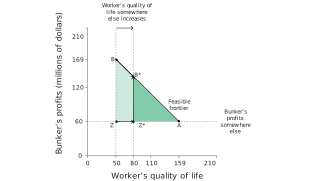
Recall from Figure 1.5 that the feasible outcomes given the two actors’ outside options (leaving town) are indicated by the green triangle of the feasible gains from cooperation, which we show again in Figure 2.2. When Bunker is first mover, we know that the outcome is point B, with the Worker’s quality of life being 51, which is only slightly better than what it would be if the Worker leaves town (50). At point B, Bunker receives 169: a much larger share of the gains from cooperation.
Changing outside options
Everyday Economics 2.2
How will the locations of job opportunities affect you when you graduate and look for a full-time job (if you are not already employed)? Are you willing to move a long distance to take a good job, or do you feel tied to your current location? If so, why?
How could the Worker’s quality of life (and the environment) be improved? One way is to improve the Worker’s outside option, shifting the dashed vertical line in from 50 to the right, say, to 80, as shown in Figure 2.2.
The Worker’s outside option could improve if:
- the government provides free training so that welders and other people working for Bunker could more easily find well-paying jobs with employers elsewhere
- firms in nearby towns emit little pollution and offer better employment opportunities for workers with the same skills as Bunker’s workforce
- the government increased the payment (called unemployment insurance) that it makes to unemployed people who are unemployed, making the period of searching for a new job less costly to the Worker
- a powerful job search engine becomes available on the Worker’s cell phone, making it easier to find a well-paying alternative to working for Bunker
- Bunker, under pressure from a labor union that represents its workers, agrees to certify the skills and job experience of each of its workers, making it easier for Bunker’s workers to find equivalent jobs elsewhere.
Proceed through the steps of Figure 2.2 to see how the feasible gains from cooperation change when the worker’s outside offer improves.
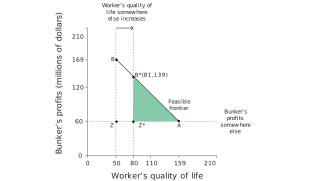
Outcomes of the bargaining game: the situation after an improvement in the Worker’s outside option.
Figure 2.2 Outcomes of the bargaining game: the situation after an improvement in the Worker’s outside option. The figure shows what happens when the Worker’s quality of life somewhere else increases, which shows a change in the Worker’s outside option. Initially, the outside option of the two actors (both leaving town) is given by point Z. Bunker’s profits are 60 and the Worker’s quality of life is 50. The bargain they initially had was given by point B where the Worker got 51 and Bunker got 169. After the improvement in the Worker’s outside option, given by point Z\(^*\), the Worker’s quality of life somewhere else has risen from 50 to 80. Bunker’s outside option has not changed. The change in the Worker’s outside option changes the offer that Bunker will make to the Worker from B to B\(^*\) where the Worker now gets 81 and Bunker gets 139.
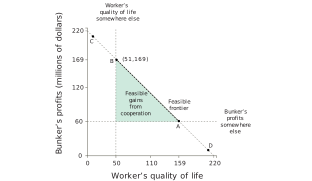
Starting point
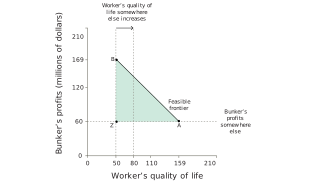
Shift in the Worker’s outside option
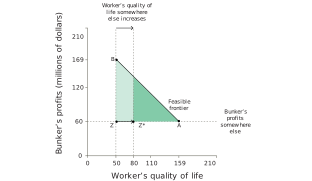
Reducing the potential gains from cooperation
Bunker’s payoff decrease
New outcome
Now that the Worker’s outside option is a quality of life of 80, think about how the game will be played. Bunker, knowing the Worker will do the best they can, will figure out that if it pollutes so much that the Worker’s quality of life in Kellogg will be less than 80, then the Worker (and the other workers) will leave and Bunker will have to close down its operations in Kellogg, reducing profits to 60. So it will limit its emissions, and the outcome of the game will be point B* in the figure, an improvement in the Worker’s quality of life to 81, and a reduction in Bunker’s profits to 139.
- power
- The ability to do and get the things we want in opposition to the intentions of others.
The distribution of the benefits of cooperation is determined by the exercise of power. If the Worker and workers or citizens around the country advocate for the policies in the bullets above and succeed, they have exercised power. They changed the payoff they received by changing the structure of society.
Everyday Economics 2.3
What examples have you seen in your own life of workers or employers exerting power? What about student or community organizers? What kinds of outcomes are these groups trying to achieve and how do they exercise their power?
Here, the workers exerted power by changing the setting in which the game takes place—changing the Worker’s outside options—in ways that improved the payoffs they received at the final bargain with Bunker. Here, the worker’s power concerned the capacity to alter the overall structure of society: the society’s government policies, the presence of other firms that will hire workers and the quality of the jobs those firms offer, and the information that players can acquire.
Exercise 2.2 How can Bunker reduce the Worker’s outside options?
If Bunker is first mover, then it will benefit if it can find a way to exercise power, reducing the outside options of the Worker and their fellow workers. Give examples, similar to the above bulleted points, that will reduce rather than improve the Worker’s outside options. For example, if there were a way that Bunker could coordinate with a firm in the next town over such that both firms pay workers less, then this would lower the Worker’s outside option. [Evidence about this is discussed in law and economics, see, e.g., Posner and Masur (2023).]
Question 2.1
Consider Question 2.1 Figure (I) depicting the payoffs to the Worker (player A) and Bunker (player B) on the same set of axes with a set of points highlighted:
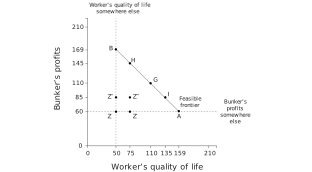
Question 2.1 Figure (I) The Worker’s quality of life and Bunker’s profits with a set of hypothetical points.
The coordinates of each point are:
- Point Z: (50, 60)
- Point Z’: (75, 60)
- Point Z’’: (50, 85)
- Point Z’’’: (75, 85)
- Point A: (159, 61)
- Point B: (51, 169)
- Point G: (110, 110)
- Point H: (75, 145)
- Point I: (135, 85)
Which of the following statements are true?
- If the Worker’s fallback option is 50 and they receive 110 at allocation G, then their rent is 110 − 50 = 60. If Bunker’s fallback option is 85 and they receive 110 at allocation G, then their rent is 110 − 85 = 25. Therefore the statement is true.
- If the Worker’s outside offer is 75, then what does this mean for their choice to stay vs. leave if Bunker offered them 75, too?
- Are you sure Bunker could only get $85 million? What would the Worker have to offer Bunker in order for Bunker not to leave if Bunker’s outside option is $85 million?
- At point B, the Worker gets 51 and Bunker receives 169, for a total of 220. Their fallbacks are 50 and 60 for a total of 110, therefore the total rent available is 220 − 110 = 110. Similarly, at point A, the total rent available is 110 (do the calculation as an exercise). At point A, the Worker receives 51 and their fallback is 50, therefore their rent is 51 − 50 = 1; Bunker receives 169, their fallback is 60, therefore their rent is 109. Similarly, the Worker receives a rent of 109 and Bunker receives a rent of 1 at point B. Therefore the statement is true.
- The size of the outside options has increased, but has anything happened that also shifts the feasible frontier?

