Chapter 2 Changing the rules: Power and fairer bargains
US President Franklin D Roosevelt signs the Social Security Act into law, August 14, 1935.
2.1 Democratic rights and changing the rules of the game
In the previous chapter, we saw how workers and firms interact when they have potential gains from cooperation and a conflict of interest over how those gains are distributed between them.
The story we told of Bunker and the Worker is one that has played out many times in our history: The owners of the firm obtained a larger share of the rents than the workers did because they owned the factory and could hire other workers if they chose to. The Worker didn’t have as many options.
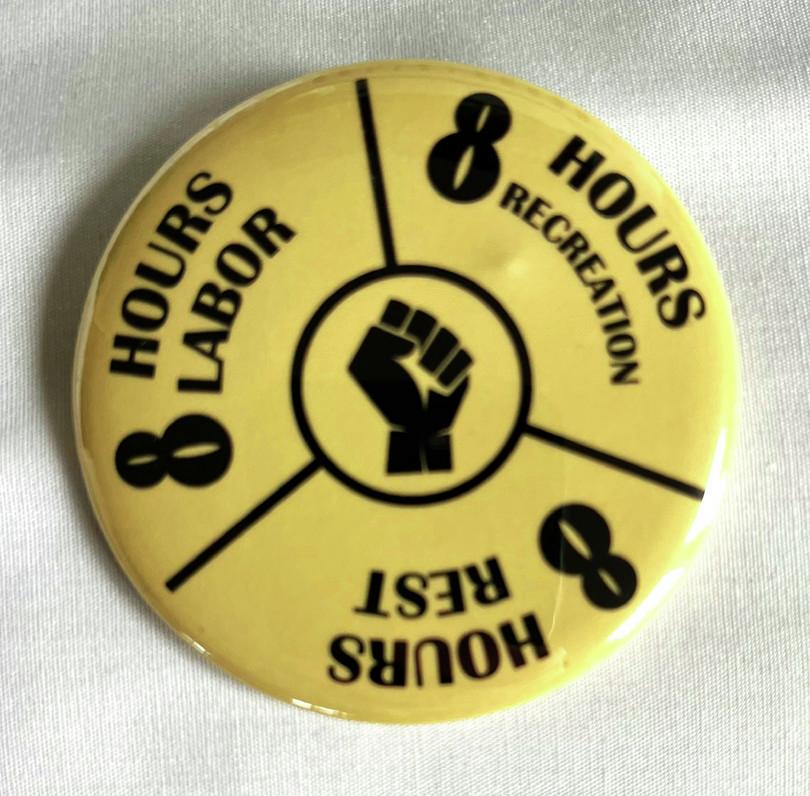
A button for the eight-hour day movement. The button says, “8 hours labor, 8 hours recreation, 8 hours rest.”
- trade or labor union
- An organization consisting predominantly of workers, the main activities of which include the negotiation of wages and conditions of employment for its members, for example, work hours and safety conditions.
In many cases throughout history, though, workers have joined together in collective action to try to get larger shares of the benefits from their work—that is, to try to get the owners of firms to share more of the profits that result from the cooperative production between workers and owners. Workers have done this by coming together and forming trade unions. A trade union or labor union is an organization that can represent the interests of a group of workers in negotiations with employers over issues such as pay, working conditions, and working hours. The resulting contract is between the firm or organization representing employers and the labor union.
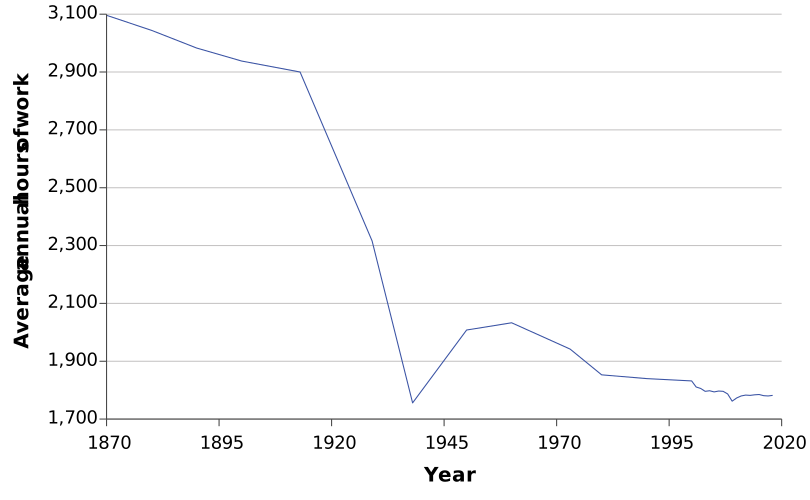
Average annual hours worked in the US over time, 1870 to 2015.
Figure 2.1 Average annual hours worked in the US over time, 1870 to 2015. In 1900, people worked an average 2,930 hours per year, equating to roughly 59 hours per week, whereas in 2015, people worked an average of about 1,800 hours per year, or roughly 37 hours per week.
Work hours, wages, and income: Trade unions and worker collective action are not the only reasons work hours for pay decreased. We explore other factors, such as increasing wages and income, in Chapters 5 and 6.
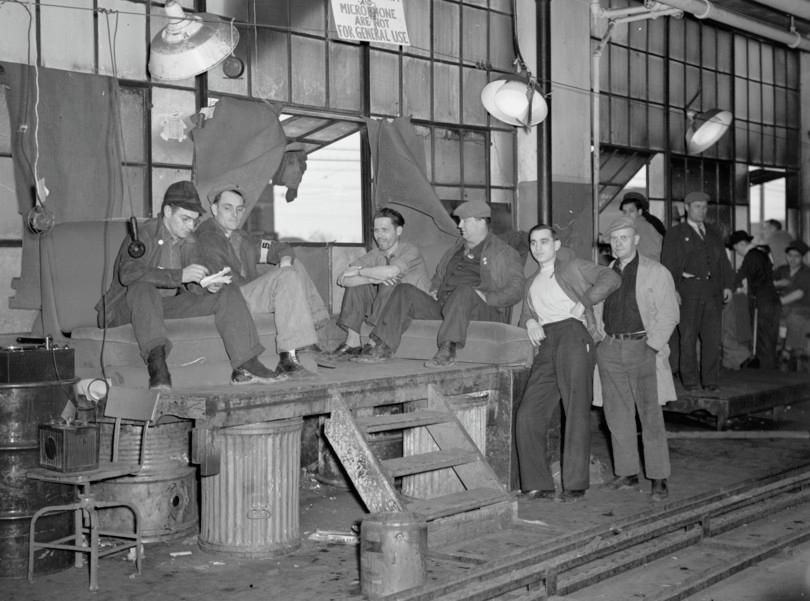
Workers at the first “sit-down” strike at the General Motors Fisher Body plant in Flint, Michigan, January 1937. (The strike began in 1936.) Photographer: Sheldon Dick; Library of Congress.
In the 1800s, workers were concerned about how long the work week was. Historical documents suggest that in 1830, manufacturing laborers worked 70 hours per week on average. Systematic data has been collected since 1890, which we show in Figure 2.1. The figure shows annual average work hours over time. People’s work hours have declined substantially since the 1890s, with major decreases in working hours at the start of the twentieth century. One factor in reducing work hours was the activity and power of trade unions. Unions helped workers to organize and lobby regulators to limit the number of hours that were permitted by law, eventually resulting in the Fair Labor Standards Act (FLSA) of 1938, which implemented a federal minimum wage and overtime pay for working more than 40 hours per week, and prohibited the employment of children. Coordinated organization by workers in the 1936 strike at the General Motors Fisher Body plant in Flint, Michigan and the “Little Steel” strike of 1937 were crucial in the movement toward the adoption of the law.
Everyday Economics 2.1
What is the longest work day that you have had for paid work? How long has your work week been on average? What kinds of rules did your workplace have about overtime pay? What do you think of the idea on the button for the Eight Hour League that your work day should be 8 hours long? Would you prefer it to be longer? Shorter? What about working more or fewer days per week?
The FLSA changed the law in the United States. In our phrasing, the law “changed the rules of the game”, thereby changing the institutions that governed how workers and the owners of firms interacted.
In Chapter 2, we explore the idea of workers coming together and trying to get larger shares of the gains from cooperation by changing the rules of the game. Changing the rules can alter what people achieve by changing people’s outside options, by changing who has more power, and by getting parties to come to the table to negotiate mutually beneficial outcomes.
Exercise 2.1 Changing the rules of the game with new laws
The Fair Labor Standards Act (FLSA) changed the rules of the game for workers in the US. Now consider the following.
- Use resources online to find similar changes in other countries, in local communities, or at other points in US history that result in changes to institutions. Think carefully about the players in the game—who can act and what the payoffs are that they care about—and what the change in institutions does to alter the outcomes in the games.
- We have typically thought about the actions players can take, the payoffs they can receive, and how they respond to others as specific games. Now consider that institutions themselves may be the outcomes over which people are in conflict or on which they are trying to coordinate. Why might people be in conflict over or try to coordinate on different sets of institutions?

