6.3 Best-response equilibrium
Game theory describes social interactions and helps predict outcomes.
- best response
- Given an action by another person, the action selected by doing the best you can is called the best response to the other’s action.
- best response
- A player’s best response is the strategy that will bring about the player’s most-preferred outcome, given the strategies adopted by the other players.
- the principle of doing the best you can
- Doing the best you can means that, from the set of actions available to them, people will choose the action that they believe will result in the outcome that they value the most, taking into account what they believe the other player will do in response to their choice.
For prediction, we need to understand the concept of a best response: the strategy that will lead to a player’s most preferred outcome, given the strategies the other players select. Best responses take us back to the doing the best you can principle.
- payoff table, game table
- A table whose rows and columns list the actions (or strategies) available to the players; each cell gives the payoffs each player receives for that combination of actions.
- best response
- Given an action by another person, the action selected by doing the best you can is called the best response to the other’s action.
- best response
- A player’s best response is the strategy that will bring about the player’s most-preferred outcome, given the strategies adopted by the other players.
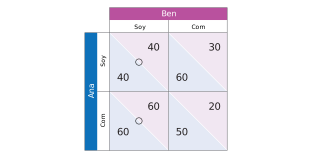
Figure 6.2 (B) represents the payoffs for Ana and Ben in the corn–soy game using a standard format called a payoff table or game table. The first (bottom-left) number in each box is the reward for the row player (whose name begins with A as a reminder that their payoff is first). The second number (in the top right of each cell) is the column player’s payoff. Each payoff depends not only on how much of the crop the player can grow but also on demand: that is, how the market price varies with the amount available. We can refer to a particular cell in the table by referring to the strategy of the row player and the strategy of the column player. For example, (Soy, Corn) is the cell where Ana plays Soy and Ben plays Corn. The outcome when they play those strategies is the payoffs they receive: (60,30).
Think about doing the best you can in this game. Suppose you are Ana, and you consider the hypothetical case in which Ben has chosen to grow soy. Which strategy yields you the higher payoff? If you grow corn, you will receive a payoff of 60, compared with a payoff of only 40 if you grow soy instead. Corn is your best response to Soy because, when you adopt it, you do the best you can, given that Ben plays Soy.
Work through the steps in Figure 6.3 to find the best responses in each hypothetical situation, using the handy method for keeping track of best responses by placing dots and circles in the payoff table. The dots indicate Ana’s best responses to each of Ben’s strategies. The circles indicate Ben’s best responses to each of Ana’s strategies.
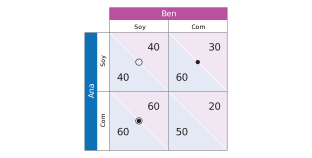
Figure 6.3 Mutual best responses in the corn–soy game. A dot and circle coincide in the lower left-hand cell. If Ana chooses Corn and Ben chooses Soy, then the players are playing their best responses to each other. The dots indicate Ana’s best responses. The circles indicate Ben’s best responses. The best-response equilibrium is (Corn, Soy).
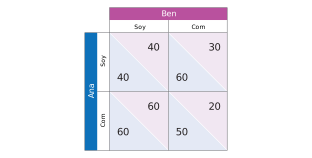
The full payoff table
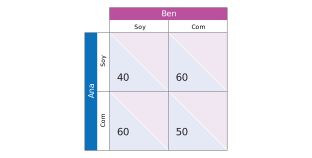
Focusing on Ana’s payoffs
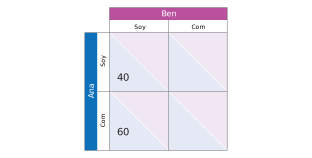
Considering Ana’s best response to Soy
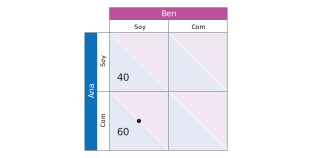
Ana’s best response to Soy is Corn
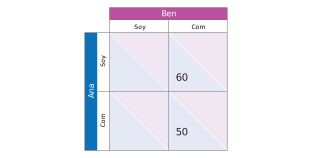
Considering Ana’s best response to Corn
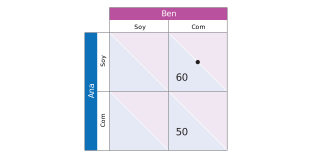
Ana’s best response to Corn is Soy
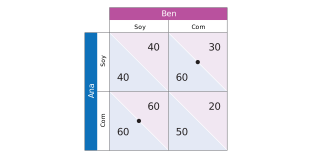
Ana’s best responses
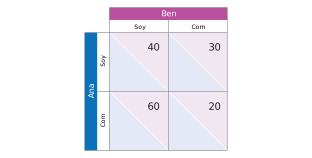
Focusing on Ben’s payoffs
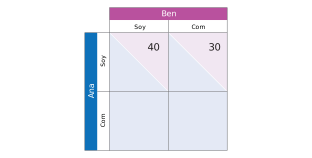
Considering Ben’s best response to Soy
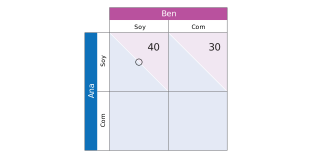
Ben’s best response to Soy is Soy
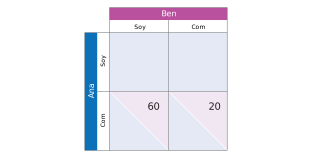
Considering Ben’s best response to Corn
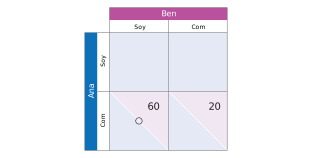
Ben’s best response to Corn is Soy
Ben’s best responses
The best-response equilibrium
A best-response equilibrium is typically called a Nash equilibrium in honor of the economist John Nash, who explained the idea of a best-response equilibrium in the 1950s.1 Read the profile of this great economist here.
- best-response equilibrium
- A best-response equilibrium is a set of strategies, one for each player in the game, such that each player’s strategy is a best response to the strategies chosen by everyone else. Best-response equilibrium is known as “Nash equilibrium” in game theory and microeconomic theory.
- best-response equilibrium
- A best-response equilibrium is a set of strategies, one for each player in the game, such that each player’s strategy is a best response to the strategies chosen by everyone else. Best-response equilibrium is known as “Nash equilibrium” in game theory and microeconomic theory.
Figure 6.3 reveals that there is one pair of strategies in which both players make the best response to each other, or a mutual best response: Ana plays Corn and Ben plays Soy. We call this pair of strategies the best-response equilibrium (the outcome with the dot and the circle). In general, an equilibrium is a self-perpetuating situation. In this case, Ana choosing Corn and Ben choosing Soy is an equilibrium because neither will want to change their decision after seeing the other’s choice.
In the best-response equilibrium of this game:
- Ana chooses Corn.
- Ben chooses Soy.
We can use the shorthand (Corn, Soy) to refer to this best-response equilibrium, listing the row player’s (Ana’s) strategy first.
Can we predict that Ana and Ben will play their best-response equilibrium strategies? Thinking about the decision from Ana’s point of view suggests that she might not be sure what to do, because her best response depends on Ben’s decision (she wants to do the opposite of what Ben does). Ben’s decision is easier: whatever Ana does, Ben gets a higher payoff from choosing Soy. So we expect him to choose Soy. If Ana thinks about Ben’s decision, she will expect Ben to choose Soy. This simplifies the problem for Ana; her best response to Soy is Corn.
- interdependence principle, principle of interdependence
- The outcomes people obtain in economic interactions depend on the actions that they and others take in response to each other and on what they believe about the future.
Reasoning in this way suggests that the best-response equilibrium gives us a believable prediction of the game’s outcome when each player does the best they can, given what they believe the other player will do. Usually, if a game has just one best-response equilibrium, it is the most believable outcome. Best-response equilibrium demonstrates the interdependence principle: what each person obtains when they do the best they can depends on what other people do when they do the best they can.
Everyday Economics 6.4
Why do restaurants and bars offer a “happy hour,” while nightclubs charge a lower entry fee on slow nights? An establishment has limited capacity: at peak times, it can be overcrowded (long waits and a worse experience), while at other times it can be half empty (unused staff and space). Changing prices helps solve this coordination problem. Lower prices early in the evening—or on a Tuesday instead of a Saturday—encourage some customers to come when the venue would otherwise be quiet. The result can be mutually beneficial: customers who are flexible get a better deal (and often a less crowded experience), and the business earns more by spreading demand across the week and using its space and staff more efficiently. No one has to be “told” when to go—people respond to prices, and the pattern of arrivals adjusts on its own. Prices don’t just determine how much we buy. They also help coordinate arrivals, reducing congestion and waste. Can you think of another case where price changes (or discounts) shift people from “peak” to “off-peak” times and make both sides better off?
In the best-response equilibrium, both Ana and Ben specialize in one crop, thereby avoiding market gluts. Moreover, both crops are produced on land well suited for growing them. In this game, each person pursuing their self-interest results in an outcome with the highest possible payoff for each player. Note, though, that this result is specific to this game, not a general result.
In this example, the best-response equilibrium is also the outcome each person would have chosen if they could coordinate their decisions, such as by talking to each other and committing to a strategy. Although they independently pursued their self-interest, market prices guided them to an outcome in their best interests.
You can find more information about Adam Smith here in CORE’s The Economy 2.0: Microeconomics.
- invisible hand game
- A game in which there is a single best-response equilibrium that is efficient may be called an invisible hand game. See also: best-response equilibrium, efficiency.
Figure 6.3 is an example of a game sometimes called an invisible hand game. It reflects Adam Smith’s idea that invisible forces can guide players toward an outcome that is best for both. In an invisible hand game, players acting independently in their self-interest reach an equilibrium that is in their joint interest. In Section 6.5, we will see a contrasting case in which the outcome of self-interested decisions is one the players would have preferred to avoid. This type of game is called the prisoners’ dilemma game.
Reasons invisible hand games can occur: Differences in natural environment or skills
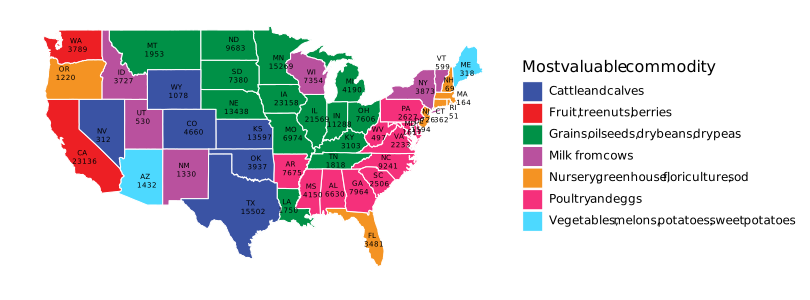
Figure 6.4 The most valuable agricultural products in each US state (2022). Soy and corn are in the category “Grains, oilseeds, dry beans, and dry peas,” which are particularly valuable in much of the Midwest.
US Department of Agriculture, National Agricultural Statistics Service. 2024. 2022 Census of Agriculture, Volume 1, Chapter 2: U.S. State Level Data, Table 2. Market Value of Agricultural Products Sold Including Food Marketing Practices and Value-Added Products: 2022 and 2017. Released February 13, 2024. Washington, DC: USDA/NASS. Data accessed via the USDA/NASS Quick Stats complete 2022 Census data set.
Earlier, we assumed that Ana’s land is equally suitable for growing soy and corn, while Ben’s land is better suited to soy. In the invisible hand game, their equilibrium choices divide production between the two crops: Ben grows soy, the crop better suited to his land, and Ana grows corn. Their different choices also avoid a glut in either market. Our explanation here is based on the ideas of specialization and gains from exchange that we explored in Chapter 3 and Chapter 4.
Everyday Economics 6.5
What are your skills? Have you ever traded a skill for another skill? For example, maybe you’ve fixed someone’s car, and in return, they did your taxes.

EBW note: The manuscript mentions a photograph but we have not been supplied with one yet.
The outcome of this invisible hand game demonstrates a general rule: people benefit from specialization when differences in natural environments make one environment or area better for producing one good than another. Figure 6.4 shows the varieties of agricultural products produced in the United States. Corn (which is in the category “grains, oilseeds, dry beans, and dry peas”) is grown in much of the US Midwest (including Indiana, Illinois, and Ohio) partly because, compared to other parts of the country, the land there is best suited to the growing of corn. Similarly, “cattle and calves” are raised on land in Colorado, Kansas, and Texas because of the suitability of the land. These are differences in natural environments that can lead to gains from cooperation or exchange.
Instead of the land being more suited or less suited to one crop, it could have been the case that Ana and Ben, though both capable farmers, were better equipped or more knowledgeable about growing one crop rather than the other. When people differ in their skills, there are opportunities for gains from trade. For example, if I am a better cook and you are a better gardener, then we can both gain from exchange if I cook for us both with vegetables and herbs you grow in your garden.
Exercise 6.3 Farmers, strategy, and the invisible hand
Consider the following game between two players, Arkady and Barbara. Like Ana and Ben, they are farmers. They are trying to decide whether to produce dairy or potatoes on the land they own. The payoff table captures the payoffs that the players will receive for their choice of action and the other player’s choice of action.
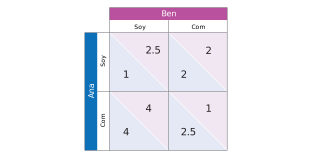
Figure Exercise 6.3(i)
- Who is better at producing dairy or potatoes: Arkady or Barbara? Explain using appropriate comparisons with the payoff table.
- Solve the game using best-response analysis (the circle-and-dot method) to find the best-response equilibrium (BRE) and state what the BRE is. Explain what you did to find the BRE.
- Is the dairy–potatoes game between Arkady and Barbara an invisible hand game? Explain why or why not, using the definition of an invisible hand game from Section 6.3. What does this type of game tell us about the role of self-interest in this type of interaction?
Question 6.3
Adam and Bella each have to choose whether to watch a football game at home or go to the cinema. The figure below shows the enjoyment levels (payoffs) each person receives based on both their own choice and the other person’s choice.
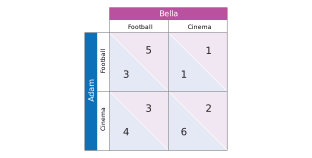
Based on the information above, we can conclude that:
- Using the dot method for Adam: if Bella chooses Football, Adam earns 3 from Football versus 4 from Cinema; if Bella chooses Cinema, Adam earns 1 from Football versus 6 from Cinema. Adam’s best response is Cinema in both cases, so Cinema—not Football—is Adam’s dominant strategy.
- Adam’s best response is Cinema (4 > 3 against Football; 6 > 1 against Cinema), and Bella’s best response is Football (5 > 1 against Football; 3 > 2 against Cinema). The pair (Cinema, Football) is a mutual best response, so it is the best-response equilibrium.
- At the best-response equilibrium (Cinema, Football), Adam gets 4 and Bella gets 3. Adam could get as much as 6 and Bella as much as 5 at other outcomes, so the equilibrium does not give either player their highest possible payoff. A best-response equilibrium need not be the best outcome for the players.
- The best-response equilibrium is (Cinema, Football), not (Football, Football). At (Football, Football) Adam would want to switch to Cinema (4 > 3), so it is not a mutual best response.
-
John F. Nash. 1950. “Equilibrium Points in n-Person Games”. Proceedings of the National Academy of Sciences 36(1): pp. 48–49. ↩

