3.3 The institutions of capitalism
A remarkable number of scientific and technological advances that have transformed our world coincided with the upward kink in the income hockey stick in the middle of the eighteenth century in Britain.
In the United States, the first water-powered roller spinning textile mill opened in 1793. Samuel Slater, an American entrepreneur, brought textile technology from Britain to the United States.
- Industrial Revolution
- A wave of technological advances and organizational changes that began in Britain in the eighteenth century; it transformed an agricultural and craft-based economy into a commercial and industrial economy.
At that time, important new technological advances were introduced in textile production, energy generation, and transportation technologies. As late as 1800, traditional craft-based techniques, using skills that had been handed down from one generation to the next, were still used in most production processes. The new era brought new ideas, new discoveries, new methods, and new machines that made old ideas and old tools obsolete—and this process happened continuously, with every new generation. This period of continuous technological innovation is called the Industrial Revolution.
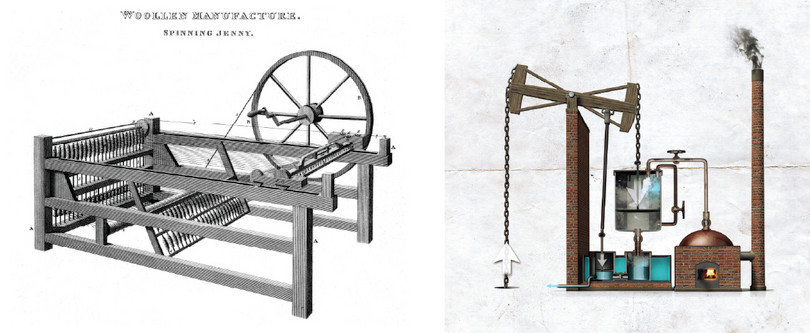
The spinning jenny (left) allowed more threads and yarns to be produced by fewer spinners (1820) and Watt’s improved Newcomen steam engine (right) resulted in the creation of semi-automated factories (1776).
How can we explain the change from a world in which living conditions changed little (unless there was an epidemic or a war) to a world of continuous technological revolution in which each generation lived longer and had access to more goods, food, and machines than the previous generation?
- economic system
- A way of organizing the economy that is distinctive in its basic institutions. Economic systems of the past and present include central economic planning (the Soviet Union in the twentieth century), feudalism (much of Europe in the early Middle Ages), slave economy (the U.S. South and the Caribbean plantation economies prior to the abolition of slavery in the nineteenth century), and capitalism (most of the world’s economies today).
- capitalism
- An economic system in which the main form of economic organization is the firm, where the private owners of capital goods hire labor to produce goods and services to be sold in markets with the intent of making a profit. The main economic institutions in a capitalist economic system are private property, markets, and firms.
An important part of the answer lies in the way the production and distribution of goods is organized in an entire economy—that is, its economic system. In the eighteenth century, a particular way of organizing the economy emerged and eventually spread globally. Today we call this system capitalism. In everyday language, the word “capitalism” is used in different ways. Economists define the term in a precise way to be able to communicate clearly: capitalism is an economic system characterized by a particular combination of institutions.
- institutions
- An institution is a set of laws and informal rules that regulate social interactions among people, and between people and the biosphere; sometimes also termed “the rules of the game.”
Recall from Chapter 1 that the term institutions refers to “the rules of the game.” They include the various sets of laws and social customs that regulate production and distribution. Households, firms, and the government create ways of organizing their interactions, and formalizing them in social customs and laws. In Chapter 2, we saw an example in which workers voted for new environmental regulation that changed the rules of the game.
- rules of the game principle
- The rules of the game affect how the players play the game, the size of the gains from cooperation available to the players, and how the gains are divided among the players.
The institutions that characterize capitalism are private property, markets, and firms. The main players that interact in a capitalist economic system are the members of households who work for or own firms, or who are employed by the government (Figure 3.2). Private property, markets, and firms shape economic interactions under capitalism; that is, the institutions affect how the players play the game, the size of the gains from cooperation available to the players, and how the gains are divided among the players—this is the rules of the game principle.
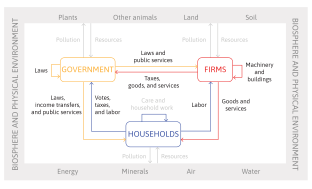
Figure 3.2 A model of the whole economy highlighting the economic interactions in a capitalist economic system. The biosphere is faded out as we are not considering that aspect of the economy yet.
John Williamson writes: “In the United States property rights are so well entrenched that their fundamental importance for the satisfactory operation of the capitalist system is easily overlooked. I suspect, however, that when Washington brings itself to think about the subject, there is general acceptance that property rights do indeed matter.” John Williamson is a senior fellow at the Peterson Institute for International Economics (PIIE).
It is easy to overlook the importance of the institutions that are fundamental to capitalism—private property, markets, and firms. They are so familiar that we may hardly notice them. Before analyzing how these institutions combine in the capitalist economic system, we need to define them.
Private property
The right to private property means that you can:
- enjoy your possessions in a way that you choose (as long as you do not violate other laws)
- exclude others from the use of your possessions if you wish
- dispose of them by gift or sale to someone else (who then becomes their owner)
Private property
- private property
- Something is private property if the person possessing it has the right to exclude others from it, to benefit from the use of it, and to exchange it with others.
Over the course of human history, the extent of private property has varied. In some societies, such as those of the hunters and gatherers who were our distant ancestors, people owned almost nothing except personal ornaments and clothing. In other societies, crops and animals were private property, but land was not. The right to use the land was granted to families by agreement among members of a group, or by a chief, but the family was not allowed to sell the land.
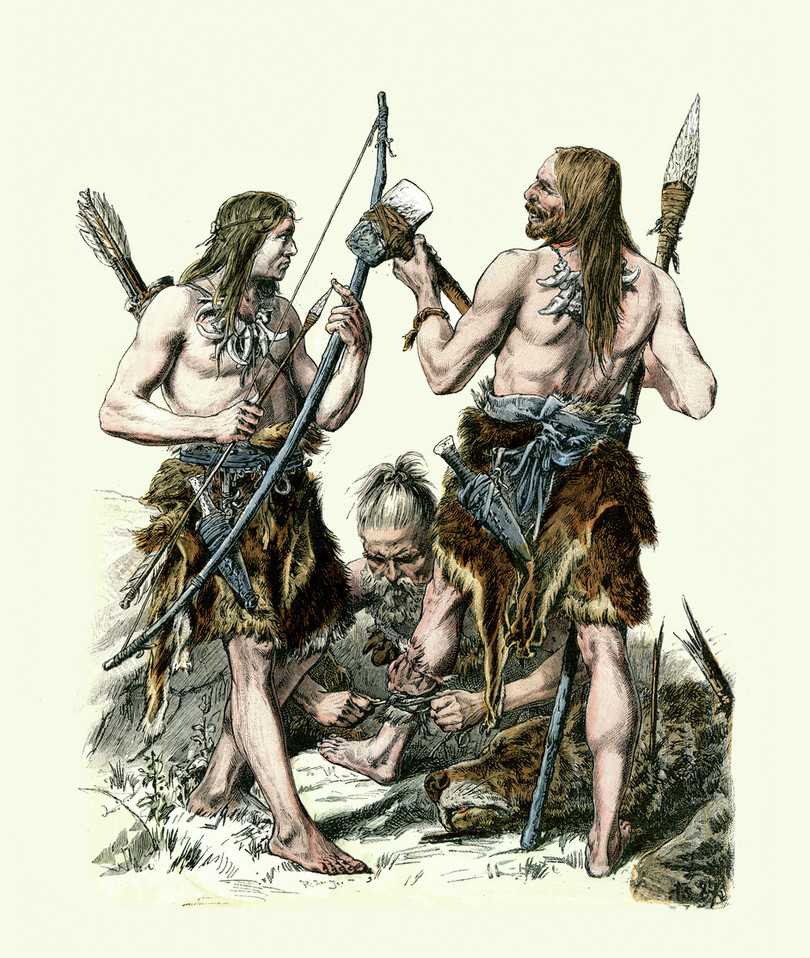
Stone Age hunters dressed in animal skins, armed with bow and arrow, flint axe and spear, wearing bone necklaces—these were likely their only private possessions.
Most of the indigenous peoples of the Americas were primarily farmers. In Mesoamerican cities, cropland was owned by households, temples, or urban nobles. In the Iroquois and Algonquian nations, women typically owned specific fields, but others farmed them, and the harvest was distributed collectively. In colonial New England, communal pastures were common. Gradually, New Englanders divided most agricultural land into privately owned family farms.
Source: JSTOR Daily.
In various societies, some human beings have been the private property of others. Slavery is illegal today, but various forms of slavery have been prevalent across time and place. For instance, before the 1500s, owners and enslaved people in Europe and Africa were typically of the same race and those enslaved were considered barbarians or infidels (non-Muslim or non-Christian). In the Americas, with the Atlantic slave trade, slavery became framed in racial terms—slaves were Black and slave owners white.
Private property may be owned by an individual, a family, a business, or some entity other than the government. Some things that we value are not private property. For example, the air we breathe and most of the knowledge we use cannot be owned, bought, or sold.
Everyday Economics 3.1
Look around you right now. Which of the things around you are privately owned and which are not? Who owns them: a person, a government, a group, a firm, or no one?
Markets
Markets connect people who may mutually benefit by exchanging goods and services through a process of buying and selling.
Markets
- market
- A market enables people to exchange goods and services by means of directly reciprocated transfers (unlike gifts), voluntarily entered into for mutual benefit (unlike theft, taxation), in a way that is often impersonal (unlike transfers among friends, family).
Markets are a means of transferring goods or services from one person to another in a decentralized manner. There are other ways to exchange goods and services, such as by theft, gift, or government order. Markets have three key characteristics:
- Reciprocity. The transfer of a good in a market is reciprocated: unlike gifts and theft, one person’s transfer of a good or service to another is directly matched by a transfer in the other direction (either as money, as another good or service as in barter exchange, or as a promise of a later payment when buying on credit).
- Voluntary participation. All transfers are willingly undertaken, because the things being exchanged are private property, and both buyer and seller expect to benefit. There are mutual gains from exchange.
- Competition. In most cases, buyers and sellers are limited in the prices they can set. A seller charging a high price, for example, will find that buyers will purchase from other competing sellers offering lower prices.

The Lancaster Central Market in Pennsylvania (left) and an online market, eBay (right).
Firms
- firm
- An economic organization in which private owners of capital goods hire and direct labor to produce goods and services for sale on markets to make a profit.
- profits
- A firm’s profits are the difference between its total revenue and total costs, including opportunity costs.
In many economies, markets and private property were important long before capitalism. Prior to 1600, most economies had markets, and production was done either by individuals (shoemakers or blacksmiths, for example) or by families (on a farm, for example). The most recent of the three components of the capitalist economy is the firm.
Firms
Firms have the following characteristics:
- One or more individuals own capital goods that are used in production.
- They pay wages and salaries to employees.
- They direct their employees (through the managers they also employ) in the production of goods and services.
- The goods and services that they sell are the property of the firms’ owners.
- They sell goods and services in markets with the intention of making a profit.
Profit is the revenue a firm receives minus the costs it pays—including wages, materials, and opportunity costs. The firms that make up a capitalist economy include restaurants, banks, large farms, industrial establishments, supermarkets, and internet service providers. Other productive organizations that are not firms, and which play a smaller role in a capitalist economy, include family businesses, in which most or all of the workers are family members; nonprofit organizations; employee-owned cooperatives; and governments (in cases such as government-owned railways and power or water companies). These are not firms, either because they do not have the intention of making a profit or because the owners are not private individuals who own the firm’s assets and employ others to work there.
Everyday Economics 3.2
Think of the place where you last bought your groceries. Did you buy them at a supermarket? Are supermarkets markets or firms? (Or both?) Perhaps you bought your groceries at a street market. Are street markets markets, or are they firms?
- labor market
- The market in which employers offer wages to individuals who may agree to work under their direction. Employers are on the demand side of this market, while employees are on the supply side.
- capital goods, capital
- Capital goods (sometimes shortened to “capital”) are the durable and costly non-labor inputs used in production, such as machinery, equipment, and buildings. Capital does not include some essential inputs (such as air, water, and knowledge) that are used in production at zero cost to the user.
Unlike households and governments, firms can quickly be born, expand, contract, and die. Over the course of just a few years, a successful firm can grow from just a few employees to a global company with hundreds of thousands of customers, employing thousands of people. Firms can grow quickly because they are able to hire additional employees on the labor market, and attract funds to finance the purchase of the capital goods—buildings, equipment, and other durable inputs—which they need to expand production.
Google was created in 1997 by two doctoral students in a garage. By 1999, the company had grown to eight employees and moved to an office in Palo Alto, CA, and later to a larger office in Mountain View. In 2004, Google went public, which means it became a publicly traded company in which anyone can buy shares. Today, Google is called Alphabet (because it does more than just Google search) and has more than 180,000 employees worldwide.
Firms can die in a few years too. A firm that does not make profits will not have enough money (and will not be able to borrow money) to continue employing and producing. The firm shrinks or goes out of business, and its employees lose their jobs.
The natural gas company Enron was created by Kenneth Lay in 1985 by the merging of Houston Natural Gas and InterNorth. By 1992, Enron was the largest seller of natural gas in North America. The company filed for bankruptcy in 2001 after it came to public light that Enron’s financial statements were hiding accounting loopholes that misrepresented their earnings.
In a capitalist economy, most production takes place in firms. Firms combine inputs—including equipment, raw materials, and labor—to produce outputs. Markets and private property are essential to the functioning of firms for two reasons.
- Outputs and capital goods are private property. The firm’s buildings, equipment, and other durable inputs (that is, its capital goods) belong to the owners. So do the resulting outputs.
- Firms use markets to buy inputs and sell outputs. The owners’ profits depend on markets in which customers may willingly purchase the products at a price that will more than cover production costs.1 Firms buy their inputs in other markets, including the labor market, where they hire workers and pay them wages to operate their capital goods.
- centrally planned economic system
- In a centrally planned economy, decisions about what and how to produce are made by the government, rather than by firms responding to market prices.
In some economic systems, private firms and markets are relatively unimportant. For example, in a centrally planned economic system, the government is the institution that owns capital goods, controls production and decides how and to whom goods should be distributed. The Soviet Union, East Germany, and many other eastern European countries had centrally planned economies before the end of Communist Party rule in the early 1990s. The United States and most economies today are capitalist according to our definition: they are characterized by the institutions of private property and markets, and the majority of their production takes place in firms. However, the ways in which the institutions of capitalism combine with each other, with households and governments, and with other institutions differ greatly across countries. For this reason, it is more accurate to describe capitalism as a variety of systems rather than one specific system.
Question 3.3
Which of the following are firms according to the definition given? Choose all that apply.
- While the hospital may hire workers, it does not aim to make a profit for private owners.
- The fast-food franchise hires labor, sells in markets, and seeks profit—all features of a firm.
- Here, household production is taking place. No paid labor is employed, and no market transactions take place.
- The tech startup is a firm: It employs workers, owns capital goods, and sells outputs in markets for profit.
Question 3.4
Which of the following would be considered market exchanges according to the definition given? Choose all that apply.
- This is an example of market exchange. It is voluntary and reciprocated, and it involves private property.
- This is a government transfer, not a market transaction.
- Barter is a form of market exchange, as both parties voluntarily transfer goods with mutual benefit.
- A gift exchange between spouses is not a market transaction because it is not based on private property exchange for mutual gain, and it does not involve competition or price-setting behavior.
Exercise 3.4 The role of firms, markets, and property in capitalism
Firms rely on both markets and private property to operate. Explain why markets are essential for firms, giving one example of how a firm uses a market. Explain why private property is essential, giving one example of a capital good that a firm must own. What would happen to firms if either markets or private property did not exist?
Exercise 3.5 What makes a firm? Applying the definition to real-world entities
Using our definition of a firm, explain why each of the following entities is or is not a firm by investigating whether it satisfies the characteristics that define a firm or not. Research the entity online if you need more information.
- TikTok
- Green Bay Packers
- Wikipedia
- A family farm in Nebraska
- Tennessee Valley Authority
- Lyft
-
Paul Seabright. 2010. The Company of Strangers: A Natural History of Economic Life (revised edition). Princeton University Press. ↩

