Chapter 1 Cooperation, conflict, and the environment
Coeur d’Alene Lake. Almost a century of dumping mine waste into the surrounding rivers has trapped toxic metals in the bottom of the Coeur d’Alene Lake.
1.1 Introduction: Why were the kids in Kellogg, Idaho, sick?
In the fall of 1973, two toddlers in Kellogg, Idaho, were taken to the doctor with what looked like symptoms of flu.
The children were irritable, they’d lost their appetites, they were constipated, and they were experiencing abdominal pain. They were tired and lacking the energy that kids their age should have had.
The doctor was confused because the evidence showed the children didn’t have the flu. So, what was it? Before the doctor could find out, more children showed up with similar symptoms. It definitely wasn’t the flu.
Instead, the children were feeling the effects of lead poisoning. The levels of lead in the children’s blood were enough to harm their social development and their ability to learn. Public health investigators examined the homes of affected children and none of the usual culprits was there: no lead paint, no lead piping. So, what was it?
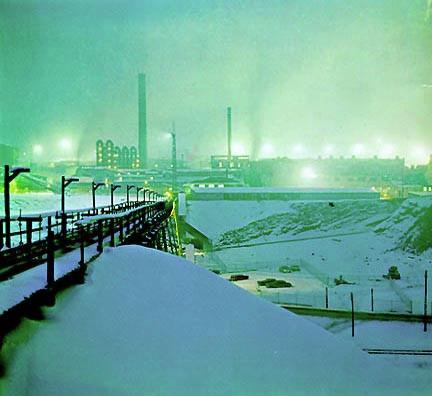
Bunker Hill smelter operating in winter snow, 1970s.
Kellogg was also the home of a giant lead, silver, and zinc smelter owned by the Bunker Hill Company that used intense heat to extract these metals from ore. The smelter in operation in 1970 is shown in the photo. At the time, the company produced over a quarter of the lead made in the United States. In a town of barely 4,000 people, the smelter employed 2,300 people, including those from nearby towns.
Investigators discovered that a fire at the smelter on 3 September 1973 had damaged the system that worked to filter many of the contaminants from the smelter and capture them for disposal. After the fire, about 1,000 tons of lead particles were dumped into the air of Kellogg and nearby communities over a period of about 12 months. That’s between 7 and 20 times the amount of the annual pollution that would regularly occur. Though the level of emissions exceeded the amount allowed by law, neither the Bunker Hill Company nor any of its shareholders or managers were charged with any crimes.
Bill Yoss was a welder at the smelter. Three of his children had dangerously high levels of lead poisoning. “I don’t know where we’ll end up,” he told a People magazine reporter. “We may pull out of the state.”
The owners of the company refused to release the results of their own tests of the smelter’s lead emission levels. Unless the state’s emissions regulations were relaxed, the owners said, the smelter would shut down, which it did in 1981. Former employees looked for work elsewhere. The value of the homes and businesses in Kellogg fell to a third of their earlier level. The local schools, which were supported by property taxes, did not have the money to fund those who remained.
Question 1.1
What event at the smelter caused the lead pollution?
- Though an explosion might cause lead to be dispersed into the environment, it wasn’t the cause of lead poisoning in the case of Kellogg, Idaho.
- Though it is important to think about the consequence of a worker’s strike, as we do later in the chapter, a strike would not cause lead poisoning.
- The lead poisoning was caused by a fire that damaged the filtration system.
- No water pipes had burst in this story.
Question 1.2
What happened to Kellogg’s economy after the smelter shut down?
- The air was not cleaner, and so that did not improve the economy. In chapter 2, we explore the consequences of improved air quality.
- The economy did not stay the same. Check the passage to see what the consequences were for housing and jobs.
- Though mining did continue for some time, this didn’t reflect the wider consequences for the economy.
- Property values fell, and people lost their jobs (resulting in unemployment). The decreased property values also meant that schools struggled with funding from taxes.
Exercise 1.1 Main characters of a story: economic cooperation
Think about the people in the story of Kellogg, Idaho—for example, the sick toddlers, Bill Yoss, and the managers of the Bunker Hill Company. Think of a similar story or similar example of an interaction or form of economic cooperation in your life. Who are the main characters? What did they do? As a starting point, you can use the stories of lead in the water of Flint, MI or the story of Love Canal, in Niagara, NY. Alternatively, use an AI chatbot to provide examples of stories of environmental injustice and use the information the chatbot provides to find similar stories. Who are the people involved? Are they members of households? Workers in a government? Managers in a firm? What actions did they take? How did the story unfold?

