3.7 Global poverty and inequality
- the distribution of income
- The distribution of income describes how income in a society is divided among its people or groups, such as between individuals, households, or social classes.
How the institutions of capitalism combine with political and other institutions can affect the distribution of income. Why? Because institutions shape the choices people have and the power that some groups can exercise over others.
Global poverty
- extreme poverty
- Extreme poverty is defined as living below the International Poverty Line of $3 per day in 2021 international dollars. The World Bank defines the International Poverty Line (IPL).
Mirroring the hockey sticks of income and carbon dioxide is the transformation from a world in which the vast majority of people struggled to meet their basic needs for food and shelter to the world today, where only about 10% of the population struggles to survive. Before the upward kink in history’s hockey stick, some people were rich by the standards of their day, but most people lived in extreme poverty. Those living in extreme poverty are often hungry, have no access to electricity (and therefore no light at night, for example), and have limited access to schooling or health care.
You can explore extreme poverty further in this article in OWiD.
Looking at Figure 3.6, we see a decrease in the share of people living in poverty over time. The decrease accelerated in the twentieth century because the slope of the line is steeper after 1950. The steeper slope means that the change over that period is greater.
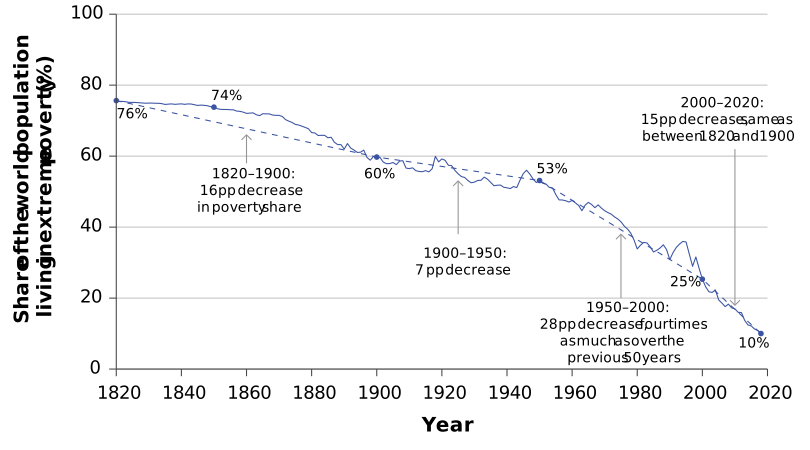
Figure 3.6 Share of the world population living in extreme poverty, 1820–2018.
Michail Moatsos. 2021. “Global extreme poverty: Present and past since 1820.” OECD; How Was Life? Volume II: New Perspectives on Well-Being and Global Inequality Since 1820. OECD. “pp” is an abbreviation for “percentage points”.
Compare the period 1900–1950 to the period 1951–2000. During the first half of the twentieth century, the share of people in poverty decreased from 60% to 53%, a decrease of 7 percentage points, but in the same length of time (1950 to 2000), the share of people in poverty decreased from 53% to 25%—a 28 percentage point decrease. That’s four times as much over the same amount of time.
The distribution of income
A thousand years ago, the world was flat, economically speaking. There were major differences in income between the world’s countries and regions but, as Figure 3.1 shows, the differences between countries were small compared to what followed.
Today, 14% of the world’s population lives in countries with lower average income than India. Because 18% of the world’s population lives in India, a total of 32% of the world’s population lives in countries with average income less than or equal to that in India.
In terms of income, nobody thinks the world is flat today. Figure 3.7 provides a snapshot for 2019. Several countries are lined up from left to right according to average income, with the poorest (South Sudan) on the left and the richest (United Arab Emirates) on the right. The width of the bars reflects the size of the population, with the bars for China and India the widest because they have the biggest populations. The horizontal scale shows the cumulative share of the world’s population, with 100% at the far right.
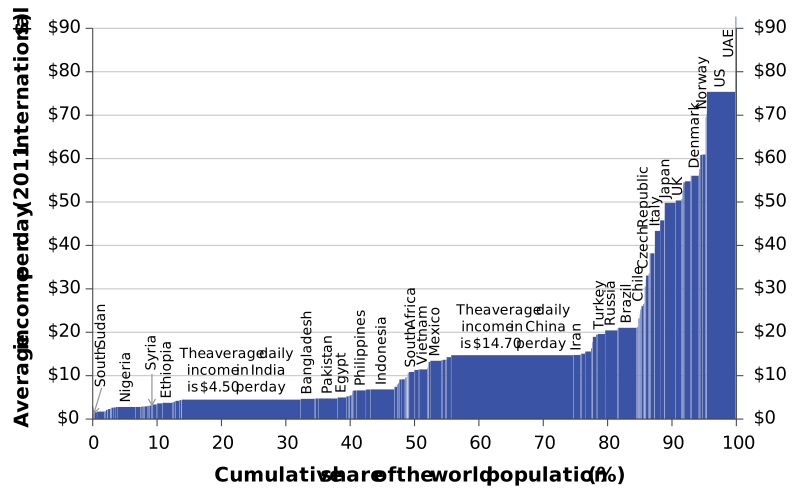
Figure 3.7 The global income distribution in 2019: average daily income by country with a selection of countries labeled.
M. Roser. 2021. “Global Poverty in an Unequal World: Who Is Considered Poor in a Rich Country? And What Does this Mean for Our Understanding of Global Poverty?” Our World in Data.
Poverty and Inequality Platform. “Mean Income or Expenditure per Day”;
The World Bank. 2022. “Population, Total”.
Note: Average income is measured in “international dollars,” which enables comparisons of the purchasing power of incomes to be made across countries; this measure is known as purchasing power parity.
- purchasing power parity (PPP)
- Purchasing power parity is a price index that measures how much it costs to purchase a basket of goods and services in a specific country compared to how much it costs to purchase the same basket in a reference country in a particular year, such as the United States in 2011.
On the vertical axis is the average daily income, measured in such a way that 20 international dollars, for example, is what a person in any given country can buy in goods and services that cost 20 US dollars in the United States. Economists measure prices using purchasing power parity to make these comparisons. At the bottom of the distribution are the 10% of countries where people on average live in extreme poverty: their daily income is just a few dollars a day. The snapshot provided by average incomes shows big differences between countries, but it does not show the vast differences in living standards within each country.
- the distribution of income
- The distribution of income describes how income in a society is divided among its people or groups, such as between individuals, households, or social classes.
Figure 3.8 goes a step further by building a three-dimensional picture that shows the distribution of income within countries as well as between them, and how this distribution changed between 1980 and 2020. Again, countries are arranged from the lowest average income in that year on the left (South Sudan in 1980) to the highest on the right (Switzerland in 1980). For every country now there are ten bars, representing the country’s population divided into income groups. Each group contains 10% of the population, and the height of the bar is the group’s average income, ranging from the poorest 10% of households at the front of the diagram to the richest 10% at the back, measured in 2021 US dollars.
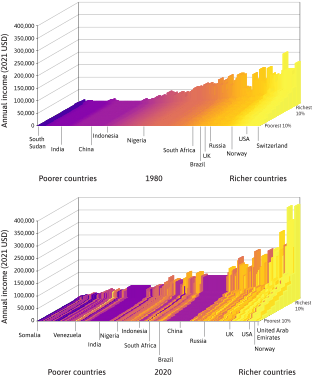
Figure 3.8 Global income inequality 1980 (top panel) and 2020 (bottom panel). Countries are ranked by income per capita from left to right. For each country, the heights of the bars show average income, from the poorest 10% at the front to the richest 10% at the back. The width of the bar indicates the country’s population. Each country is colored based on its average income in 1980 so that we can see how countries change their position over time.
World Inequality Database (WID). You can download the data for all countries and years used in the skyscraper figures here. Robert Sutcliffe designed the representation of global inequality in Figure 3.8. A first version was published in: Robert B. Sutcliffe (2001) 100 Ways of Seeing an Unequal World, Zed Books, using the data in the Global Consumption and Income Project (GCIP) 2015.
The skyscrapers (the highest columns) at the back of the right-hand side of the two panels represent the income of the richest 10% households in the richest countries. In 2020, the tallest skyscraper represents the richest 10% in the United Arab Emirates. In 2020, this exclusive group had an average income per capita of around $390,000. Norway, the country with the second-highest GDP per capita, does not have a particularly tall skyscraper (it is hidden between the skyscrapers for the United Arab Emirates and the third-richest country, the United States) because income is more evenly distributed in Norway than in some other rich countries. Closely examine the steps in Figure 3.9 to understand how income within and between countries has changed over time.
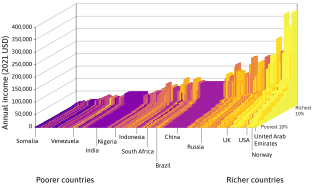
Figure 3.9 The world income distribution within countries and across countries over time.
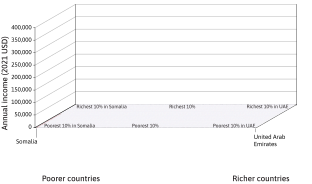
The axes for the skyscraper graph
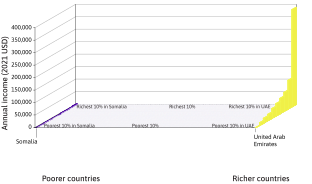
Comparing the richest (United Arab Emirates) and poorest (Somalia) in 2020.
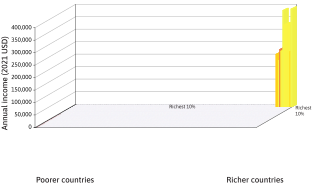
Skyscrapers of the richest 10% in the 10 richest countries in 2020.
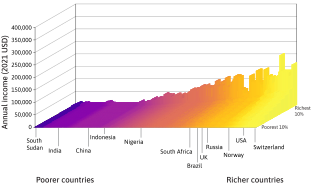
World income distribution in 1980 (Figure 3.8, top panel).
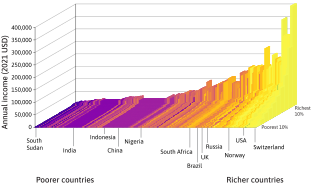
World income distribution in 2000.
World income distribution in 2020 (Figure 3.8, bottom panel).
Everyday Economics 3.6
Look up your country’s Gini coefficient or rich/poor ratio for 1980 and 2020. Has inequality increased or decreased? Who do you think captured most of the gains from economic growth in your country over that period—people at the top, the middle, or the bottom? What would the gains-from-cooperation framework from Chapter 1 predict about this?
- rich/poor ratio
- The rich/poor ratio is the ratio of the average income of the richest 10% of the population to the average income of the poorest 10% of the population within a country. It is a measure of inequality in a country.
- inequality
- Inequality refers to the degree to which income, wealth, or other economic resources are distributed unevenly among people or groups in a society. It can be measured using statistical tools such as income percentiles, the Gini coefficient, or income shares held by different segments of the population (for example, the top 10% vs. the bottom 10%, called the Rich/Poor ratio).
Two things are clear from the distribution of income in 2020. First, in each country, there are large differences in income between the richest and the poorest 10% of households. We can use the ratio between the heights of the front and back bars, called the rich/poor ratio, as one measure of inequality in a country. The rich/poor ratio is the ratio of the average income of the richest 10% of the population to the average income of the poorest 10% of the population within a country. In the United States, the rich/poor ratio is 244, which means that in the United States in 2020, the richest 10% of the population had incomes 244 times as large as the poorest 10%. Even in a relatively equal country such as Norway, the rich/poor ratio is 66. In Botswana in southern Africa, it is 488. Inequality also exists within the poorest countries. For example, the rich/poor ratio is 174 in Nigeria and 246 in India.
Also apparent in Figure 3.9 are the huge differences in income between countries. In 2020, the average income in Norway was nearly seven times the average income in Nigeria. What other differences do you notice?
Question 3.10
Which of the following statements about global poverty are correct? Choose all that apply.
- The share of the population living in poverty decreased from 76% to 60%, a decrease of 16 percentage points (76 – 60 = 16) between 1820 and 1900. From 2000 to 2020 (20 years), the share of the population living in poverty decreased from 25% to 10%, a decrease of 15 percentage points. So, almost the same share of people left extreme poverty between 1820 and 1900, and between 2000 and 2020.
- Much of the reduction occurred more rapidly in recent decades, especially after 1950.
- The figure illustrates that the share of people in extreme poverty has fallen dramatically since the nineteenth century, which reflects a reduction in percentage but does not give us information about absolute numbers.
- Poverty reduction has not been uniform across countries.
Question 3.11
Figure 3.8 shows the global income distribution in 1980 and 2020. Based on this figure, which of the following statements are correct?
- Countries are shaded according to their average income in 1980 (darkest purple for poorest countries and lightest yellow for richest countries). The change in order of the colors in the figure for 2020 indicates that the rankings have changed for many countries except the very rich countries.
- In most countries, some very tall skyscrapers appear at the back by 2020, indicating that the very rich have become even richer. In other words, income distributions have become more unequal.
- Some countries that were relatively poor in 1980 have moved up in the rankings (for example, China and Indonesia). China was in the red, left part of the ranking in 1980 but jumped over many countries by 2020 (moving to the right).
- The width of the bars represents the country’s population size. India and China have the widest bars in the figure.
Exercise 3.10 Measuring global poverty reduction
According to Figure 3.6, the vast majority of people struggled to meet their basic needs for food and shelter in 1820. If we extend that observation back in time—based on Figure 3.1, which shows stagnant living standards in the years prior to 1820—Figure 3.6 suggests that most of humanity was destitute before the industrial era. In this article, Jason Hickel discusses another way to measure poverty in the past that provides a different viewpoint on extreme poverty. Read the article to answer the questions below.
- How are the data that Hickel discusses different from that in Figure 3.6?
- According to Hickel, what do the data tell us about the well-being of the US population in the nineteenth century?
- Comment on Hickel’s criticisms of Figure 3.6. What does Hickel’s discussion bring to our analysis of institutions and economic well-being in this chapter?
Math Extension 3.7 Unpacking the skyscraper graph: Deciles and the rich/poor ratio
- decile
- A decile is a group containing 10% of the population.
Figure 3.8 shows the distribution of income within countries as well as between them, and how the income distributions changed between 1980 and 2020. For every country in Figure 3.8 there are ten bars that represent each country’s population divided into income groups. These bars are called deciles of income.
To understand income deciles, it is useful to think of a country’s GDP as a pie. When we think of income deciles, we think about slicing up the pie into ten pieces. Now imagine that the ten groups of people getting the slices correspond to the ranks of people from poorest to richest in terms of their annual incomes. If everyone had the same annual income, then the slices of pie would be the same size (the “poorest” and the “richest” would have the same income). In reality, the poorest have much lower annual incomes than the richest.
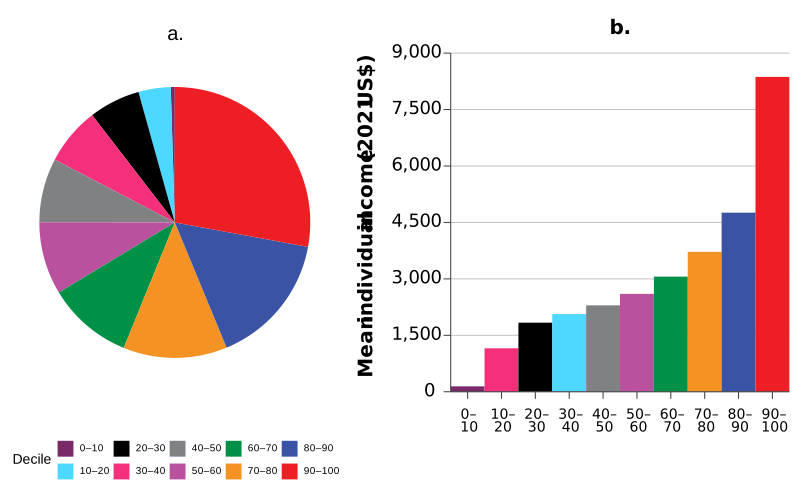
Figure E3.3 A and B
Panel A: A pie chart for China’s 1980 income distribution in deciles from poorest to richest.
Panel B: Income deciles for China in 1980 from poorest to richest. Note that this measure doesn’t mean “the richest 10% of income earners.” Instead, it means the richest 10% of people, where each person in a household, including children, is assumed to have an equal share of the household’s income.
World Inequality Database 2022.
Figure E3.3 shows a pie chart of China’s income deciles from richest to poorest in 1980. In chart A, the size of each slice corresponds to the height of the bar (in terms of income) in panel B. Each slice in panel A has the same colors as the corresponding bar in panel B to make it easier to see how they correspond to each other. We chose China in 1980 because the size of the slice of the poorest 10% is visible. If we had chosen the United States instead, then the size of the slice for the poorest 10% would not be visible in the pie chart because the slice would be too thin to see—the poorest 10% have so little money that we can’t see their average income relative to other people in the economy.
- rich/poor ratio
- The rich/poor ratio is the ratio of the average income of the richest 10% of the population to the average income of the poorest 10% of the population within a country. It is a measure of inequality in a country.
The bar charts of income deciles in chart B are helpful because they show us the average income of each “slice” or decile of the economy. We can use the ratio between the heights of the bars for the richest 10% and the poorest 10% as one measure of inequality in a country. We call this measure the rich/poor ratio, because it is the ratio of the income of the richest people to the income of the poorest people within a country. In China in 1980, the richest 10% had average incomes of $8,368 and the poorest 10% had average incomes of $144, so the rich/poor ratio was $8,368/$144, which is approximately equal to 58. So, in China in 1980 the richest 10% of the population had incomes 58 times as large as the poorest 10%.
We can also use the bar charts of income deciles to compare incomes across countries. Figure E3.4 does exactly this by comparing the income inequality in a set of countries in two specific years: 1980 (figures on the left) and 2020 (figures on the right).
What does inequality look like in the countries that took off economically before 1900—for example, Japan, Norway, and the United States? In 1980, for all three countries, the incomes of the poorest 10% are almost invisible (top of Figure E3.4) and the incomes of the richest 10% tower over the others. From 1980 to 2020, the incomes of the richest 10% in the United States more than doubled (going from about $142,000 to over $325,000). The figure also shows that Norway is a more equal country than the United States: Norway’s income bars are higher than the US bars for each decile except the top two. Norway has a higher average income than the United States and lower inequality. US inequality is among the highest in the wealthy parts of the world. As Table E3.3 shows, the rich/poor ratio is 66 in Norway, 153 in Japan, and 244 in the United States. By this measure, inequality in the US is 3.7 times as great as in Norway.
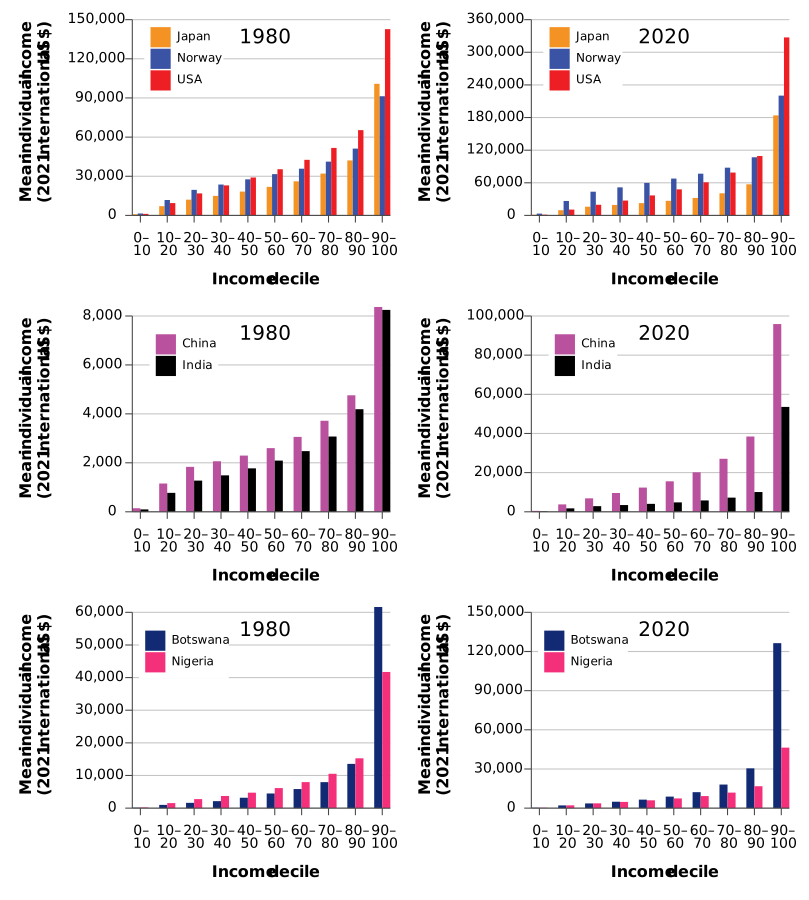
Figure E3.4 A and B Income deciles for Japan, Norway, the United States, India, China, Nigeria, and Botswana in 1980 (panel A) and in 2020 (panel B).
World Inequality Database 2022.
| Country | Poorest 10% average income | Richest 10% average income | Rich/poor ratio | Average income (per capita GDP in 2021 international $) |
|---|---|---|---|---|
| Norway | 3,323 | 220,314 | 220,314/3,323 = 66 | 52,336 |
| Japan | 1,201 | 183,965 | 183,965/1,201 = 153 | 29,629 |
| United States | 1,344 | 327,322 | 327,322/1,344 = 244 | 51,572 |
| China | 471 | 95,884 | 95,884/471 = 204 | 16,497 |
| India | 218 | 53,556 | 53,556/218 = 246 | 7,022 |
| Nigeria | 266 | 46,347 | 46,347/266 = 174 | 7,936 |
| Botswana | 259 | 126,390 | 126,390/259 = 488 | 14,399 |
Table E3.3 Income data for a selection of countries in 2020.
World Inequality Database 2022.
In 1980, the income distributions in China and India were fairly similar, with incomes in China being just slightly larger than those in India. But, as Figure 3.1 shows, China experienced a faster growth rate than India did over the period 1980 to 2020. The incomes in the figure for China and India in 2020 increase according to the economic growth that each country experienced. As Table E3.3 below shows, the rich/poor ratio in both countries was more than 200 in 2020: each had experienced growth in average incomes alongside growth in within-country inequality. Now compare the experience of India and China to two countries in Africa: Botswana and Nigeria. Botswana started off with somewhat more inequality than Nigeria, and average income was $10,153 for Botswana and $9,458 for Nigeria. After 40 years, their average incomes had increased substantially and Botswana’s average income was almost double Nigeria’s (Table E3.3). Inequality was much greater in Botswana, with a rich/poor ratio of 488 compared to Nigeria’s ratio of 174.
Question E3.4
Which of the following statements about the rich/poor ratio are correct? Choose all that apply.
- This is the definition of the rich/poor ratio.
- A high ratio indicates greater income inequality.
- Higher rich/poor ratios are not necessarily linked to lower GDP per capita; some high-income countries, such as the United States, have a high rich/poor ratio.
- The rich/poor ratio compares only the extremes, not the full distribution.
Exercise E3.4 Norway vs United States: Differences in equality
Norway and the United States have similar average income levels but very different rich/poor ratios. Research and explain two specific policies or institutional features that help explain why Norway’s rich/poor ratio is much lower than that of the US’s.

