2.5 Application: Environmental inequality
So far, our discussions of the bargaining between workers and owners have assumed that workers are similarly affected by the policies of the firms.
- rules of the game principle
- The rules of the game affect how the players play the game, the size of the gains from cooperation available to the players, and how the gains are divided among the players.
When Bunker treated the Worker in a particular way, it was treating all workers that way. But real-world evidence suggests that people might be affected unequally by emissions. Furthermore, if people come together to try to change the rules of the game, those changes may not affect everyone equally. We look at these inequalities by examining lead pollution and air quality in the United States.
As in the case of Kellogg, Idaho, lead exposure can cause long-lasting and significant damage to the health of adults and especially children. Lead affects children’s mental development and, in turn, reduces their ability to earn income. At the community level, greater lead exposure in childhood results in higher crime rates later on. In recent decades, lead exposure in children has decreased due to the adoption of unleaded gasoline and the decreased prevalence of lead in pipes, paint, food, and soil. Leaded gasoline was banned in the United States in 1975 and phased out subsequently. Figure 2.6 shows the results of the bans on lead in gasoline, paint, and more on the lead concentration in children’s blood. As fewer children have been exposed to lead, crime rates when those children reach adolescence and adulthood have decreased.
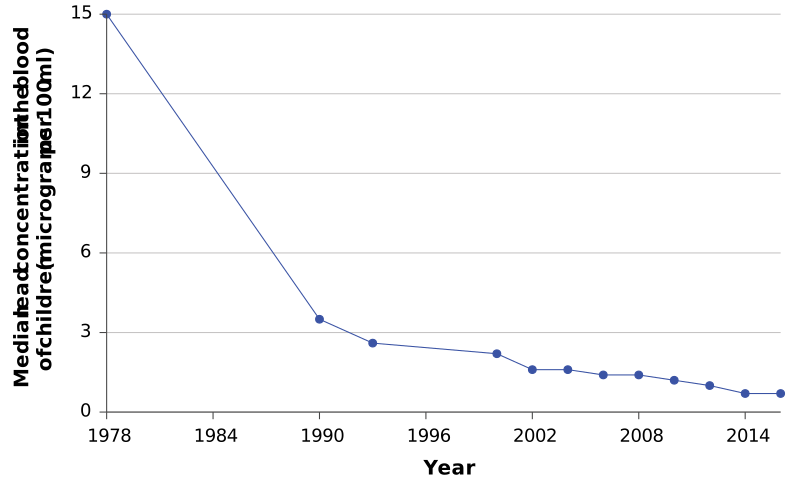
Figure 2.6 Mean lead concentrations of lead in the blood of children (micrograms per 100 ml of blood).
Everyday Economics 2.6
Where do you see pollution in your current surroundings? Think broadly—for example, some people might think graffiti is a type of pollution.
Do we have any evidence that all children are equally affected by toxins such as lead? What do we know about the outcomes for citizens of all races and income levels?
Race, income, toxins, and air quality

A NASCAR car racing with a crowd in the background. Before 2007, these cars would dramatically increase children’s exposure to lead.
Midjourney AI created image. Generated by SDH on 2023.05.24
The decrease in lead exposure has not been equally spread across the United States. Instead, certain communities have had greater decreases than others. Researchers have documented this phenomenon in a fascinating example: NASCAR racing. In 2007, NASCAR, which had been exempted from the leaded gasoline ban in 1975, banned leaded gasoline and switched to unleaded gasoline. This switch allowed researchers to find out how decreased exposure to lead affected people. Before the ban, people who lived close to the racetracks and children who went to school close to the racetracks were exposed to much higher levels of lead than people who lived further away from them.
To understand how lead affects children, economists studied elementary school children in Florida. The ban on leaded gasoline allowed them to identify the effects of the lower lead emissions after the ban on the children’s health and mental development depending on the distance of the student’s school from NASCAR racetracks. Historically, children who attended the schools that were closer to NASCAR tracks had much greater lead exposure, and the lead exposure decreased after the ban on leaded gasoline.
The researchers found that lead exposure negatively affected all students’ school achievement. In terms of environmental justice, the researchers showed that the lead exposure affected students in school districts with larger shares of Black and low-income households. These students scored worse on tests than students who did not attend schools near a racetrack. Because students’ test scores predict how much money they make over their careers, the researchers concluded that Black and low-income students will make less money over their lives than the students who had not been affected by lead.
Toxins like lead are hard for people to see in their everyday lives, but people can see when their air quality changes. Evidence in the United States over time suggests that air quality in most areas of the United States improved from 1981 to 2016: the quality of air for most people, and for people across the income distribution, has improved. However, poorer households experienced lower air quality in 2016 than richer households. Furthermore, the air quality of certain locations—often locations with desirable jobs—deteriorated over that period, with the air quality in California, Arizona, and Texas worsening compared to other parts of the country.
Data Extension 2.5 Air quality, race, and inequality in the United States: The remarkable success of the Clean Air Act
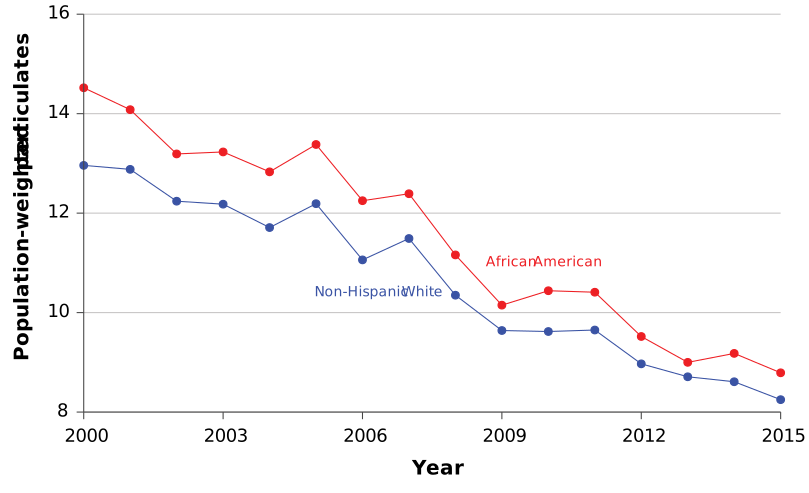
Figure E2.1 The population-weighted level of particulate matter over time. The vertical axis measures how polluted an area is: the higher the value, the greater is the pollution at that level of population. Over time, African Americans’ and non-Hispanic white Americans’ exposure to air pollution has decreased.
Currie et al. “What Caused Racial Disparities in Particulate Exposure to Fall? New Evidence from the Clean Air Act and Satellite-Based Measures of Air Quality.” American Economic Review 113, no. 1 (2023): 71–97, using data from the US Census Bureau; and Di et al. “Assessing PM.5 Exposures with High Spatiotemporal Resolution Across the Continental United States”. Environmental Science and Technology 50, no. 9 (2016): 4712–21.
What can government policy do about poor air quality? Consider Figure E2.1. The horizontal axis shows years from 2000 to 2015. The vertical axis reflects the population-weighted level of particulate matter. Particulate matter is composed of tiny pieces of liquids and solids, not visible to the naked eye, that can significantly damage health. More particulate matter in the air means worse air quality. When we “weight” particulate matter by the population, we take the measure of particulates and adjust it for how populated a given location is. So, when more people in a particular place are exposed to higher levels of pollution, the population-weighted level of particulates will be higher in that place. When there are fewer people in a place, the number will be lower because fewer people are exposed to that level of particulates. Using the population-weighed level gives us a number that is comparable across different areas because it takes into account the fact that different places have different-sized populations.
In the year 2000, on average, non-Hispanic white households lived in places with lower levels of particulate matter in the air than African American households. For both kinds of households, the levels of particulate matter to which they were exposed dramatically decreased by 2015, though white households experienced a greater decrease than African American households did.
Why did air quality improve so much over the period 2000–2015? One big reason is government regulation. In 1963, the US government passed the Clean Air Act. Initially the Act did not change air quality much, but in 1997, the government updated the regulation to increase the strictness of air standards and in 2005 it started penalizing areas that didn’t comply. African Americans lived in more polluted areas in 2000 and the updated Clean Air Act caused more cleanup in those places that were most polluted. The results show how government regulation can lead to improvements in outcomes for all residents, and for minorities and for the poor especially.
Exercise E2.1 How does air quality differ by race?
Consider Figure E2.1, which shows the level of population-weighted particulate matter over time for African Americans and non-Hispanic white Americans. Choose two different years and specify the approximate values of the outcome variable (on the vertical axis) in each of those years for people of each race group. Compare and comment on these values.
Question E2.1
Consider the figures from this section (Figures 2.6 and E2.1). Evaluate the following statements based on your interpretation of the figures and identify the statements that are true. For some of the questions, you will need to use the linked interactive graphs provided in the text. Remember the following definitions when reading the answers: The median is the middle number in a list of numbers sorted from smallest to largest. A percentile considers a distribution of numbers from smallest to largest and gives them numbers from 0 to 100 (so the 5th percentile corresponds to the first 5% of the distribution and the 95th corresponds to numbers toward the top of the distribution).
- Are you sure that both groups experienced increases only in 2005 and 2007? What does the data suggest about other potential increases?
- In 1978, the median value was 15 micrograms per 100 ml. In 2015, it was below 1 microgram per 100 ml (approximately). Therefore, the statement is true.
- The image shows that the two dots for each group (Non-Hispanic white and African American) were the closest in 2013, this does not mean that it was the lowest for African Americans (which happened in 2015 in the data). The statement is therefore true.
- Make sure that the levels of lead concentration in the blood shown in the interactive figure for the 95th percentile are also decreasing for the whole period. Can you find any years in which the levels increase?

