10.5 Application: Matching and group inequality
Due to the need for employers to closely evaluate current and potential workers, and groups of workers possibly having differing average interests and work preferences, the matching process in the labor market can further contribute to group or categorical inequality.
- group or categorical inequality
- Inequality between particular social groups (identified, for instance, by a category such as race, nation, caste, gender, or religion). Also known as group inequality.
In this section, we look at how both sides of the matching process can potentially contribute to group inequality. On the firm side of the matching market, we will examine the role of discrimination. On the worker side, we will see how gendered social norms can perpetuate gender inequality by affecting the types of jobs that men and women pursue.
The study by Bertrand and Mullainathan was a ground-breaking piece of research on the causes of group inequality that laid the foundation for work like that by Kline, Rose, and Walters in 2020, which we explained in Section 5.3. Kline et al found that job applicants with distinctively white names were 10% more likely to be contacted by employers than applicants with distinctively Black names, a smaller effect than that found by Bertrand and Mullainathan, but still economically significant.
Discrimination in the matching process
In 2001 and 2002, the economists Marianne Bertrand and Sendhil Mullainathan conducted an experiment. They sent out 5,000 fake résumés in response to 1,300 job postings in Chicago and Boston. The résumés were either “high quality” (more job experience and education) or “low quality,” with all the résumés in each group being otherwise the same. Each résumé was randomly assigned either a “white-sounding” name, such as Brad or Laurie, or a “Black-sounding” name, such as Keisha or Tremayne. The authors found that a “low-quality” résumé with a white-sounding name was more likely to get a callback from employers than a “high-quality” résumé with a Black-sounding name.
- discrimination
- The practice of treating people differently based on their membership, or perceived membership, in a group or category, such as race, gender, class, age, disability, religion, or national origin.
Economists and other social scientists have used experiments like this to show the existence and extent of discrimination, which occurs when people are treated differently based on their membership, or perceived membership, in a group, such as gender, race, class, age, or sexual identity. You can read more about how these experiments have examined discrimination against Black workers in Data Extension 10.5a.
Everyday Economics 10.17
These days, it may not be an employer or hiring manager who first looks at a résumé or application, but an artificial intelligence (AI) program. According to a 2024 survey conducted by the website Resume Builder (described in this Forbes article), 51% of companies were already using AI in the hiring process, with 68% saying they would do so by the end of 2025. The most common usages of AI are to review résumés and provide an initial assessment of candidates. But 19% also stated they are considering using AI to conduct job interviews. How will AI change the labor market? How will it affect the way you write your résumé, fill out job applications, and prepare for interviews? Do you think the use of AI in hiring will reduce discrimination? Some economists believe the introduction of AI into hiring will make social connections even more important. Do you agree?
Given these results, how does discrimination work in labor markets? The matching process in the labor market has many steps. Employers must attract job applicants, read applications, and decide whom to call, whom to interview, and whom to hire. Once someone is hired, employers or managers will decide whether to keep them, fire them, or promote them. Each of these steps is characterized by a person or group of people closely evaluating whether someone is a suitable candidate for a position. Their decisions may be influenced by their own experiences and interests, as well as any norms, biases, or stereotypes they may hold about what makes for a good worker or suitable fit.
Discrimination and US law: Title VII of the Civil Rights Act of 1964 makes it illegal for employers in the United States to discriminate against workers based on race, color, religion, sex, or national origin. In addition to these groups, it is illegal to discriminate against workers based on age, pregnancy, sexual orientation, gender identity, citizenship status, disability, genetic information, or bankruptcy or bad debts.
Because the labor market is a matching market and people on both sides care a lot about the qualities and characteristics of those they are interacting with, it is especially prone to widespread discrimination. This type of discrimination, called labor market discrimination, occurs when workers are denied jobs, denied promotions, paid less, or treated unfairly at work based on factors unrelated to their productivity, such as education, social class, race, ethnicity, gender, sexuality, age, disability, or religion. Labor market discrimination can occur due to the actions of one or more individuals, or it can be the result of laws and social norms, or both. Because employers have more power in the labor market and are in charge of hiring, firing, and promoting, labor market discrimination by employers has the biggest effects and garners the most attention.
Discrimination becomes a severe and persistent problem when certain groups are disproportionately discriminated against (or disproportionately favored) compared to other groups. The experiment described above, and other such experiments, show that some groups are indeed disproportionately discriminated against. This discrimination can set in motion a dynamic whereby some groups continue to have worse labor market outcomes than others, thereby creating or perpetuating group inequality. In addition, labor market discrimination weakens the overall economy by reducing the quality of the matches made, meaning workers and firms may be less productive.
Data Extension 10.5a Detecting discrimination
- audit study
- A type of experiment in which trained individuals called auditors pretend to apply for a service or enter a marketplace to test for discrimination. To do this they pretend to have matching characteristics, except for the one being tested.
- correspondence study
- A type of experiment in which experimenters send out fictitious applications submitted online or via the mail. The experimenters randomly vary the specific characteristics they are interested in studying.
- In an audit study of the labor market, an experimenter sends out equally qualified candidates, who differ only in their category or group membership, to look for a job and records the results.
- A correspondence study is similar to an audit study, but it uses fake résumés sent to prospective employers. In these résumés, the experimenters randomly vary specific characteristics, such as race, gender, or employment history.
Let’s use racial discrimination as an example. It is impossible for people to randomize their own racial identity while seeking jobs, but by using trained testers and fake résumés, these types of experiments try to approximate what might happen if we could randomize racial identity. By holding other relevant factors constant, such as education and work history, researchers can better focus on the specific effect of race in the hiring process. The experiment by Marianne Bertrand and Sendhil Mullainathan described above is a famous example of a correspondence study.
Similar experiments have tested for discrimination by gender, nationality, ethnicity, duration of unemployment, immigrant status, sexuality, age, and many other variables. These experiments help us to understand how bias and discrimination affect matches in the labor market.
The sociologist Devah Pager and her colleagues ran a set of audit studies similar to the correspondence studies conducted by Bertrand and Mullainathan. She and her team trained groups of young men, such as college students and other men in their 20s, to go out on the streets of Milwaukee to hand out a résumé, fill out a job application, and act similarly to each other in their interactions with potential employers. In this experiment, everyone had the same résumé, and the only differences were the race of the person physically supplying the application and whether or not they had a criminal record, which was indicated by answering “Yes” to the section of an application that asks, “Have you ever been convicted of a crime?”
Figure E10.3 shows the results. The height of each bar indicates the percentage of the applications submitted that led to a job offer or callback from the employer. There are four bars, two for white applicants and two for Black applicants. For each race there is a light-blue bar for when the applicant checked “Yes” for having a criminal record and a purple bar for when they checked “No.” As the figure shows, Black applicants who said they had no criminal record were called back 14% of the time, whereas the Black applicants who said they did have a criminal record were called back 5% of the time. The figure also shows that white applicants with a criminal record were called back more often than Black applicants with no criminal record.
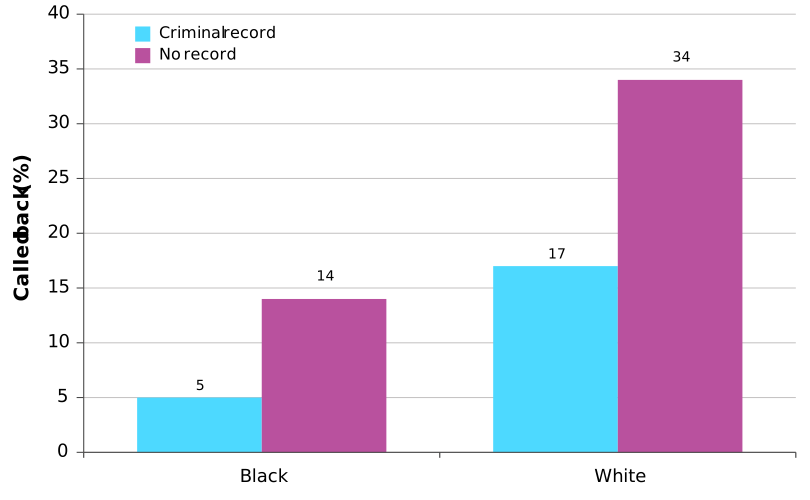
Figure E10.3 Audit study results from Milwaukee showing notable discrimination against Black applicants with a criminal record.
Devah Pager. 2008. Marked: Race, Crime, and Finding Work in an Era of Mass Incarceration. University of Chicago Press.
Labor market discrimination is not just about whether a person does or does not get a job, but also about what kind of job they are offered, how much they are paid, and how they are treated once they are employed. Another important finding from audit studies is that Black workers are more likely to be recruited into lower-paying work than they applied for, whereas the opposite is true for white workers.
Exercise E10.3 Designing a study to test for discrimination
Design a hypothetical audit study to measure discrimination in a market that’s interesting to you. In your description, address the following points:
- What type of discrimination are you attempting to measure?
- How would you make sure that the information that people receive about the group or category you’re studying is randomized in the study?
- How would you ensure that the information about that group or category is not communicating some other important information?
- What would you measure as outcomes?
Social norms and job choice: Men’s and women’s education and income
The most common form of categorical inequality around the world is that between men and women. This inequality cannot be due to inherent differences between the biological sexes. Other than having differing roles in reproduction, men and women are very similar: They have similar parents, go to similar schools (in most countries), have similar genetic inheritance on matters affecting cognitive skills, and so on. But people treat men and women differently in ways that affect their economic outcomes.
Income disparities between men and women among otherwise similar people are one measure of this inequality. Figure 10.9 shows the expected lifetime earnings (labor income) of men and women in the United States who work full-time from the time they leave school until retirement. Because this figure excludes workers who leave the labor force for any extended period of time, any differences in the figure cannot be due to women having more time out of the labor force (on average) because of childcare responsibilities.
Because the quality of schooling does not differ between men and women on average (and girls tend to do as well as boys on most tests), the gender differences in pay are not due to differences in cognitive ability or education. Yet, for every level of education, women can expect to earn, on average, less than men. However, Figure 10.9 also shows that additional schooling contributes to higher lifetime incomes, and that women who receive a bachelor’s degree can expect to earn more than men who ended their schooling after secondary school.
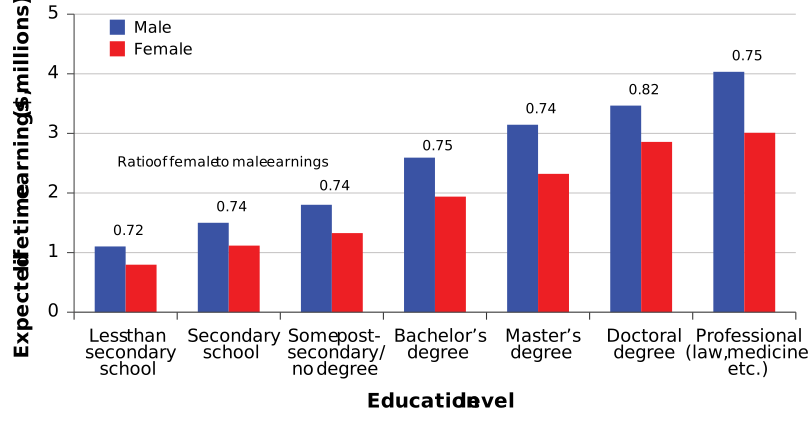
Figure 10.9 Group inequality: schooling and lifetime earnings for men and women in the United States according to data gathered from 2007 to 2009.
Adapted from Figure 5 in Anthony P. Carnevale, Stephen J. Rose, and Ban Cheah. 2011. The College Payoff. Georgetown University Center on Education and the Workforce. (Note: The average expected lifetime earnings for males is $2,520,286, while for females it is $1,909,714.)
Everyday Economics 10.18
This video discusses a study by the economists Leonardo Bursztyn, Thomas Fujiwara, and Amanda Pallais. The study found that unmarried women in MBA programs downplay their professional preferences and ambitions when they think this information might be shared with or noticed by their classmates, especially classmates who are unmarried men. The study provides evidence that, for unmarried women, there may be a trade-off between success in the labor market and success in the marriage market. Are these findings consistent with your experience or the experiences of people you know? Do you think this possible trade-off exists for all women or only for the type of women examined in this study? What, if any, institutional changes could weaken this potential trade-off?
Most of the observed gender inequality in income is due not to discrimination in the labor market, but rather to different choices in college majors and careers. Women are more likely to choose college majors and occupations that pay less than the careers chosen by men. For example, a study by the economists Vanessa Burbano, Nicolas Padilla, and Stephan Meier found that, on average, women have a stronger preference for work that they see as more meaningful, as opposed to work that merely pays well. Given that such choices and preferences are not the result of genetic differences between men and women, this outcome highlights the role of social norms in shaping the preferences of both men and women.
Occupational segregation: Vicious and virtuous circles of stereotypes and job choice
The interaction between social norms, preferences, and stereotypes can lead to a vicious circle that perpetuates gender inequality and other types of group inequality. Figure 10.10 illustrates how this cycle can unfold.
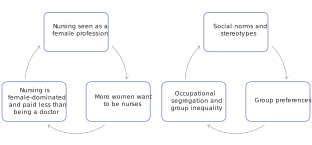
Figure 10.10 Vicious circle of social norms, preferences, and occupational segregation.

Nursing is seen as a female profession
More women want to be nurses
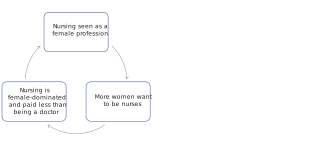
Nursing remains female dominated
Vicious circle of norms, preferences, and occupational segregation
Everyday Economics 10.19
As reported in this study, Katherine B. Coffman, Manuela R. Collis, and Leena Kulkarni ran a series of experiments to test whether men and women differ in their willingness to apply for higher-income, more challenging jobs. They found that, in jobs typically associated with men, women were less likely to apply than equally qualified men. However, they also found that making the required qualifications clearer on the job posting reduced the gender difference. Why do you think making the qualifications clearer reduces the gender difference? What can we learn from this experiment about how to change labor market institutions to help reduce gender inequality?
Institutions and rules of the game—for example, social norms about which type of work is “men’s work” and which is “women’s work”—are learned, often at a young age, by the members of a society. These norms become not simply externally imposed constraints but also the preferences and values of many people in the society. Norms, and their accompanying gender stereotypes, can lead people to misperceive their strengths and weaknesses if they don’t align with common stereotypes. Workers’ misperceptions of their own characteristics can lead them to avoid jobs for which they may be well suited.
- occupational segregation
- The uneven distribution of workers across jobs based on characteristics such as gender, race, or ethnicity. It includes both horizontal segregation (different groups in different types of jobs) and vertical segregation (some groups more likely to be in lower-paid or lower-status positions within the same field).
As men and women enter the labor market, they act on those preferences and stereotypes, which leads to group inequality and occupational segregation, which occurs when groups are over- or underrepresented in specific jobs or industries. Occupational segregation can be horizontal, which is when different groups are in different types of jobs, or vertical, which is when certain groups are more likely to be in lower-paid or lower-status positions within the same field. Group inequality and occupational segregation can then reinforce the social norms and stereotypes that led to them in the first place, leading to a vicious cycle.
In summary, the matching process, to the extent that it relies on the judgments of individuals in firms and preferences that are influenced by social norms, can create and perpetuate group inequality. The matching process in the labor market is therefore an illustration of the principle of individual and societal interests, because society would benefit from the weakening of discrimination and biased norms, as lower levels of discrimination and bias will lead to more people engaging in the work at which they’re most productive.
Data Extension 10.5b Has the extent of occupational segregation changed over time?
Figure E10.4 shows the share of women in 14 different occupations from 1995 to 2024. A few things in this figure are particularly noteworthy:
- The share of women who work as preschool teachers, kindergarten teachers, dental assistants, registered nurses, and librarians changed very little over this period.
- The share of women who work as pharmacists, physicians and surgeons, lawyers, and photographers significantly increased.
- Carpenters and civil engineers, both male-dominated occupations, saw relatively little change over this period.
- The share of men working as cashiers and computer programmers both increased by similar amounts over this period.

Figure E10.4 Women’s share of selected occupations, 1995–2024.
Data from the Current Population Survey produced by the US Census Bureau and the Bureau of Labor Statistics (Table 11).
In addition to occupational segregation by gender, the United States has occupational segregation by race, though it is much lower than occupational segregation by gender. However, the extent of racial occupational segregation has barely changed over the last 40 years.
When economists measure occupational segregation by gender in the whole economy, they find that it still exists, but on average it has decreased over the last 50 years. Since the year 2000, however, it has stayed approximately the same.
Labor market discrimination against women also remains a problem. But it is also true that men have been discriminated against when entering occupations heavily dominated by women, such as nursing or teaching young children.
The decrease in occupational segregation over this period contributed to a decrease in the earnings gap between men and women, as more women moved into higher-paid, male-dominated fields. However, occupational segregation remains an important cause of the earnings gap that we saw in Figure 10.9 because occupations dominated by women on average pay lower wages than occupations dominated by men.
One notable exception is pharmacists. Pharmacists make relatively high incomes, even when compared to workers with similar levels of education. And on an hourly basis, there is virtually no gender pay gap for pharmacists. In addition, the field employs an approximately equal number of men and women, as shown in Figure E10.5. This is quite remarkable given that in 1960 fewer than 10% of pharmacists were women. Between 1960 and 2010 that number increased to just over 50%, with an even higher percentage of those graduating from pharmacy programs being women.
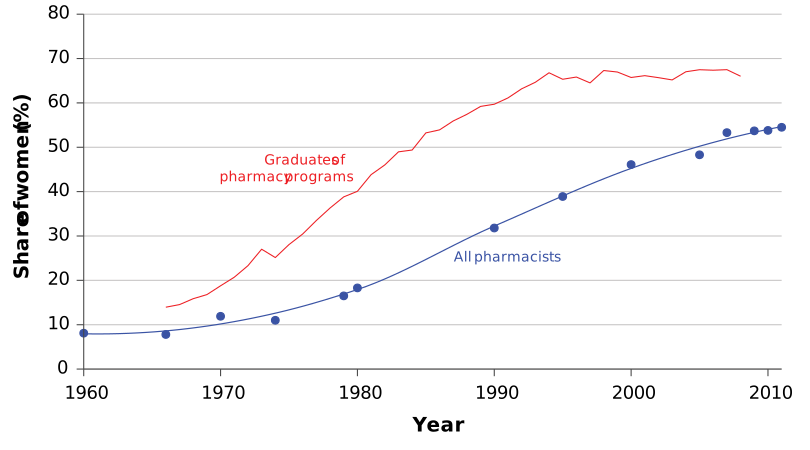
Figure E10.5 Women’s share of all pharmacists and graduates of pharmacy programs.
Claudia Goldin and Lawrence F. Katz. 2016. “A Most Egalitarian Profession: Pharmacy and the Evolution of a Family-Friendly Occupation.” Journal of Labor Economics 343: pp. 705–746.
The Nobel Prize–winning economist Claudia Goldin and the economist Lawrence Katz describe a few key reasons why the pharmacy profession became so equitable. One is that technological changes made the pharmacist’s job more standardized, which made it easier to quickly substitute one pharmacist for another during a shift. As a result, hours and shifts became more flexible because pharmacies needed a trained pharmacist, not a particular pharmacist.
This video from Vox discusses the gender pay gap, including a discussion of the role of flexible hours and pharmacies.
The pay structure of the profession also shifted. In the past, working more hours usually meant a higher hourly wage—a link that holds true today in certain professions, such as lawyers. Today, though, a pharmacist’s hourly wage is the same regardless of when they work or how many hours they work. This wage equity allows for much more flexibility in hours and shifts because there is no wage penalty to working fewer hours. This situation especially benefits women, who continue to take on more of the unpaid care work in families and therefore value job flexibility more.
Although the changes in the pharmacy industry were primarily due to technology and market forces, making similar changes in other industries might require social movements, changed norms, or other strategies for eliminating or reducing gender pay disparities and occupational segregation.
Exercise E10.4 Exploring racial and gender-based occupational segregation
Read this article from The New York Times about racial occupation segregation. The article summarizes research done by the economists Ashley Jardina, Peter Q. Blair, Justin Heck, and Papia Debroy.
- What are the main findings of the research?
- Based on our discussion in this Data Extension and in the chapter, what are some similarities between occupational segregation by gender and occupational segregation by race? What are some differences?
- What is the dissimilarity index? Is it a useful measure of occupational segregation?
- Look at the graphs in this post from the Washington Center for Equitable Growth. What do they suggest about the overlap between occupational segregation by gender and race?
Question 10.7
Which of the situations described below qualify as an example of labor market discrimination? Choose all that apply.
- This is not discrimination, as the decision was based on qualifications and experience relevant to the job.
- This is labor market discrimination because the candidate is rejected based on an accent, which is unrelated to ability or productivity.
- While this is an example of how social networks can create inequality, it is not direct discrimination against the individual by the employer.
- This is gender discrimination. The woman is denied a promotion based on assumptions about her future behavior as a mother, not her performance or qualifications.
Question 10.8
Which of the following factors contribute to income disparities between men and women? Choose all that apply.
- Differences in college major choices lead to different career paths and income levels. Studies show that women are more likely to choose college majors and occupations that currently pay less than those men choose.
- The textbook notes that there is no evidence that differences in cognitive ability explain the pay gap.
- Social norms and stereotypes about what kinds of work are appropriate for each gender influence job choices and contribute to occupational segregation.
- Discrimination in pay and promotions is another factor driving income disparities.
Exercise 10.8 Tracking gender trends in college majors
- Using this table of degrees granted in the 2021–2022 school year, look up the subject you plan to major in. What is the ratio of men to women who graduated with a bachelor’s degree in your major?
- Now, using this table, look at the data for your major from the 1991–1992 academic year. What was the ratio of men to women in your major then?
- How did the ratio in your major change between 1991–1992 and 2021–2022? What might have caused the change?
Exercise 10.9 Discrimination and feedback loops: Vicious vs virtuous cycles
Draw a figure similar to Figure 10.10 modeling how discrimination disproportionately targeted at certain groups or categories of people can become a feedback cycle. Your figure should have a vicious circle for those being discriminated against, and a virtuous circle for the groups or categories who experience positive discrimination, which means they are given preferential treatment.

