5.5 The ultimatum game: Dividing a pie (or leaving it on the table)
One way to understand the different preferences people might have is to use an experiment like the ultimatum game.
- ultimatum game
- A game in which the first player proposes a division of a “pie” with the second player, who may either accept the offer, in which case each player gets the division proposed by the first person, or reject the offer, in which case both players receive nothing.
The ultimatum game is based on a thought experiment: If you and another person find a $100 bill on the street, splitting the money has potential benefits for both of you. But how you share the benefits, and the rules for doing so, are affected by your preferences, by who has power in the interaction, and by institutions. In this section we outline how the game works, and in the next section we explore how real people actually play the game.
The ultimatum game is a two-person, one-shot, take-it-or-leave-it game. It has been used around the world with students, farmers, warehouse workers, and hunter-gatherers.
Participants in the ultimatum game can get an amount of money, depending on how they and other participants play. Real money is at stake to ensure that their decisions reflect real life. The experiment is explained to the players, who are randomly matched in pairs. One is randomly assigned as the Proposer, and the other as the Responder. They do not know each other, but they know that all players were recruited in the same way. Players remain anonymous.
The point of the experiment is to observe how the players will decide to share an amount of money—say $100—which we call the “pie.”
The rules of the game
- The Proposer is provisionally given $100.
- The Proposer decides how much money, y, to offer to the Responder; y can be anything from $0 to $100.
- The Responder chooses one of two actions: Accept or Reject the offer.
- If the Responder Rejects the offer, both players get nothing.
- If the Responder Accepts, then the Responder receives y and the Proposer gets $100 – y.
Suppose the Proposer offers $40 while keeping $60. This is a take-it-or-leave-it offer: The Responder either accepts $40 or gets nothing. If the Responder Accepts, then both players receive a rent (a slice of the pie) because their next-best alternative is to get nothing (not playing the game). But remember, a crucial rule of the game is that if the Responder Rejects, both get nothing.
- economic rent
- Economic rent is the difference between the net benefit (monetary or otherwise) that an individual receives from a chosen action, and the net benefit from the next-best alternative (or reservation option).
Tying the experiment to ideas we introduced in Chapter 1, any accepted positive offer leaves both players better off than no deal. In economics, the benefit someone receives above their next-best alternative is called economic rent. Here, the Responder’s outside option is zero—the game pays nothing if they reject—so any accepted offer is pure economic rent for the Responder. Similarly, whatever the Proposer keeps is their economic rent from the interaction. The total pie to be divided is, in this sense, the combined potential economic rent for both players.
Understanding this, the choice the Responder makes depends on their preferences: Do they care only about the payoffs they receive, or do they care about fairness and/or have other social preferences?
A Responder who cares only about their own payoffs
The fallback option for the Responder is to play Reject and receive a payoff of 0. If a Responder cares only about their own payoff, then any payoff that is greater than zero is better than their fallback offer. We call a person who cares only about their own payoff “economic man.”
A Responder with social preferences
Some people have social preferences, caring about inequality between players, reciprocity, and/or social norms. How will a person with these preferences play the ultimatum game? A person who has social preferences will do the best they can by comparing outcomes and choosing the outcome that they consider to be consistent with the goals they care about given their social preferences. Specifically, someone concerned about fairness might be doing the best they can by rejecting an offer that, if accepted, would result in an outcome they consider unfair.
For example, when the Proposer offers $20 to a Responder who dislikes being treated unfairly (in their eyes), that Responder might play Reject and get $0 rather than get what they consider to be an unfair amount of $20. If the Proposer offers $50, which the Responder perceives as fair, then the Responder will Accept that offer.
Even if the Proposer does not care about fairness, if they know that they are playing with someone who cares about fairness, then they will not make a very low offer because it will be rejected. The Proposer needs to anticipate what a Responder who cares about fairness will accept.
Suppose the Proposer believes that a fair-minded Responder will reject an offer of $20 but accept a higher offer. Even if the Proposer cares only about their own payoffs, they will try to work out how much is just enough to get the Responder who cares about fairness to accept their offer. For some fair-minded Responders, any offer lower than $50 would be unacceptable, and they will reject it. They want an exact 50-50 split. Other Responders might think that, although it’s not ideal for them, a 60-40 split where the Proposer offers them $40 is acceptable. For yet other Responders, a 70-30 split may be considered far from ideal (they would make a 50-50 offer if they were the Proposer), but they consider it acceptable. The challenge for the Proposer is to figure out what kind of Responder they’re paired with and what they consider acceptable.

Figure 5.6 Ultimatum game offers with corresponding slices of a pie for the same proportion of the offer and the corresponding Gini coefficients when the pie can be shared between two people. We assume that the Responder accepts the offer (even the offer of $0).
As Figure 5.6 shows, the size of the slice of the pie that each player gets in the ultimatum game corresponds to a particular level of the Gini coefficient (explained in Section 5.2). With a 50-50 offer, there is no inequality, and the Gini coefficient equals zero. With smaller offers, the Gini coefficient increases. When someone cares about fairness, they may care about a measure of inequality like the Gini coefficient as a measurement of the fairness of outcomes in society.
Extension 5.5a Using a game tree to understand the ultimatum game
Simplified example
- game tree
- A game tree shows the players, the actions, the sequence of moves, and the payoffs resulting from each possible pathway through the game that results from the actions the players take.
- interdependence principle, principle of interdependence
- The outcomes people obtain in economic interactions depend on the actions that they and others take in response to each other and on what they believe about the future.
Suppose the Proposer has only two choices: a “fair offer” ($50) or an “unfair offer” ($20). We can represent this game using the game tree in Figure E5.7, which shows the payoffs at the bottom of the tree. Game trees allow us to see how people with interdependent outcomes make choices in sequential games. Work through the steps to see how the game tree is constructed.
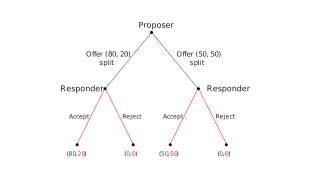
Figure E5.7 Game tree for a simplified ultimatum game. The Proposer’s payoff is listed before the comma in blue, and the Responder’s payoff is listed after the comma in red.
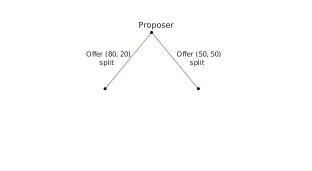
The Proposer can offer to split (80,20) or (50,50)
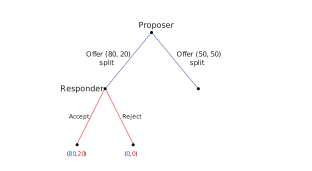
The Responder’s choices when the Proposer offers a split of (80,20)
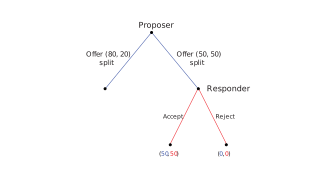
The Responder’s choices when the Proposer offers a split of (50,50)
The complete game tree
This game is sequential, like the interaction between Bunker and the Worker. In Figure E5.7, the Proposer moves first and the Responder moves second.
- the principle of doing the best you can
- Doing the best you can means that, from the set of actions available to them, people will choose the action that they believe will result in the outcome that they value the most, taking into account what they believe the other player will do in response to their choice.
To predict the outcome and what people do when they do the best they can, first consider what the Responder does when they do the best they can. Put yourself in the place of the Responder. Would you accept a 50-50 split? Would you accept an 80-20 split (the Proposer offers you $20 and keeps $80)? Or would you reject an 80-20 split, sacrificing your payoff to punish the Proposer for offering less than $50? Now switch roles. If you were the Proposer, what would you offer the Responder?
The choice the Responder makes depends on their preferences: Do they care only about the payoffs they receive, or do they have social preferences?
A Responder who cares only about their own payoffs
The fallback option for the Responder is to play Reject and receive a payoff of 0. If a Responder cares only about their own payoff, then any payoff that is greater than zero is better than their fallback offer. When a Responder cares only about their own payoffs and is not concerned with equality or fairness, then they do the best they can by achieving any possible positive payoff. As noted earlier, we call a person who cares only about their own payoff a Homo economicus or “economic man.”
In terms of Figure E5.7, a Homo economicus will accept an offer of $20 when the Proposer offers $20 and accept an offer of $50 when the Proposer offers $50. Knowing that the Responder is a Homo economicus, the Proposer will choose to keep $80 and therefore make an offer of $20, which they know the Responder as a Homo economicus will accept.
A Responder with social preferences
Some people have social preferences, caring about inequality between players, reciprocity, and/or social norms. How will a person with these preferences play the ultimatum game? A person who has social preferences will do the best they can by comparing outcomes and choosing the outcome that they consider to be consistent with the goals they care about given their social preferences. Specifically, someone concerned about inequality may act to rectify that inequality by rejecting an offer that results in a very unequal outcome, thereby producing an equal outcome (both players get nothing). For example, when the Proposer offers $20 to a Responder who dislikes inequality, that Responder might play Reject and get $0 rather than get what they consider to be an unequal offer of $20. If the Proposer offers $50, then the Responder who cares about inequality will Accept that offer, which they perceive as fair.
If the Proposer knows that they are playing with someone who cares about inequality, then they will offer $50 knowing that a fair-minded person will reject the offer of $20 and both players will receive $0 if the Proposer makes that offer. Comparing the possible outcomes of $0 and $50, the Proposer makes an offer of $50.
Exercise 5.6 Social preferences in the ultimatum game
Consider the theoretical predictions of the ultimatum game as described in this section. Explain how inequality aversion, reciprocity, and social norms could motivate Responders’ willingness to reject low offers, even though they receive nothing at all when they choose to reject such offers.
Exercise 5.7 Economics rents and fallback options in the ultimatum game
In the ultimatum game, the Proposer offers $40 to the Responder and keeps $60 for themselves. The Responder’s outside option (what they receive if they reject) is $0, and the Proposer’s outside option is also $0 if the offer is rejected.
- What is the economic rent earned by the Responder if they accept the offer? What is the economic rent earned by the Proposer?
- Is the resulting allocation ($60,$40) efficient (assuming that both players are self-interested)? Explain.
- If a Responder with social preferences rejects the $40 offer, are they acting efficiently? What does the rejection tell us about whether Responders care only about their own economic rent?
Question 5.8
Which of the following outcomes can occur in the ultimatum game when the Responder is fair-minded? Choose all that apply.
- A fair-minded Responder will accept an equal offer.
- A fair-minded Responder is likely to reject highly unequal splits.
- The Responder may reject an 80-20 split to punish unfairness.
- Accepting any positive offer describes a self-interested Responder.

