11.5 The labor discipline model: A best-response equilibrium between workers and employers

Even though workers want to be paid as high a wage as possible for as little effort as possible, and employers want to pay workers as low a wage as possible for as much effort as possible, employers and workers come to agreements that involve long-standing contracts between them where both are sufficiently happy that neither wants to leave the contract, as we saw in Figure 10.4.

labor discipline model
Employers face a labor discipline problem when they need to give workers an incentive to ensure that they work hard and well. In the labor discipline model, they do this by setting wages that include an economic rent (employment rent), which will be lost if the job is terminated.
strategic interaction
A strategic interaction is an interaction in which each actor knows that what they get from the interaction depends on what they do and on what other people do, including how others respond to each person’s action.

The labor discipline model helps us to explain why this is true. It also helps us to answer the following questions: Why do many employers in the fast food industry choose to pay their workers more than the minimum wage? Why do employers spend so much money to track and monitor their workers? Why are some workers paid more than others in the same industry? To answer these questions and develop the labor discipline model, we revisit the example of the Mexican restaurant from Chapter 10.

Chef working in a kitchen.
Fullscreen

Chef working in a kitchen.

Imagine you and your friend are preparing for the opening of your restaurant. Before the restaurant opens, you have to hire a chef. You and your friend decide that a chef named Celia is the best match for a position. Now you and Celia have decisions to make.

If you and your partner do not make Celia a profit claimant, you have to decide what wage to offer her as a worker. Celia then must choose how hard to work in response to your wage offer. This is a strategic interaction, meaning the outcomes for Celia and you and your partner are interdependent.

A game between firms and workers

Let’s assume Celia accepts the job. We can then model the principal–agent relationship between you and Celia as a game like the one described in Section 11.3. You and your partner act as the principal; Celia is the agent. We call this game the labor discipline model.

To simplify our model, we will assume that you and your partner control three features of the interaction, all of which are communicated to Celia: 1) the wage, 2) the effort you require, and 3) the level of monitoring. The higher the level of monitoring, the more likely you are to catch her if she is not providing the effort you require (but monitoring Celia is costly). If you believe Celia is exerting less than the required level of effort, you will fire her.

shirking
Occurs when a worker does not exert the effort that the employer demands.

We also assume Celia has only two choices when it comes to her effort: working and shirking. If she works, she puts in the effort required by you and your partner. If she shirks, she does not work as hard as you asked her to. If she gets caught shirking, she will get fired. The likelihood of her getting caught depends on the level of monitoring.

How is the game played?

This is a sequential game. The employer goes first, and Celia, the worker, goes second. The steps of the game proceed as follows:

  1. You and your partner announce a wage, a required level of effort, and a level of monitoring.
  2. In response, Celia decides either to work or to shirk.
  3. If Celia works, she will receive the wage and will have to pay the personal cost of working at the required effort.
  4. If Celia shirks, two things may happen. If she is not caught shirking, then she receives the wage without paying the personal cost of working. If she is caught shirking, then she will be fired and receive her outside option. Whether she is caught shirking is determined partially by the level of monitoring in which the employer has invested and partially by luck.

As with other sequential games, we can draw this game as a game tree, shown in Figure 11.4.
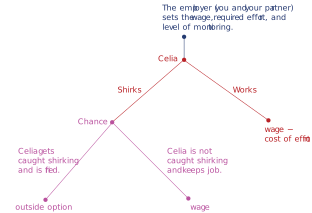
This diagram displays a game tree of the payoffs to Celia’s choice to work or shirk. It begins with the employer setting the wage, required effort and level of monitoring. Celia can then choose to shirk and work. If she chooses to work, her payoff would be her wage minus her cost of effort. If she chooses to shirt, it is up to Chance. She could be caught shirking and get fired. Her payoff then would depend on her outside option. Alternatively, she could not get caught. In that case, her payoff would be her wage.
Fullscreen
https://books.core-econ.org/uoe-101/11-05.html#figure-11-4

Figure 11.4 Game tree of the payoffs to Celia’s choice to work or shirk. Her outcomes for shirking depend on the chance of her employer catching her shirking.
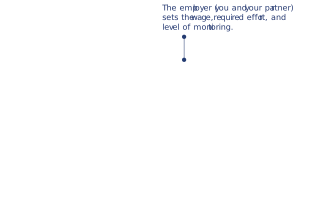
You and your partner move first by setting the wage, required effort, and level of monitoring: This diagram displays a game tree of the payoffs to Celia’s choice to work or shirk. It begins with the employer setting the wage, required effort and level of monitoring.
Fullscreen
https://books.core-econ.org/uoe-101/11-05.html#figure-11-4a

You and your partner move first by setting the wage, required effort, and level of monitoring
Because this is a sequential game, someone has to move first. In this case, it is the employer (you and your partner) who always moves first. You and your partner set a wage, and you communicate to Celia the effort that will be required to keep the job and the level and type of monitoring to which she will be subjected.

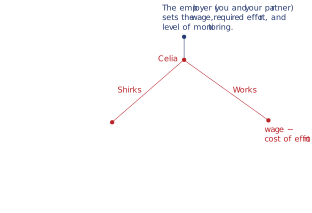
Celia chooses to either work or shirk: This diagram displays a game tree of the payoffs to Celia’s choice to work or shirk. It begins with the employer setting the wage, required eddort and level of monitoring. Celia can then choose to shirk and work. If she chooses to work, her payoff would be her wage minus her cost of effort.
Fullscreen
https://books.core-econ.org/uoe-101/11-05.html#figure-11-4b

Celia chooses to either work or shirk
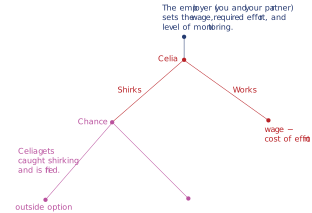
In response to the wage, required effort, and level of monitoring set by you and your partner, Celia has to choose her level of effort. We are simplifying by assuming she has only two options: work or shirk. If she works, she puts in the required level of effort and her outcome is her wage minus her cost of effort (personal cost of working). If she shirks, there are a few possible outcomes.

Celia gets caught shirking: This diagram displays a game tree of the payoffs to Celia’s choice to work or shirk. It begins with the employer setting the wage, required effort and level of monitoring. Celia can then choose to shirk and work. If she chooses to work, her payoff would be her wage minus her cost of effort. If she chooses to shirt, it is up to Chance. She could be caught shirking and get fired. Her payoff then would depend on her outside option.
Fullscreen
https://books.core-econ.org/uoe-101/11-05.html#figure-11-4c

Celia gets caught shirking

What happens if Celia shirks depends on two things: luck and the level of monitoring. The higher the level of monitoring, the more likely she will be caught shirking. But perfect monitoring is impossible, so there will always be some chance she will shirk and not get caught. If Celia decides to shirk and is caught, she will get fired. In that case, her outcome is the value of her outside option.

Celia shirks but keeps her job: This diagram displays a game tree of the payoffs to Celia’s choice to work or shirk. It begins with the employer setting the wage, required effort and level of monitoring. Celia can then choose to shirk and work. If she chooses to work, her payoff would be her wage minus her cost of effort. If she chooses to shirt, it is up to Chance. She could be caught shirking and get fired. Her payoff then would depend on her outside option. Alternatively, she could not get caught. In that case, her payoff would be her wage.
Fullscreen
https://books.core-econ.org/uoe-101/11-05.html#figure-11-4d

Celia shirks but keeps her job

If Celia decides to shirk, she may get lucky and not get caught. That is the best outcome for her, as her outcome is only the value of the wage (she does not have to subtract her personal cost of work). You and your partner thus need to offer a wage high enough to make the risk of getting caught not worth it. That is, you need to make Celia’s best response working, not shirking.

The best outcome for Celia in this game is to shirk and not get caught. In that case, she receives the wage without having to subtract her personal cost of working. For you and your partner, the best outcome is that Celia chooses to work. You and your partner then have two ways to incentivize her to work:

  1. Monitoring: Increasing the extent to which you monitor Celia’s work will reduce her likelihood of shirking, as she does not want to get caught and lose her job.
  2. Employment rent: The bigger the employment rent, the less likely Celia is to risk losing her job due to shirking, and the more effort she will exert. You can increase her employment rent either by raising her wage or reducing her personal cost of working.

The best-response equilibrium and the no-shirking wage

best response
Given an action by another person, the action selected by doing the best you can is called the best response to the other’s action.
no-shirking wage
The wage that is just sufficient to motivate a worker to provide effort at the level specified by their employer.
incentive-compatibility constraint
The incentive-compatibility constraint (ICC) describes the limits on the outcomes that a first mover in a sequential game may achieve by showing how a second mover will respond to each of the choices that the first mover might make.

The best-response equilibrium of this game is for you and your partner to offer Celia her no-shirking wage and for Celia to choose to work and not shirk. The no-shirking wage is the lowest wage at which Celia will always choose to work instead of shirking. It is the wage where the employment rent is just high enough for the risk of getting caught shirking to no longer be worth losing the job, making working her best response to the wage offered. The no-shirking wage is therefore also the incentive compatibility constraint, as you know that offering her a wage any lower would result in her shirking.

Everyday Economics 11.8

This article from the satirical newspaper The Onion highlights the basic goal for many workers in this game, which is to determine the minimum amount of effort required so as not to be considered shirking by their boss or employer. In thinking about jobs you’ve had, did you do the same thing?

Fullscreen

Offering the no-shirking wage is also the best response for you and your partner, because you are paying Celia the lowest amount that will still motivate her to work at the effort you require. If you raise the wage any higher, your profits will decrease.

In our model, Celia’s no-shirking wage depends on two things: 1) the net benefit of her outside option, and 2) her personal cost of working.

reservation wage
The reservation wage is the lowest wage a worker is willing to accept to take up a new job. It is the wage available in the worker’s next-best job option (the outside option). For workers whose next-best option is unemployment, the reservation wage takes into account the wages they expect to receive when they find a new job as well as any income received while unemployed.
participation constraint
Each member of an interaction must receive at least their outside option in order to participate in the interaction.

At the absolute minimum, you cannot pay her less than the net benefit of her outside option, which is also known as Celia’s reservation wage. It is the absolute minimum she will accept for a job.

However, if you pay Celia a wage just above her reservation wage, she will shirk because the personal cost of working decreases the net benefit of the job. If her wage does not compensate for that cost, she will be worse off than if she had remained unemployed. Her best response in that case is to take the job and shirk.

Knowing this, you and your partner offer a wage that is equal to the value of her outside option plus her personal cost of working. This wage is her participation constraint, or the absolute minimum she requires in order to take the job and put in any effort at all. If the employment contract were complete, and you could perfectly and costlessly monitor Celia’s effort, her participation constraint wage would be sufficient to motivate her to work instead of shirk.

Because effort cannot be part of an employment contract, and because you cannot perfectly monitor her effort, Celia’s best response at the participation constraint wage is still to shirk. At that wage, she’s no better off than she would be if she lost her job. So long as there is some chance she could shirk and keep the job (such a chance always exists), shirking remains her best response.

This clip from the 1999 comedy Office Space illustrates the dilemma facing workers as a result of their not being profit claimants. In the clip, Peter, the main character, explains to the two consultants interviewing him why he shirks. He points out that, even if he works hard and the firm “ships a few extra units,” his pay will not go up at all. He is unmotivated to work hard because he does not have a direct incentive to do so. He wants to work just hard enough to avoid being fired and not to be hassled by his bosses.

You therefore need to give Celia further incentives to work instead of shirking—by itself, the participation constraint is not enough to discourage shirking. In other words, for you and your partner, doing the best you can means offering Celia a wage equal to her outside option plus her personal cost of working plus a large enough employment rent to ensure that working is preferred not only to her outside option, but also to taking the job and shirking.

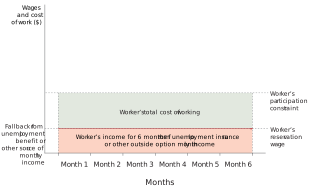
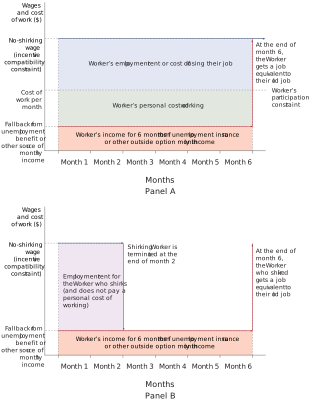
Figure 11.5 models this scenario for a typical worker and employer. At the bottom of panel (A) in red is the net benefit of the worker’s outside option. Above that, in green, is their personal cost of work, which they must be compensated for if they are going to exert any effort at all. The wage equal to the outside option plus the personal cost of working is the worker’s participation constraint. Because effort increases with employment rent, the employer needs to adjust wages accordingly until the effort is where they need it. Whatever wage leads to the required effort is the no-shirking wage, which is the incentive compatibility constraint.
What determines the no-shirking wage?
Fullscreen
https://books.core-econ.org/uoe-101/11-05.html#figure-11-5

Figure 11.5 What determines the no-shirking wage?

What determines the no-shirking wage?: Panel A: In this diagram, the horizontal axis displays months from Month 1 to Month 6. The vertical axis displays Bob’s wage when he kept his job at the steel mill for 50,000 USD per year. There is a horizontal line across the chart representing Bobs no shirking wage. Below this line representing Bobs cost of work. Below this line is a horizontal line representing Bobs fallback when he ended up fired and used unemployment benefits for 6 months. The area under the line is his income for 6 months from unemployment insurance. The area under the line is his income for 6 months from unemployment insurance. The area between his cost of work and fallback wage represents his total cost of working and the area between his no shirking wage and cost of work per month is his employment rent. Panel B: In this diagram, the horizontal axis displays months from Month 1 and Month 6. The vertical axis displays workers’ wages and cost of work in dollars. On the graph, there is a horizontal line representing the workers fallback wage from unemployment benefits. The area below this line is a worker’s income for 6 months from unemployment insurance. Above this line is a horizontal line representing the workers no shirking wage. If the shirking worker is terminated at the end of month 2, the employment rent is the area between the workers no shirking wage and fallback wage till month 2. At the end of month 6, Worker who shirked gets an equivalent job to their old job.
Fullscreen
https://books.core-econ.org/uoe-101/11-05.html#figure-11-5

What determines the no-shirking wage?

For a given unemployment rate, a given level of unemployment benefits, and a given chance of getting fired, the employer needs to offer the worker a wage that satisfies the worker’s incentive compatibility constraint—that is, the no-shirking wage. Because this wage is greater than the worker’s participation constraint, the worker receives a rent—specifically, their employment rent (or cost of losing the job).
Panel (A): The net benefits or employment rent for a worker who does not shirk.
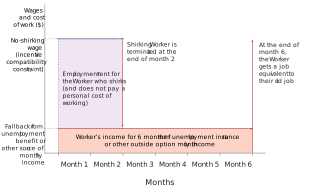
Panel (B): The net benefits or employment rent for a worker who shirks.

The worker’s reservation wage and participation constraint: In this diagram, the horizontal axis displays months from Month 1 and Month 6. The vertical axis displays workers’ wages and cost of work in dollars. On the graph, there is a horizontal line representing the workers fallback wage from unemployment benefits. This is his reservation wage. The area below this line is a worker’s income for 6 months from unemployment insurance. Above this line is a horizontal line representing the cost of work per month. This is his participation constraint. The area between the lines represents the Workers total income for 6 months from unemployment insurance.
Fullscreen
https://books.core-econ.org/uoe-101/11-05.html#figure-11-5a

The worker’s reservation wage and participation constraint
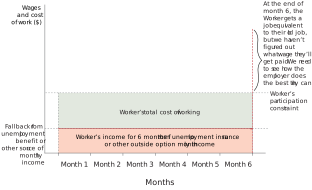
The worker’s reservation wage, which is equal to the value of their fallback option, is the least they will accept to take a job. The worker’s participation constraint to accept a job from the employer (principal) and put in any effort at all corresponds to the value of their outside option plus the cost of working. If the employment contract were complete and the employer could costlessly monitor the worker’s effort, the employer would offer a wage just a tiny bit more than the participation constraint to get the worker to work, similar to the interaction between the worker and Bunker in Chapters 1 and 2.

If the worker is fired, they return to work after a given period: In this diagram, the horizontal axis displays months from Month 1 and Month 6. The vertical axis displays workers’ wages and cost of work in dollars. On the graph, there is a horizontal line representing the workers fallback wage from unemployment benefits. This is his reservation wage. The area below this line is a worker’s income for 6 months from unemployment insurance. Above this line is a horizontal line representing the cost of work per month. This is his participation constraint. The area between the lines represents the Workers total income for 6 months from unemployment insurance.
Fullscreen
https://books.core-econ.org/uoe-101/11-05.html#figure-11-5b

If the worker is fired, they return to work after a given period
We assume that if the worker is fired, the worker will find another job depending on the going unemployment rate, which we assume here means they will find a job within six months. We have not established what wage the employer will offer them after they find a job, but we keep in mind that the worker is likely to find a job in a given amount of time after they are fired.

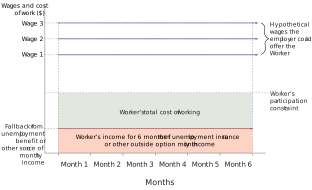
Potential wages the employer could offer the worker: In this diagram, the horizontal axis displays months from Month 1 and Month 6. The vertical axis displays workers’ wages and cost of work in dollars. On the graph, there is a horizontal line representing the workers fallback wage from unemployment benefits. This is his reservation wage. The area below this line is a worker’s income for 6 months from unemployment insurance. Above this line is a horizontal line representing the cost of work per month. This is his participation constraint. The area between the lines represents the Workers total income for 6 months from unemployment insurance. Above these are 3 horizontal wage lines- Wage 1, Wage 2, Wage 3. These are hypothetical wages the employer could offer the worker.
Fullscreen
https://books.core-econ.org/uoe-101/11-05.html#figure-11-5c

Potential wages the employer could offer the worker
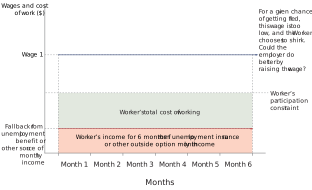
The employer (principal) needs to offer the worker (agent) a wage that is higher than the participation constraint in order to elicit effort from the worker such that the worker will work rather than shirk. We consider in the next steps three hypothetical wages from lowest to highest: wage 1, wage 2, and wage 3.

The employer offers wage 1, a low wage: In this diagram, the horizontal axis displays months from Month 1 and Month 6. The vertical axis displays workers’ wages and cost of work in dollars. On the graph, there is a horizontal line representing the workers fallback wage from unemployment benefits. This is his reservation wage. The area below this line is a worker’s income for 6 months from unemployment insurance. Above this line is a horizontal line representing the cost of work per month. This is his participation constraint. The area between the lines represents the Workers total income for 6 months from unemployment insurance. Above these are 3 horizontal wage lines- Wage 1, Wage 2, Wage 3. Wage 1 is too low, so the worker decides to shirk.
Fullscreen
https://books.core-econ.org/uoe-101/11-05.html#figure-11-5d

The employer offers wage 1, a low wage
The first wage, wage 1, is somewhat low. Given the unemployment rate, the chance of getting fired, the cost of work, and the worker’s other opportunities, wage 1 is not high enough to incentivize the worker to exert effort. Instead, the worker shirks at wage 1. Because the contract is incomplete, the employer cannot immediately determine that the worker didn’t work (managers don’t immediately figure out which workers aren’t working as hard as others, for example), and the worker may continue getting paid while the employer incurs the cost of paying them. The employer would do better by paying a higher wage and incentivizing the worker to work.

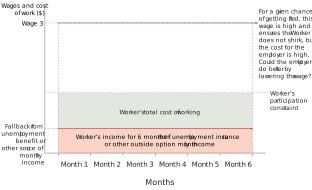
The employer offers wage 3, a high wage: In this diagram, the horizontal axis displays months from Month 1 and Month 6. The vertical axis displays workers’ wages and cost of work in dollars. On the graph, there is a horizontal line representing the workers fallback wage from unemployment benefits. This is his reservation wage. The area below this line is a worker’s income for 6 months from unemployment insurance. Above this line is a horizontal line representing the cost of work per month. This is his participation constraint. The area between the lines represents the Workers total income for 6 months from unemployment insurance. Above these are 3 horizontal wage lines- Wage 1, Wage 2, Wage 3. Wage 3 is the highest wage. At this wage the worker chooses to work but the cost of the employer is too high.
Fullscreen
https://books.core-econ.org/uoe-101/11-05.html#figure-11-5e

The employer offers wage 3, a high wage
The third wage, wage 3, is somewhat high. Given the unemployment rate, the chance of getting fired, the cost of work, and the worker’s other opportunities, the wage is more than high enough to incentivize the worker to exert effort. The worker exerts the effort the employer requires and will not be terminated. Because the wage is high, though, the employer incurs costs greater than the benefits they get from the worker. Could the employer do better by lowering the wage?

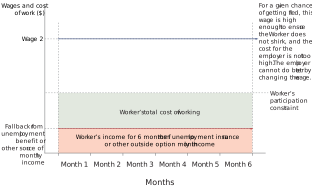
The employer offers wage 2, which is just enough to get the worker to work: In this diagram, the horizontal axis displays months from Month 1 and Month 6. The vertical axis displays workers’ wages and cost of work in dollars. On the graph, there is a horizontal line representing the workers fallback wage from unemployment benefits. This is his reservation wage. The area below this line is a worker’s income for 6 months from unemployment insurance. Above this line is a horizontal line representing the cost of work per month. This is his participation constraint. The area between the lines represents the Workers total income for 6 months from unemployment insurance. Above these are 3 horizontal wage lines- Wage 1, Wage 2, Wage 3. Between Wage 1 and 3, is wage 2. This wage is high enough for the worker to not shirk and the cost is not too high for the employer.
Fullscreen
https://books.core-econ.org/uoe-101/11-05.html#figure-11-5f

The employer offers wage 2, which is just enough to get the worker to work
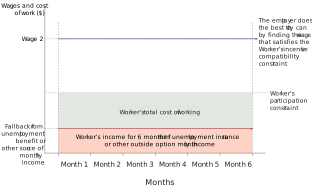
The second wage, wage 2, is somewhat higher than wage 1, which was too low and at which the worker shirked, and lower than wage 3, at which the worker worked, but which was costly for the employer. Given the unemployment rate, the chance of getting fired, the cost of work, and the worker’s other opportunities, wage 2 is just enough to incentivize the worker to exert effort. The worker exerts the effort the employer requires and will not be terminated. The employer cannot do better by either raising or lowering the wage. If the employer raises the wage, it increases costs without getting more effort. If it lowers the wage, it doesn’t get enough effort while incurring the costs of paying shirking workers. Wage 2 is the wage at which the employer does the best it can.

The employer satisfies the worker’s incentive compatibility constraint: In this diagram, the horizontal axis displays months from Month 1 and Month 6. The vertical axis displays workers’ wages and cost of work in dollars. On the graph, there is a horizontal line representing the workers fallback wage from unemployment benefits. This is his reservation wage. The area below this line is a worker’s income for 6 months from unemployment insurance. Above this line is a horizontal line representing the cost of work per month. This is his participation constraint. The area between the lines represents the Workers total income for 6 months from unemployment insurance. Above these are 3 horizontal wage lines- Wage 1, Wage 2, Wage 3. Between Wage 1 and 3, is wage 2. This wage is high enough for the worker to not shirk and the cost is not too high for the employer. This wage is known as the workers incentive compatibility constraint.
Fullscreen
https://books.core-econ.org/uoe-101/11-05.html#figure-11-5g

The employer satisfies the worker’s incentive compatibility constraint
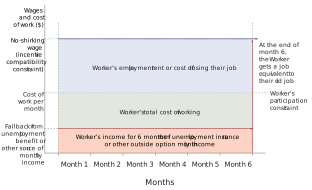
By experimenting with different wages, the employer found the wage that satisfies the worker’s incentive compatibility constraint: the wage that is just enough for the worker to prefer working given the chance they’ll be fired, the unemployment rate, the cost of work, and the size of their outside option.

A worker with a job earns an employment rent at the no-shirking wage: In this diagram, the horizontal axis displays months from Month 1 and Month 6. The vertical axis displays workers’ wages and cost of work in dollars. On the graph, there is a horizontal line representing the workers fallback wage from unemployment benefits. This is his reservation wage. The area below this line is a worker’s income for 6 months from unemployment insurance. Above this line is a horizontal line representing the cost of work per month. This is his participation constraint. The area between the lines represents the Workers total income for 6 months from unemployment insurance. The area between the workers no shirking wage and cost of work is his employment rent.
Fullscreen
https://books.core-econ.org/uoe-101/11-05.html#figure-11-5h

A worker with a job earns an employment rent at the no-shirking wage
The no-shirking wage is greater than the worker’s participation constraint and therefore the worker earns an economic rent: their employment rent. The employment rent also gives the employer power over the worker: the worker does not want to lose the employment rent and therefore gives the employer authority over them and obeys the employer’s commands while they are working (and exerting the no-shirking level of effort).

The employment rent for a worker who shirks: In this diagram, the horizontal axis displays months from Month 1 and Month 6. The vertical axis displays workers’ wages and cost of work in dollars. On the graph, there is a horizontal line representing the workers fallback wage from unemployment benefits. The area below this line is a worker’s income for 6 months from unemployment insurance. Above this line is a horizontal line representing the workers no shirking wage. If the shirking worker is terminated at the end of month 2, the employment rent is the area between the workers no shirking wage and fallback wage till month 2. At the end of month 6, Worker who shirked gets an equivalent job to their old job.
Fullscreen
https://books.core-econ.org/uoe-101/11-05.html#figure-11-5i

The employment rent for a worker who shirks

This figure shows the employment rent for a worker who shirks for two months (blue arrow), but then is caught and fired at the end of the second month (downward red arrow), and then four months later gets an equivalent job (flat red arrow to upward red arrow). The purple area is the employment rent for the first two months. Compared to the employment rent for the worker who works, the employment rent is bigger for those two months because this shirking worker does not pay the personal cost of working. Spread out over six months, however, the shirker will receive less employment rent per month than if the shirker worked, which is why this worker will choose to work.

Panel (B) of Figure 11.5 shows the same worker’s employment rent if they decide to shirk instead of work. Although they have two months of higher employment rent because they do not have to pay the personal cost of working, they are caught shirking at the end of the second month and are fired. They then have four months of unemployment before getting a similar job. Knowing that their overall employment rent over these six months will be lower if they shirk, this worker will then choose to work.

Like employment rents, outside factors or changing rules of the game can change a worker’s no-shirking wage. For example, Celia’s employment rent will increase if the unemployment rate increases because the value of her outside option will decrease. Assuming her wage and personal cost of working stay the same, the weaker outside option will cause her no-shirking wage to drop as well.

This example helps to explain why, as we saw in the introduction to this chapter, workers tend to work harder during recessions, when unemployment increases. Because most firms do not cut the wages of their workers during recessions, workers see their employment rent increase as their outside option worsens, which incentivizes them to exert more effort.

Everyday Economics 11.9

In many jobs today, it is getting easier for employers to monitor workers’ effort. For example, the “items per minute” of checkout staff can be checked in real time by managers (17 items per minute is the minimum to keep your job at one outlet), and software called a keylogger can record the keystrokes of data-entry workers. Similarly, trip recorders on trucks have been in use for decades and have vastly improved employers’ ability to monitor the actions of truck drivers. When the trip recorders were introduced, companies were able to write contracts based on the speed at which the truck was driven, and to provide drivers other incentives to act in the companies’ interests. Think about jobs at which you or someone you know has worked. How were you monitored while you worked? How did the level or intensity of monitoring affect your effort level? Were there any changes in how you were monitored while at the job? Did you try to find ways to resist monitoring?

In addition to an increased unemployment rate, any of the following will decrease the no-shirking wage an employer must offer a worker if they want the worker to put in sufficient effort:

  • less generous unemployment benefits
  • lower personal cost of working
  • increased monitoring.

The last point explains why employers have an incentive to adopt more and/or better monitoring technologies. So long as the cost of a monitoring technology is less than the benefits to the employer of lower no-shirking wages and increased effort, they will be doing the best they can by investing in it. This technology allows them to claim some of the employment rent from the worker because they now have to pay the worker less. They also get more effort for the wage they pay, illustrating how the principle of mutual exchange and conflicts from exchange can play out in this game. We can think of increased monitoring as a way of making the employment contract closer to a complete contract, because it means that a worker shirking is more likely to get caught and fired.

A mouse jiggler moves a user’s mouse gently to prevent the computer going into sleep mode. Remote workers can use these devices to look like they are logged in and busy even if they are not.
Fullscreen

A mouse jiggler moves a user’s mouse gently to prevent the computer going into sleep mode. Remote workers can use these devices to look like they are logged in and busy even if they are not.

New monitoring technologies have enabled the growth of the gig economy, exemplified by companies like Uber, Lyft, and UpWork, by allowing for the precise definition of tasks. This precision has made it possible to pay gig workers per task rather than per hour, an arrangement that is closer to a complete contract. For example, if a Lyft driver does not finish driving someone to a bar, or a TaskRabbit worker doesn’t properly assemble a piece of Ikea furniture, neither makes a single penny.

Because gig workers are paid only if they complete a task, and monitoring that task is relatively easy, employers only have to pay them just above their participation constraint. This arrangement benefits employers, who make more money from the work done by their workers. But for the gig workers, this arrangement reduces their pay, economic security, and their fallback option, because in many cases these platforms are the only place to get such work.

Characteristics of the best-response equilibrium

What lessons have we learned from the employer–worker game?

  • Equilibrium: In the employer–worker game, the employer offers a wage (alongside a level of monitoring) and Celia provides a level of effort in response. Their strategies are a best-response equilibrium.
  • Shirking is deterred by the employment rent: Celia provides effort because her net benefits of working are higher than the net benefits of unemployment (her reservation wage).
  • Power: Because Celia fears losing her job, her employer exercises power over her, getting her to act in ways that she would not do without this threat of job loss. As a result, the employer’s profits increase.

The meaning of work

We have mainly been focusing on the financial costs and benefits of keeping or losing a job. For most people, however, work is far more than just a source of income. In addition to providing other material benefits such as health insurance, it can greatly contribute to a person’s psychological well-being. According to some studies, the amount of income that would compensate typical workers for the loss of social esteem and other costs of being out of work is greater than the income loss itself. Workers’ desire to be treated fairly and with dignity is also both individually and societally important.

Similarly, the cost of losing a job is not just the loss of money and material hardship for most people, though those can certainly be substantial. Getting fired or laid off can also harm one’s health and be socially isolating.

Why, then, are there always some workers in capitalist economies who want to work but cannot find a job? In the next section, we use the models above and the lessons we’ve learned to answer that question.

Extension 11.5 What else affects a worker’s employment rent?

We have been assuming that the only things that can affect a worker’s employment rent are:

  • wage of current job
  • expected wage of outside option
  • personal cost of working
  • unemployment benefits, and
  • expected length of unemployment.

Wages, however, are not the only benefit of a job. There are other costs and benefits to workers of both keeping their job and their outside option, some of which can have substantial effects on a worker’s employment rent and thus also on their no-shirking wage.

Understanding how these other factors can affect the size of the employment rent furthers our understanding of how employers set wages and how workers decide how much effort to put in at work.

Additional costs and benefits of a job

In earlier sections we assumed that Celia will accept the job as a chef and work hard because you pay her a wage that provides an employment rent over and above the value of her outside option plus her personal cost of working.

But there are other possible reasons for her hard work. Perhaps she loves being a chef and takes pride in it. Perhaps she has a strong work ethic and will work hard at any job she has. Maybe she wants to get promoted. She may also feel a sense of obligation toward her co-workers—some of whom are now her friends—and works hard so as not to let them down. She may also feel thankful to you and your partner for creating a good work environment and shows her appreciation by doing a good job. All of these factors, and more, could affect her employment rent and thus her no-shirking wage.

So, in addition to the wage, some additional benefits to Celia of keeping her job for six months might include:

firm-specific assets
Any knowledge, skills, or networks that are only valuable to a person while that person remains employed in a particular firm.
  • Firm-specific assets: Her firm-specific assets are a unique benefit of Celia’s job. They will be lost if she no longer has the job, and they will be larger the longer she keeps the job.
  • Health insurance: Celia gets health insurance for herself and her family through her employer which is lost if she quits or is fired.
  • Sense of pride and purpose: Doing the work gives Celia a sense of pride and purpose, which are psychologically and socially valuable to her and improve her well-being.
  • Feeling of security: Having a stable job gives Celia a sense of security, making it easier for her to plan for the future and adding to her general well-being.

In addition to the personal cost of working, other potential costs to Celia of keeping a job might include:

  • Travel: Celia takes a bus to work and buys a monthly pass. Many workers today have to drive to work, which means the cost of gas, car payments, car insurance, and repairs.
  • Childcare: Because Celia and her partner both work, and due to the somewhat unusual hours of Celia’s job, they sometimes have to pay for babysitters or childcare.

Everyday Economics 11.10

Think about jobs you or someone you know has had. Were the workers there generally paid fairly relative to their employers, managers, and coworkers? Were the workers generally treated fairly? If the workers were paid or treated unfairly, how did they or you react?

One feature of a job that can be either a cost or a benefit is a worker’s sense of fairness and equity with respect to pay levels and overall treatment by others. For example, if workers believe their bosses are substantially overpaid, or are upset that people who do the same work they do are paid more, their sense of fairness and equity may be offended. This perception will be perceived as a cost, meaning it will decrease a worker’s employment rent and reduce the effort a worker is willing to exert. On the other hand, if a worker believes people at the firm are generally paid and treated fairly, they may perceive this treatment as a benefit of the job and work harder than they otherwise would.

The importance of workers’ sense of fairness can help explain why employers typically do not cut wages during periods of high unemployment. In investigating this phenomenon, economist Truman Bewley interviewed more than 300 businesspeople, labor leaders, business consultants, and career advisers in the northeastern United States. He found that employers chose not to cut wages partly because they thought workers would see it as deeply unfair, which would then lead to an angry pushback from workers, who would work less hard. Ultimately, the employers thought that cutting pay would cost the firms more than the money they would save from paying lower wages. Some employers told Bewley that pay cuts during tough times are unfair, and so would not cut wages even if doing so would save them money.

Additional costs and benefits of a worker’s outside option

In addition to unemployment benefits and the net benefit of a new job, there are other potential costs and benefits to Celia’s outside option. They include:

  • Other sources of income or support: Celia expects that friends and family could help her cover her living costs while she is unemployed. She may also have savings or income from investments that can help her bridge the gap.
  • Free time: While unemployed, Celia may benefit from having more time to pursue her hobbies, spend time with family, or otherwise improve her well-being.

Earlier we did not list any costs of Celia’s outside option. Some potential expected costs of her outside option are:

  • Health problems: The stress of unemployment, especially of long periods of unemployment, can lead to increased risks of heart disease, obesity, chronic pain, depression, and other ailments. Celia doesn’t expect to be unemployed long enough for these to become a problem, but she nonetheless expects the stress may strain her health slightly and harm her mental well-being.
  • Social stigma: Celia has a strong work ethic and knows she might feel some shame from being unemployed, causing her to withdraw somewhat from her social life. Social stigmas around unemployment are common in many cultures and can be a substantial cost of unemployment.
  • Boredom: Celia is worried about being bored during her expected months of unemployment. She will experience this boredom as a cost.


Employment rents, wages, and the value of work

A change in any of the factors listed above affects a worker’s employment rent and no-shirking wage. Unlike wages and unemployment benefits, but similar to the personal cost of working, some of these factors are difficult to measure and hard to observe directly, and they can vary substantially between workers. Often workers themselves will not know how they will value a particular job until they have started it. And it is hard to measure or observe the factors—such as pride and sense of purpose—that often seem to be the most important. These factors can have a substantial effect on a worker’s no-shirking wage.

This discussion highlights why the matching process in the labor market can be so difficult for workers. Doing the best they can means maximizing their employment rent, but the matching process—searching for jobs, possibly quitting a less-than-ideal job, and so forth—has real risks and costs associated with it.

Exercise E11.6 Factors affecting a worker’s outside option

Kira is a professional soccer player. Describe how and why each of the following changes will affect Kira’s net benefit of keeping her job, the net benefit of her outside option, and her employment rent.

  1. All the other players on Kira’s team get a raise. Kira’s wage stays the same.
  2. Kira begins to feel less enthusiastic about soccer.
  3. As Kira moves into her thirties, she worries that her age makes her less valuable as a soccer player.
  4. Kira and the other players learn that the coach’s wage is ten times greater than the average wage for the players.
  5. Kira learns that Henrietta, whom Kira thinks is not a very good player, is paid nearly as much as she is.
  6. The social stigma around unemployment decreases.
  7. Kira learns that the players in a similarly competitive league make substantially more money than the players in her league.

Question E11.6

Which of the following will increase Celia’s employment rent? Choose all that apply.

  • The social stigma of unemployment decreases.
  • Celia develops excellent working relationships with her co-workers at her current job.
  • The federal government implements a program offering free childcare for children under the age of four. Celia has one child under the age of four and currently has to pay for childcare three days a week.
  • Celia inherits a large sum of money following the death of a relative.
  • Lower stigma improves the attractiveness of being unemployed, raising the fallback option and reducing employment rent.
  • Better relationships make the current job more valuable (higher non‑wage benefits), increasing employment rent.
  • Free childcare cuts a work‑related cost, raising the net benefit of keeping the job and thus employment rent.
  • Wealth boosts the fallback option (Celia can afford time without work), which lowers employment rent.

Exercise 11.8 Effort, no-shirking wage, and labor market conditions

Li works at a marketing firm. Explain how and why each of the following will affect Li’s effort level and no-shirking wage.

  1. One of the technologies used for monitoring workers at Li’s firm is deemed an invasion of privacy by the government and can no longer be used.
  2. A few of Li’s co-workers are fired, and she has to take over some of their workload, increasing her personal cost of working.
  3. Unemployment benefits, which used to last six months, are altered so that they now last only three months.
  4. The unemployment rate decreases from 5% to 4%.
  5. Li starts receiving job offers from employers at other marketing firms, some of which she thinks might pay her more than her current employer.

Exercise 11.9 Recession, recovery, and productivity: Lessons from a case study

In a 2016 study, economists Edward Lazear (an economic adviser to former US President George W. Bush), Kathryn L. Shaw, and Christopher Stanton investigated a single firm during the Great Recession in order to understand how the managers and workers reacted to the turbulent economic conditions. The firm specializes in technology-based services such as insurance claims processing, computer-based test grading, and technical call centers. Lazear and his colleagues used the firm’s data from 2006 to 2010 to analyze the effect on labor productivity of the worst recession since the Great Depression.

The researchers found that productivity increased noticeably during 2008 and 2009, as unemployment and the average length of unemployment increased. They also found that the increase in productivity was strongest for branches of the firm located in places that experienced an especially large increase in unemployment. In 2010, as the unemployment rate slowly started to decline, productivity at the firm began to decrease, but was still higher than it had been in 2006 and 2007.

Assuming the wages of the workers at this firm did not change, answer the following questions.

  1. Why were workers more productive during 2008 and 2009 compared to the prior years?
  2. Why did worker productivity begin to decrease in 2010?
  3. Why were workers more productive in 2010 than in 2006 and 2007?
  4. Draw a diagram like Figure 11.5a for the workers in this firm for 2006, 2008–2009, and 2010 in order to illustrate what changed across these years.

Question 11.7

Which of the following will lower Celia’s no-shirking wage? Choose all that apply.

  • Celia realizes the surveillance camera the company installed to monitor workers is never turned on.
  • The government passes a law that increases the amount of unemployment benefits.
  • New co-workers with whom Celia gets along well make the work more enjoyable.
  • The unemployment rate increases.
  • Weaker monitoring makes shirking less risky, so the firm must pay a higher no-shirking wage.
  • More generous benefits improve the outside option, so the firm must pay a higher no-shirking wage.
  • A lower personal cost of working (more enjoyable job) means the firm can pay a lower no-shirking wage.
  • A worse outside option (higher unemployment) raises employment rent, allowing a lower no-shirking wage.

Question 11.8

FurnitureInc employees are aware that if they are laid off, it could take several months longer than before to find a new job due to high unemployment rates. Assuming their wage does not change, how does this awareness affect their effort at work?

  • Employees are less motivated to work hard because they know jobs are scarce.
  • Employees reduce their effort because the company provides generous severance packages.
  • Employees are more motivated to put in effort to avoid being laid off.
  • Employees are indifferent to the risk of job loss because unemployment benefits are generous.
  • Scarcity of jobs increases the effort that workers put in to avoid being laid off, not the opposite.
  • High severance packages may reduce fear of job loss, but that is not the scenario described here.
  • Fear of long-term unemployment increases the incentive for workers to maintain high effort to avoid job loss.
  • Generous unemployment benefits may reduce fear slightly, but workers typically still prefer job security.