1.6 People in conflict over possible benefits
Despite their conflicting interests, there are some levels of pollution—between the minimum feasible and maximum feasible—at which both Bunker and the Worker do better than their outside options.
- gains to cooperation
- In a strategic interaction, payoffs in excess of outside options are called the gains to cooperation. Gains to cooperation are also sometimes called rents.
- economic rent
- Economic rent is the difference between the net benefit (monetary or otherwise) that an individual receives from a chosen action, and the net benefit from the next-best alternative (or reservation option).
Any level of emissions between the two limits means the Worker’s quality of life working for Bunker is preferable to the quality of life somewhere else. Bunker’s profits are also higher than what it would receive somewhere else. The payoffs in excess of their outside options are called the gains to cooperation. Whenever a player receives a payoff that is greater than their outside option, then they receive a rent. A player’s rent is the benefit they receive in excess of their outside option.
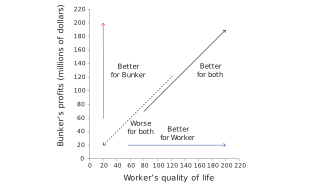
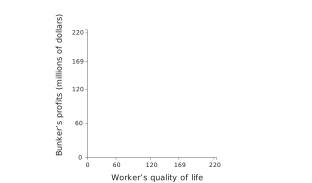
Figure 1.4 translates these ideas by illustrating the possible outcomes of the game in terms of the players’ payoffs. The horizontal axis in this figure gives the quality of life that the Worker may receive (a series of numbers), and the vertical axis shows the profits that Bunker may receive (in millions of dollars).
- infeasible outcome
- An infeasible outcome is one that will not occur, either because it is technically impossible or because one of the two players would never agree to it.
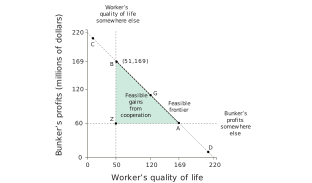
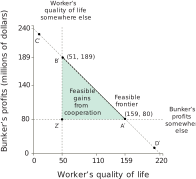
Each point in Figure 1.5 gives the payoffs of the two players at an outcome of the game. Work through the steps in the figure to understand what the points mean, and how we can find the gains from cooperation. For example, we show the two outside options as the coordinates of point Z, with Bunker’s profits as 60 million and the Worker’s quality of life as 50. Any point to the left of or below point Z does not satisfy the two actors’ participation constraints. For example, any point below the Worker’s participation constraint corresponds to an outcome of the game where the Worker will be worse off if they stayed in town than if they had left town. These outcomes are called infeasible outcomes. An infeasible outcome is one that will not occur, either because it is technically impossible or because one of the two players would never agree to it. The same is true about any outcome below point Z: the payoffs violate Bunker’s participation constraint, and those outcomes are infeasible.
Better and worse outcomes for the two parties.
Figure 1.4 Better and worse outcomes for the two parties. Better outcomes for Bunker are shown by the red arrow pointing upwards. Better outcomes for the Worker are shown by the blue arrow pointing to the right. Better outcomes for both are to the top right and worse outcomes for both are to the bottom left.
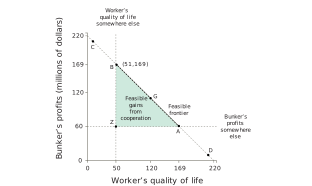
Feasible outcomes of the game given their outside options. We exclude the area where the Worker’s quality of life will be negative and the area where Bunker’s profits will be negative because neither player would agree to bargains in those areas.
Figure 1.5 Feasible outcomes of the game given their outside options. We exclude the area where the Worker’s quality of life will be negative and the area where Bunker’s profits will be negative because neither player would agree to bargains in those areas.
Understanding the gains from cooperation
Worker and Bunker’s payoff
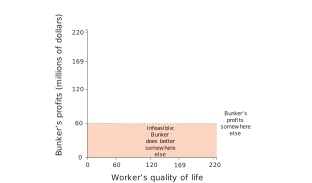
Bunker’s outside option
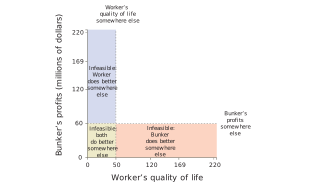
Worker’s outside option
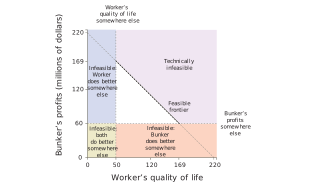
Drawing the feasible frontier
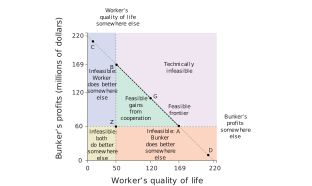
Feasible gains from cooperation
Feasible gains from cooperation: The potential bargains that the two actors can obtain
Everyday Economics 1.7
In the interaction between Bunker and the Worker, the technical infeasibility is a result of the chemistry of smelting and the biology of human health, not the choices made by the players. When something is technically infeasible, it is infeasible for technical reasons—because of the available technologies. Consider the kinds of choices you face in your day-to-day life, what kinds of things are technically infeasible for you even if you might want them? Why are they technically infeasible?
- technically feasible and infeasible outcomes
- An outcome is technically feasible when the available technologies and resources make it possible to be achieved. An outcome is technically infeasible when the available technologies and resources make it not possible to be achieved.
People’s next best alternatives are not the only limits on feasible outcomes of the game. The area in the top-right portion of the graph beyond the feasible frontier is technically infeasible because the smelting necessary for Bunker’s profits results in pollution, which reduces the Worker’s quality of life.
The green-shaded area of the figure (the green triangle) shows the economically and technically feasible outcomes of the game—specifically, those outcomes that are not eliminated by:
- technically feasible and infeasible outcomes
- An outcome is technically feasible when the available technologies and resources make it possible to be achieved. An outcome is technically infeasible when the available technologies and resources make it not possible to be achieved.
- participation constraint
- Each member of an interaction must receive at least their outside option in order to participate in the interaction.
- the technology and biology of human health and smelting (being technically infeasible), or
- the fact that the interaction is voluntary—neither Bunker nor the Worker can be forced to stay in Kellogg—so the outcomes must satisfy the players’ participation constraints.
All of the points in the green triangle in Figure 1.5 are outcomes at which both Bunker and the Worker do better than their reservation options. They both gain from cooperation.
- conflict of interest
- People have a conflict of interest when they disagree about the outcome of a decision or an allocation. Conflicts of interest over gains from cooperation exist because people disagree about who should get a larger share of the gains.
- principle of mutual gains and conflicts from exchange
- People mutually benefit by interacting with others, but there are typically conflicts over the distribution of these gains.
Principle of mutual gains and conflict from exchange
People mutually benefit by interacting with others, but there are typically conflicts over the distribution of these gains.
If there are feasible gains to cooperation, then there must also be a conflict of interest about how the gains will be distributed. We have just seen that, if Bunker emits just a little less than 190, then the Worker will not leave town. But if the Worker remains in Bunker’s employment, they will be barely better off than if they chose to leave. So, they will not receive any of the gains from cooperation. All of the gains will go to Bunker. The benefits that the Worker and Bunker receive from interacting with each other and the conflict they have over the benefits demonstrates the principle of mutual gains and conflicts from exchange.
How will the distribution of the gains to cooperation between Bunker and the Worker be determined? Is there any way that the Worker can capture most of the gains from cooperation? The answer depends on the rules of the game and how the players choose their actions by doing the best they can, given the rules.
Exercise 1.6 Effects of constraints on feasible outcomes
Consider a change in technology that allows Bunker, at every level of emissions, to make $20 million more in profits either in Kellogg or elsewhere. These changes for Bunker are shown in Exercise 1.6 Figure (I).
Exercise 1.6 Figure (I) Bunker has increased profits from a new technology and this changes the interaction with the Worker.
- Given the reasoning above, explain why the coordinates for the points have changed, for example, why did point Z change its coordinate to point Z’?
- Redraw Exercise 1.6 Figure (I) and repeat the steps we went through with Figure 1.5f. Shade each area and highlight who that area is infeasible for and why.
- Explain the figure you redrew in question 2. Why are the different areas labeled the way they are?
- Can the Worker benefit from the improved technology Bunker has? Why or why not?
Question 1.7
Consider the connections between Figure 1.3 and Figure 1.5. Which of the following statements are correct?
- If Bunker experiences a shock that increases its costs, then Bunker’s profits will be lower at every level of emissions (including zero emissions). What do you think this means for Figure 1.5? The changes mean that the slope of the feasible frontier in Figure 1.5 will be flatter and intercept the y-axis at a lower point (for example, at 200). This means that the area for the feasible gains from cooperation will be smaller.
- If the Worker can get more quality of life (at close to zero cost) for every wage they could be paid by Bunker, this suggests that the feasible frontier shifts outwards. This means that (for the same outside offers) there are more gains from cooperation. Therefore the statement is true.
- If Bunker experiences an increase in costs, this lowers the wages and profit they can receive for all levels of the Worker’s quality of life. This means that the feasible frontier shifts downwards. Therefore, for the same outside offers, the feasible gains from cooperation decrease. Therefore the statement is true.
- If another firm increases its emissions, these emissions will not affect Bunker’s profits, but they will affect the Worker’s quality of life. What will increased emissions mean for the Worker’s quality of life? Higher emissions mean that the Worker has a lower quality of life for every level of emissions chosen by Bunker because Bunker’s emissions and other emissions accumulate and lower the Worker’s quality of life. Therefore, the area for gains from cooperation will be smaller than otherwise.

