10.2 Why are labor markets different from other markets?
Imagine you and a friend decide to open an upscale Mexican restaurant. Together you will decide where to locate this restaurant, how to design and decorate it, and what types of dishes will be on the menu. As the owners, you and your partner will make all the big decisions.
- interdependence principle, principle of interdependence
- The outcomes people obtain in economic interactions depend on the actions that they and others take in response to each other and on what they believe about the future.
- firm
- An economic organization in which private owners of capital goods hire and direct labor to produce goods and services for sale on markets to make a profit.
However, as we know from the principle of interdependence, the restaurant’s operations and its success also depend on other people. You will need to hire cooks, dishwashers, servers, bartenders, and others. You and your friend will decide on the tasks the workers need to perform, which workers will carry out these tasks, and how much you will pay them. You might also hire managers to direct and supervise the workers, ensure work is completed, tasks are coordinated, and problems are responded to. Figure 10.3 shows a simplified diagram of how the personnel within a firm are organized.
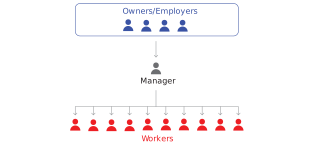
Figure 10.3 The firm’s actors and decision-making structure. Gray arrows represent decision-making power among actors. Owners or employers hire managers who supervise the jobs done by workers.
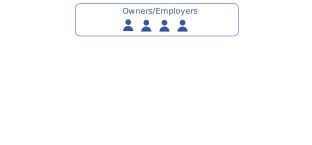
What do owners/employers do?
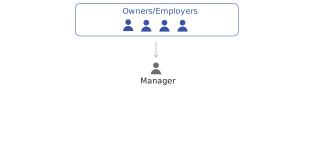
Owners/employers direct managers
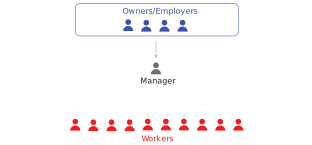
Workers
Managers direct workers
- power
- The ability to do and get the things we want in opposition to the intentions of others.
- employer
- A person who, alone or with others, employs people. The employer is either the firm’s owner(s) or a corporation’s board of directors.
The gray arrows in Figure 10.3 represent the decision-making power in a firm. The direction of the arrow represents who has the power to give orders to whom. For example, the arrows from the manager to the workers indicate that the managers can order the workers to do something. Notice that no gray arrows point upwards. In firms, power is concentrated at the top with the owners or, in the case of corporations, the board of directors. In this chapter and in Chapter 11, we use the term employer to refer to either the owners of the firm or a corporation’s board of directors.
- product market
- The markets where goods or services are sold to households, other firms, and governments.
- labor market
- The market in which employers offer wages to individuals who may agree to work under their direction. Employers are on the demand side of this market, while employees are on the supply side.
The decision-making structure of firms creates important differences in how people interact within firms compared to how they interact in product markets (the markets for goods and services). These differences help us better understand labor markets and how they differ from product markets. A few crucial differences in how people interact in firms compared to product markets are:
- strategic asymmetry
- Strategic asymmetry exists when one side of a strategic interaction has more power to make offers, set the rules of the game, or move first in the interaction. Because of this advantage, they can shape the outcome in their favor.
- Strategic asymmetry: In a firm, an employer can issue orders and expect them to be carried out, but a worker cannot do the same. As in the Bunker Hill example in Section 1.7, all actors here can act strategically in how they respond to or give orders, but the employer acts first. It’s no coincidence that Figure 10.3 resembles the game tree in Figure 1.7.
- Authority: Interactions in product markets are voluntary. When a person or firm buys or sells a good or service, they are choosing to do so—no one orders them to do it. For example, you and your business partner can’t order a customer to buy the most expensive dish on the menu. Though the interaction between a worker and their employer is voluntary (the worker can always resign), the work that the worker does involves the exercise of authority by the employer. The employer—the worker’s boss—tells the worker what to do, and the worker is expected to obey their boss. If the worker doesn’t obey the boss, they may be fired.
- Power: No one buyer or seller in a product market has the ability to force others to do what they want. In contrast, power in a firm is centralized, as we saw in Figure 10.3.
- Working together: For product markets to operate smoothly, buyers and sellers do not need to work together. For example, in many online markets or supermarkets with self-checkout, we don’t interact with other people at all! In contrast, much of the value of organizing production in a firm, whether a bar, a factory, or an office, comes from hiring workers whose strengths, weaknesses, and interests complement each other and having them work together. Firms are social in a way that product markets are not.
Figure 4.9, which shows an example of learning by doing at a Ford plant during the Second World War, illustrates the advantage of groups working together.

A group of business people working together at a whiteboard.
Everyday Economics 10.1
If you’ve had a job, did you ask or seek information about the personality of your boss before agreeing to work there? Did you seek the same information about your potential coworkers?
- the principle of doing the best you can
- Doing the best you can means that, from the set of actions available to them, people will choose the action that they believe will result in the outcome that they value the most, taking into account what they believe the other player will do in response to their choice.
The differences between firms and markets help to explain why we usually care more about whom we interact with in firms than we do in product markets. When you buy something, such as a cup of coffee at Starbucks or Dunkin’, you probably do not pay much attention to the person who fills the order or checks you out at the counter. In contrast, if you are an employer, you want to find workers who work well together and who can reliably carry out assigned tasks. If you are a worker, the personalities of your employers and coworkers have an enormous effect on the value of the job. In labor markets, doing the best we can as employers or workers requires paying close attention to the people we will interact with.
Differing contracts
- private property
- Something is private property if the person possessing it has the right to exclude others from it, to benefit from the use of it, and to exchange it with others.
- contract
- A legal document or understanding that specifies a set of actions that parties to the contract must undertake.
Another difference between product markets and firms is the contracts. If you buy a new couch, that couch becomes your private property. In a contract for the sale of goods, the seller transfers property to the buyer, and the buyer transfers money to the seller. Sometimes, as with a car, this contract is formal and written down. With most goods we buy, though, the contract is implicit. If you buy a bag of chips from a store, for example, the implicit contract refers to the terms of the exchange and what will happen if one side fails to deliver what they promise.
Everyday Economics 10.2
Although a firm cannot literally own a person’s skills, some firms still try to stop workers from using the skills they’ve learned on the job at a rival company. One common method of doing this is non-compete clauses in the employment contract, which bar a worker from working for rival companies for a certain period after they’ve quit or lost their job. In 2024, about one in five workers in the United States had such a clause in their contract.
An employment contract differs from a contract for the sale of goods. In a labor market, the workers themselves are not bought and sold, as that would be slavery. Workers also cannot sell their skills or knowledge, which don’t become the property of the firm when a worker is hired. When workers quit or are fired, they take their skills and knowledge with them.

People waiting for a job interview.
Everyday Economics 10.3
Think about a job you’ve had or someone you know has had. What tasks did you expect to have to do for this job? What tasks did you do that you were not expecting to do?
- employment contract
- A system in which producers are paid for the time they work for their employers.
- principle of mutual gains and conflicts from exchange
- People mutually benefit by interacting with others, but there are typically conflicts over the distribution of these gains.
What, then, does a worker transfer to an employer in a labor market? The worker transfers authority. When workers sign an employment contract with a firm, they agree to allow the employers or managers to tell them what to do when they are at work. In exchange for workers ceding temporary authority over themselves, the employer will pay the workers. Though workers are typically hired with specific jobs and tasks in mind, the employment contract allows firms to direct employees to do whatever the firm might need, as we saw in Figure 10.3. This arrangement illustrates the principle of mutual gains and conflicts from exchange, as both sides get something from this contract, though, as we discuss more in Chapter 11, there may be conflict over the terms of that contract.
Everyday Economics 10.4
How do our institutions—the rules of the game between workers and employers—limit what employers can ask workers to do? Which tasks are illegal for an employer to ask a worker to do?
- rules of the game principle
- The rules of the game affect how the players play the game, the size of the gains from cooperation available to the players, and how the gains are divided among the players.
The employment contract also gives employers the power to monitor and control how the worker performs the assigned tasks. The ability to do this is crucial to distinguishing between an employment contract and a contract for services (as in the case of independent contractors, such as Lyft drivers, freelance photographers, or solo practitioner accountants). The terms of the employment contract and who counts as an employee can vary substantially across industries, states, and countries. These differences are determined by the specific institutions that apply—the rules of the game—especially the laws governing the relationship between employers and workers.
Compared to interactions in product markets, then, workers and employers care much more about whom they will be interacting with at their job.
Long-term relationships
The nature of the employment contract points to another difference between labor market and product market interactions. In markets for goods and services, repeated personal interaction between particular buyers and sellers is rare. In contrast, an employment contract usually establishes a long-term relationship, one that can last years or even decades. As Figure 10.4 shows, in 2021, more than 40% of employees in a selection of medium-income and high-income countries (the OECD countries) had been with their current job for at least ten years. If there is a good chance that choosing a new job or hiring a new person will lead to a long-term commitment, we expect people to be thorough in making that choice.
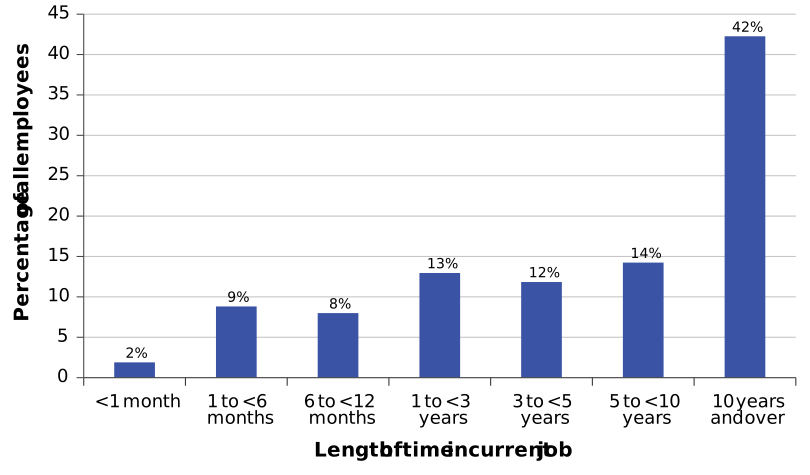
Figure 10.4 Distribution of job tenure, 2021.
Horizontal and vertical axes
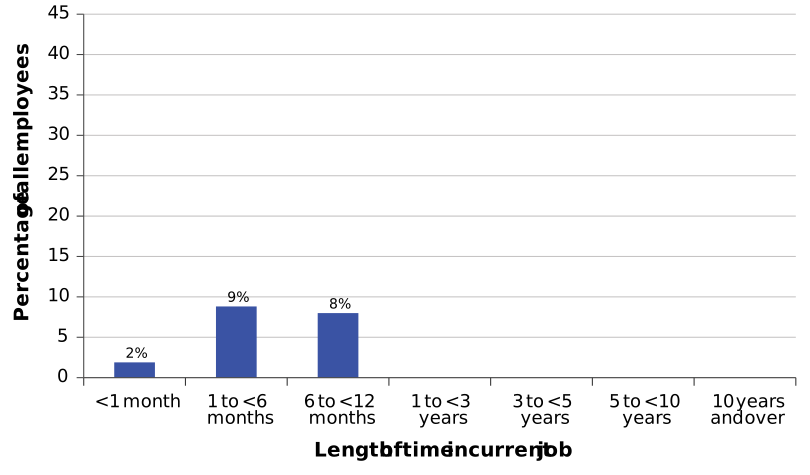
19% of employees had been at their job for less than a year
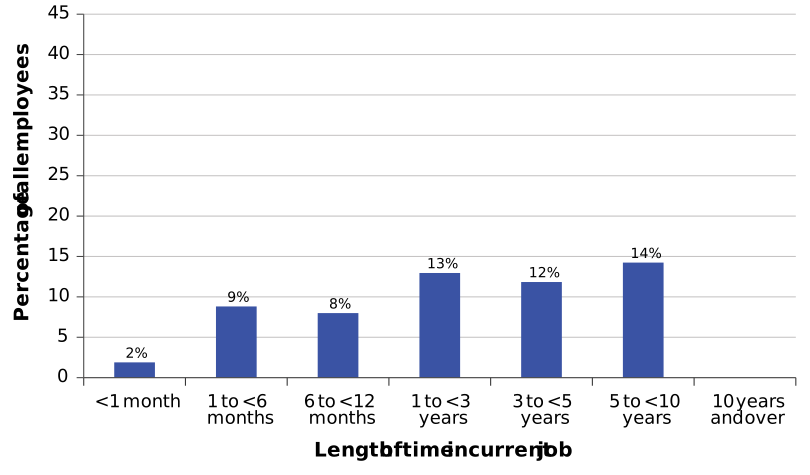
Nearly 40% of employees had been at their current job between 1 and 10 years
42% of employees had been at their current job for at least 10 years
Although full-time employment and long-term relationships remain the norm in the labor market, many workers now have jobs with short-term contracts. For example, adjunct faculty typically have semester-by-semester contracts, meaning they are hired and fired with each new semester. Other workers, like Karim in Chapter 8, do gig work, such as driving for Uber or doing small tasks on TaskRabbit. Gig workers usually count as independent contractors, not employees.
Workers who do not have long-term employment relationships and/or are not technically employees face extraordinary economic insecurity. Both gig work platforms and employers who hire gig workers have no incentive to offer job security, on-the-job training, or other benefits often associated with full-time employment, such as health insurance or pension contributions.
In the next section, we further explore how the features of the employment contract and employment relationship affect the labor market, job search, and hiring process.
Question 10.2
Which of the following statements is true of employment contracts? Choose all that apply.
- Employment contracts do not transfer ownership of a worker.
- Employment contracts allow firms to command a worker to do certain tasks during working hours.
- Although people often say that workers “sell their time,” they do not literally sell time, because time cannot be owned. Instead, workers agree to cede authority to the employer over what they do while they are at work.
- Employment contracts allow firms to demand that assigned tasks be done in a specific way, giving them the authority to monitor and direct how the work is performed.
Question 10.3
Which of the following is true of interactions in firms, but not in product markets? Choose all that apply.
- In firms, there is strategic asymmetry and authority: employers and managers can command workers to perform tasks and control how they are done.
- In firms, employment contracts do not transfer ownership of workers. Instead, workers agree to be directed temporarily but retain ownership of their skills and knowledge.
- Employment contracts usually establish long-term relationships. In contrast, transactions in product markets are often one-time interactions.
- Contracts in both contexts are generally voluntary agreements: you can choose to buy or not buy, and you can choose whether to accept an employment contract.
Exercise 10.2 How do organizations make decisions?
Figure 10.3 shows the actors and decision-making structure of a typical firm.
Exercise 10.3 Freelancer vs employee: What’s the difference?
Consider a web designer hired on a freelance basis by a firm to create a website.
- How does the relationship between the designer and the firm differ from a typical employer–employee relationship in terms of control, expectations, and job stability?
- Discuss one benefit and one drawback of this independent arrangement for the web designer.

