1.5 The importance of options outside of the game and how they affect the players
Once the game is fully described—especially the payoffs—the reason why there is a conflict of interest between Bunker and the Worker is clear.
Bunker’s profits are higher the more emissions the firm produces, and the Worker’s quality of life is lower as a result of Bunker’s choice of technology.
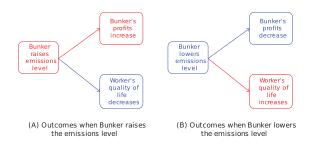
Bunker’s choice of emissions levels and the consequences for Bunker’s profits and the Worker’s quality of life.
Figure 1.2(A) and (B) Bunker’s choice of emissions levels and the consequences for Bunker’s profits and the Worker’s quality of life. Increases are shown in red and decreases are shown in blue. Panel A: If Bunker raises its emissions level, then its profits increase, and the Worker’s quality of life decreases. Panel B: If Bunker lowers its emissions level, then its profits decrease, and the Worker’s quality of life increases.
- outside option
- The payoff a player will receive if they do not engage in the particular interaction being modeled. The outside option is also sometimes called the player’s reservation position or reservation option (it is “held in reserve”). Sometimes it is called the next-best alternative because it is the alternative to the agreement that is “next-best” in terms of how good it is.
- opportunity cost
- The opportunity cost is the net benefit of the next-best alternative—what you give up when you make a choice.
Everyday Economics 1.5
What is the opportunity cost to you of reading this chapter? What could you be doing instead?
Outside options. The payoffs that Bunker and the Worker would get if they did not interact are called their outside options. An outside option is what someone receives at their next-best alternative. Bunker could get $60 million if it shut down its plant in Kellogg and produced metals somewhere else. The Worker could obtain a quality of life of 50 from working and living somewhere else. We can also think of the Worker’s outside option as the opportunity cost of working for Bunker. When taking an action implies giving up the next-best alternative action, the opportunity cost is the net benefit of the foregone alternative.
Profits. Bunker’s profits and the level of emissions it chooses as a result of its choice of technology are shown in both figures. The emissions level is determined by the technology Bunker chooses to adopt: It costs Bunker money to reduce its emissions, and if Bunker were to choose a very low emissions level, it would have negative profit (loss). Bunker would prefer a level of emissions that will result in it having profits greater than its outside option. Bunker’s outside option is $60 million if it were to sell its plant in Kellogg and produce elsewhere.
Everyday Economics 1.6
What does “quality of life” mean to you? What matters more and what matters less? How will you weigh these factors when you are deciding where to live and where to work?
Quality of life. The Worker’s quality of life and its relationship to the level of emissions chosen by Bunker are shown in Figure 1.2(A) and 1.2(B). The Worker’s quality of life is determined by the level of emissions, which in turn is determined by the technology that Bunker chooses to adopt. The Worker’s quality of life is high and positive for low levels of emissions, as suggested by Figure 1.2(B). When Bunker chooses higher levels of emissions, as shown in panel A, the Worker’s quality of life decreases. If Bunker chooses very high levels of emissions, then the Worker’s quality of life will be lower than zero.
Conflicts of interest. Figure 1.2(A) and 1.2(B) and Table 1.1 show the conflict of interest between the Worker and Bunker. When Bunker chooses a higher level of emissions, then its profits are higher, as shown in red in panel A, but the Worker’s quality of life is lower. When Bunker chooses a lower level of emissions, then its profits are lower, and the Worker’s quality of life is higher.
- conflict of interest
- People have a conflict of interest when they disagree about the outcome of a decision or an allocation. Conflicts of interest over gains from cooperation exist because people disagree about who should get a larger share of the gains.
As Table 1.1 shows, Bunker’s most preferred option is very high emissions. At that level, it earns profits of 210 and the Worker has a quality of life of 10. The Worker’s most preferred outcome is when Bunker chooses a very low level of emissions. At that level, the Worker’s quality of life is 210 and Bunker’s profits are 10. As the table shows, the Worker’s quality of life and Bunker’s profits go in opposite directions as Bunker chooses different levels of emissions. Because the benefits to the players move in opposing directions depending on the technology Bunker chooses (remember, limiting emissions is costly for Bunker), the players have a conflict of interest over the level of emissions. Bunker wants higher emissions and the Worker wants lower emissions. Follow the steps to see the five potential levels of emission and observe Bunker’s profits and the Worker’s quality of life.
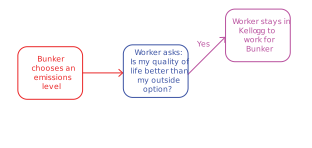
Does this mean that Bunker and the Worker cannot come to an agreement? No. They can come to an agreement, but Bunker needs to think about the level of emissions it will choose based on what the Worker can get elsewhere. We use the steps in Figure 1.3 to illustrate the process the Worker goes through when thinking about the level of emissions that Bunker sets.
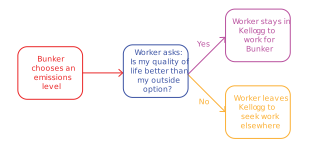
The process the Worker goes through when thinking about the level of emissions that Bunker sets.
Figure 1.3 The process the Worker goes through when thinking about the level of emissions that Bunker sets. If the Worker’s quality of life is lower than their outside option (50), they will choose to leave. If the Worker’s quality of life is more than their outside option, they will stay and work for Bunker.
Bunker owners choose emissions level
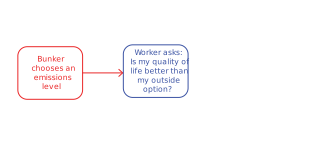
Worker’s response
Worker stays
Worker leaves
How does the Worker’s thinking unfold? Figure 1.3 captures their thought process and how they and other workers will respond to the level of emissions chosen by Bunker. If Bunker chooses a level of emissions such that the Worker’s quality of life is lower than 50 (the Worker’s outside option), then the Worker will choose not to work for Bunker. Instead, they will choose to move somewhere else and get a new job. The corresponding level of emissions is what we call the maximum feasible level of emissions: the level of emissions that is just enough to ensure that the Worker stays in Kellogg rather than leaving.
Similarly, if for some reason another person controlled the level of emissions (for example, the government rather than Bunker), and Bunker had to choose how to respond to that level of emissions, then a level of emissions that results in Bunker having profits less than its outside option of $60 million would mean that Bunker will prefer to shut down operations in Kellogg and start production elsewhere. The corresponding level of emissions where Bunker chooses to stay rather than to shut down production in Kellogg is the minimum feasible level of emissions.
If Bunker shuts down, then the Worker and other workers will have to leave Kellogg and find jobs somewhere else. Similarly, if the Worker chooses not to work for Bunker because the emissions level means their quality of life is lower than what they can get somewhere else, then they will leave Kellogg. Because the Worker represents all the workers in Kellogg, the same is true for all the workers of Kellogg: they will leave and find jobs somewhere else if their quality of life is lower than their outside option.
The outside options narrow down the possible outcomes of the game, as shown in Table 1.1 and Figure 1.4. As a worker for Bunker in Kellogg:
- The worst the Worker can do is to experience a quality of life of 51, at the maximum feasible level of emissions.
- The best the Worker can do is to experience a quality of life of 159. If Bunker were required to emit less than the level that produces that quality of life for the Worker, then it will shut down. This is the minimum feasible level of emissions.
- The Worker has an incentive to ensure that Bunker does not shut down production.
In terms of Bunker’s options:
- The worst Bunker can do is to be limited to profits of only 61, at the minimum feasible level of emissions.
- The best Bunker can do is to gain profits of 169, because if it emits more, then the Worker will leave; this is the maximum feasible level of emissions.
- Bunker has an incentive for the Worker not to leave.
- participation constraint
- Each member of an interaction must receive at least their outside option in order to participate in the interaction.
The outside options limit the best and worst outcomes for each player in the game. For both to participate in the interaction, they must receive at least their outside option. This requirement is called the participation constraint of each player.
Exercise 1.5 What affects the players’ payoffs?
- Explain the thinking behind Figure 1.2(A) and (B). What happens to its profits and to the Worker’s quality of life as Bunker increases or decreases its level of emissions?
- Imagine the Worker finds out that there are jobs available elsewhere where their payoff would be 80. How does this new payoff affect the reasoning that the Worker goes through in Figure 1.3 and the level of emissions that Bunker can think about choosing in Figure 1.2(A) and (B)?
Question 1.6
What are the reasons for the conflict of interest between Bunker and the Worker? Select all the statements that are correct.
- Make sure to check Figure 1.2(A) to be sure that you understand what happens to Bunker’s profits as emissions are reduced.
- Consulting Figure 1.2 (A) and (B), we can see that as Bunker decreases emissions, its profits decrease. Therefore, the statement is true.
- Consulting Figure 1.2 (A) and (B), we can see that as Bunker increases emissions, its profits increase. Therefore, the statement is true.
- Make sure to check Figure 1.2(A) to be sure that you understand what happens to Bunker’s profits as emissions are increased.
- Consulting Figure 1.2 (A) and (B), we can see that as Bunker decreases emissions, the Worker’s quality of life increases. Therefore, the statement is true.
- Make sure to check Figure 1.2(B) to be sure that you understand what happens to the Worker’s quality of life as emissions are reduced.
- Make sure to check Figure 1.2(B) to be sure that you understand what happens to the Worker’s quality of life as emissions are increased.
- Consulting Figure 1.2 (A) and (B), we can see that as Bunker increases emissions, the Worker’s quality of life decreases. Therefore, the statement is true.

