12.3 Production and costs
Understanding costs is important because profits depend on how much total costs increase as a firm produces more output. In this section, we explore the different types of costs that firms incur, including opportunity costs.
Fixed costs and variable costs
Let’s start by considering some of the costs you might face as a craft brewer. Table 12.3 lists several potential costs.
| Fixed costs | Variable costs |
|---|---|
|
|
Table 12.3 Fixed costs and variable costs incurred by CORE Brewing Co.
Firms such as CORE Brewing can incur various costs in producing beer. This table provides examples of potential fixed costs and variable costs.
Everyday Economics 12.6
Why do fixed costs matter if you have to pay them regardless of how much you produce and sell? Understanding fixed costs is important because not being able to identify them correctly can lead to a wrong decision. Suppose you are deciding to brew an extra keg of beer for an event. The variable costs, such as hops and labor to produce that extra keg, are $120, but the rent on the brewery space, which is a fixed cost, is $2,000 per month. If you mistakenly include a portion of the rent in every decision you make about how much to produce, you might think it costs too much to brew that extra keg and choose not to produce it. But since you have to pay the rent no matter what, the real question is whether the revenue from selling that extra keg covers the additional costs of making it. If it does, then producing the extra keg might be a good idea.
- variable cost
- Variable costs are costs that change with the level of output.
- fixed cost
- Fixed costs are costs that do not change with the level of output.
Some of the costs listed in Table 12.3, such as water and hops, depend on how much beer you produce. These variable costs are denoted VC. Variable costs change with the amount of beer that you produce. For example, if you produce zero kegs of beer, you don’t need any hops, yeast, or water. In this case, your variable costs are zero. As you produce more kegs of beer, you will need more hops, yeast, water, and electricity, and your variable costs will increase.
Other costs must be paid regardless of the amount of beer you produce and sell. These fixed costs are denoted FC. Even if CORE Brewing produces zero kegs of beer, you still need to pay rent on your 3-year lease contract for your brewhouse. The cost of the lease is the same whether you produce 1 keg, 10 kegs, or any other amount.
Opportunity costs
- opportunity cost
- The opportunity cost is the net benefit of the next-best alternative—what you give up when you make a choice.
It is important to consider opportunity costs when doing the best you can. Producing craft beer entails many opportunity costs. Some opportunity costs relate to your time. Suppose that if you were not producing craft beer you would be working as a high school teacher earning $70,000 a year. You would therefore need to make profits of at least $70,000 operating your brewery to make more than if you’d been a high school teacher.
- principle of trade-offs and opportunity cost
- The gains you make by choosing some action typically come at the cost of gains that would have been possible had you acted differently.
Other opportunity costs relate to your money. Suppose that if you didn’t pay monthly rent for your brewhouse, you would lend that money to a potential entrepreneur and earn 8% interest on the loan. Applying the trade-offs and opportunity costs principle, we can see that choosing to use the money for rent means giving up the chance to earn interest. The foregone interest is a real cost of your decision.
- the principle of doing the best you can
- Doing the best you can means that, from the set of actions available to them, people will choose the action that they believe will result in the outcome that they value the most, taking into account what they believe the other player will do in response to their choice.
When we calculate economic profits, we include opportunity costs because they represent a trade-off. You are giving up one potential gain (interest) to pursue another (running your brewery). By recognizing these opportunity costs, you are better equipped to do the best you can—that is, to choose the option that leads to the outcome that you value the most, which is to maximize profits.
Opportunity costs are included in the costs of a firm’s production, so when we subtract a firm’s total costs from its revenues, we are including opportunity costs to calculate economic profits. From this point onward, when we use the term profits, we will be referring to economic profits. (See Math Extension 12.2.)
Total costs
- total cost
- A firm’s total costs are the sum of all the costs it incurs to produce its total output, including opportunity costs.
A firm’s total costs are the sum of its fixed costs and variable costs, and they include opportunity costs. Let’s build a table that shows your total costs when you produce different quantities of beer. Table 12.4 provides cost information for CORE Brewing Co. The quantity of beer you produce is displayed in Column 1.
Column 2 shows that total fixed costs are $100. No matter how many kegs of beer you produce in a day, you incur costs of $100, even if you produce zero kegs. In other words, the fixed costs remain the same for all output levels. The $100 fixed costs may represent the rent on your brewing space, the costs of your brewing equipment, and your opportunity costs of capital.
Column 3 (in Step b of Table 12.4) shows your brewery’s variable costs. For example, when you produce 2 kegs of beer, the variable costs are $160, but when you produce 4 kegs your variable costs are $320. This column shows us that variable costs change as quantity changes. Variable costs include the wages you pay to workers, shipping costs, and the costs of the hops and malt that you purchase from suppliers. When you produce zero kegs of beer, your variable costs are zero because you don’t ship any beer or buy any hops and malt.
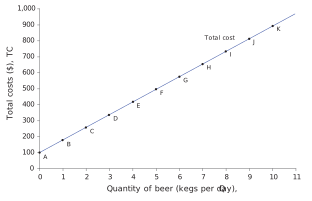
The last column shows your brewery’s total costs, which are the sum of your fixed and variable costs. Total costs represent all the different types of costs listed in Table 12.3. Column 4 shows that the more kegs of beer you produce, the greater your costs of production. Why? As CORE Brewing Co. produces greater quantities of beer, it uses more hours of workers’ effort, hops, water, electricity, and yeast, resulting in higher costs. If you want to produce more beer, you will incur greater costs.
Math Extension 12.3 Plotting the TC curve
Total costs for CORE Brewing.
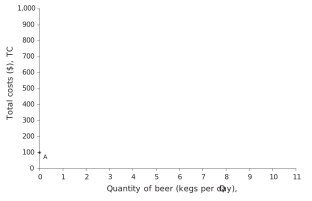
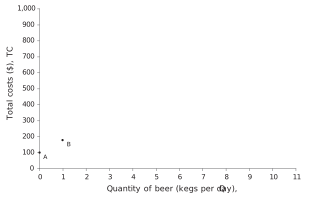
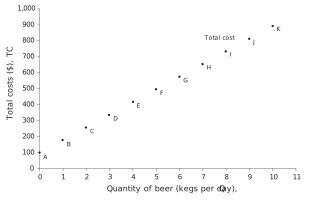
Figure E12.4 Total costs for CORE Brewing. The figure shows CORE Brewing’s total cost (TC) curve. The curve’s upward slope indicates that as CORE Brewing produces more beer, it will need more workers, hops, malt, water, and other ingredients to produce those kegs of beer, resulting in higher total costs.
Total costs for CORE Brewing.
Total costs for CORE Brewing: showing just one point
Total costs for CORE Brewing: adding another point
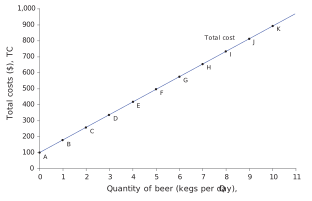
Total costs for CORE Brewing: showing remaining points
Total costs for CORE Brewing: connecting the points
Economies of scale
We have focused our discussion of production costs on a hypothetical small craft brewer, modeled after one of the 9,000 or so craft brewers collectively accounting for only 24.7% of the total US retail beer market in 2024. In contrast, a single firm, Anheuser-Busch, the nation’s leading brewing company and the producer of Michelob, Budweiser, and Bud Light, accounted for 40% of the US beer market. How do costs relate to the size of the firm?
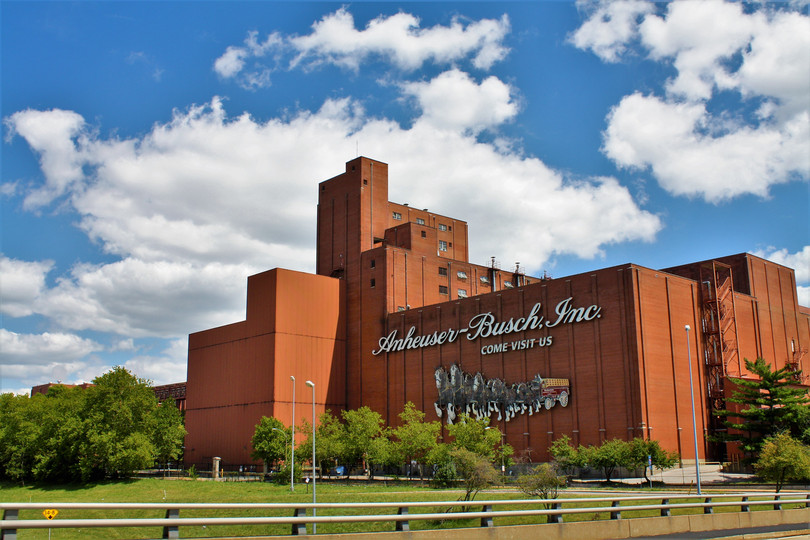
Anheuser-Busch brewery in Williamsburg, VA.
- economies of scale
- When production exhibits increasing returns to scale, increasing all of the inputs to a production process by the same proportion increases the output by a higher proportion.
Economies of scale may result from specialization within the firm. Specialization allows workers to do the task they do best and reduces the cost of training by limiting the skill set that each worker needs. When a firm like Anheuser-Busch has economies of scale through specialization, it produces more than double the amount of beer as a result of doubling its number of workers. As a result, the average cost of a keg of beer decreases, demonstrating how decreasing average costs result from economies of scale.
Diversification and specialization
- specialization
- Specialization exists when workers, organizations, or countries concentrate on producing a limited set of goods or performing specific tasks. This often happens through the division of labor—a system where production is broken into smaller tasks and different people or groups take on different parts of production.
In Chapter 3 and Chapter 4, we saw the benefits of specialization and trade. When people specialize, they can experience gains from trade, including a higher standard of living. When people can’t trade, they often have to engage in multiple tasks, such as growing vegetables and raising cattle, or doing many jobs to make ends meet. Within firms, workers can specialize and become more productive at their tasks, thereby lowering costs for the firm’s owners as workers produce more output, resulting in economies of scale.
Small craft breweries may hire up to dozens of workers, but large brewers such as Anheuser-Busch employ as many as 19,000 US workers. A worker at a small craft brewery might be responsible for multiple tasks: brewing, packaging, and shipping the beer. In contrast, a worker at Anheuser-Busch may focus exclusively on shipping. Specialization can also occur with greater use of automation or robots, which can be programmed to complete tasks around the clock. No training costs are incurred with robots. Larger breweries that produce and ship significant quantities of beer can reap the benefits of automation more than smaller breweries. We take a closer look at the behavior and decision-making of larger firms in Chapters 14, 15, and 16.
Math Extension 12.3a Economies of scale: How average total costs fall as the firm gets bigger
- average total cost
- Average total costs are the total cost of producing the firm’s output divided by the total number of units of output produced.
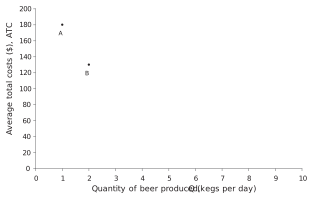
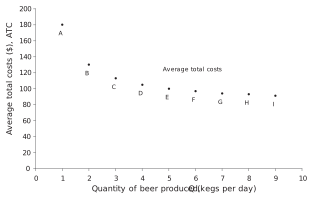
Average total costs, denoted as ATC, are the total costs of producing \(Q\) units of output divided by the number of units. ATC represents the cost per unit of output produced. Table E12.1 shows the average total costs for various quantities that CORE Brewing Co. produces. From the total costs, we have worked out the average total costs per keg of beer and how they change with \(Q\). Column 3 shows that as quantity increases, average total costs decrease.
Let’s now graph the data from Table E12.1 as an alternative way of viewing the relationship between quantity and average total costs. As Figure E12.5 shows, average total costs are declining as the quantity produced increases. If the firm’s average total costs decrease as it becomes a larger firm (or as output increases), it exhibits economies of scale. The larger the firm, the greater the decrease in average total costs. Sometimes economists use the term scale to denote size. So, as a firm produces more and becomes larger, its scale increases.
- economies of scale
- When production exhibits increasing returns to scale, increasing all of the inputs to a production process by the same proportion increases the output by a higher proportion.
A firm exhibits economies of scale when average total costs decrease with scale.
- long run
- The term does not refer to a specific length of time, but instead to what is held constant and what can vary within a model. The short run refers to what happens while some variables (such as prices, wages, or capital stock) are held constant (taken to be exogenous). The long run refers to what happens when these variables are allowed to vary and be determined by the model (they become endogenous). A long-run cost curve, for example, refers to costs when the firm can fully adjust all of the inputs including its capital goods.
Economies of scale occur in the long run when all inputs can be adjusted. For example, CORE Brewing Co. may not be able to expand its brewing space immediately because it is locked into a 2-year lease and must operate within its existing capacity. However, in the long run, once the lease expires, it can move to a larger retail space that accommodates bigger brewing tanks. As CORE expands production, its average total costs per unit may fall. We will discuss the difference between the short run and the long run in greater depth in Chapter 14.
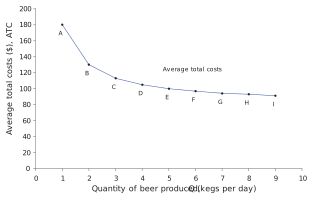
Figure E12.5 A firm exhibits economies of scale when average total costs decrease with scale.
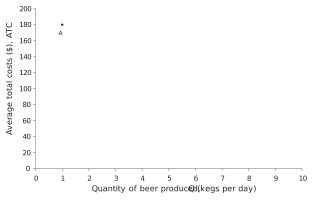
Average total costs for CORE Brewing: showing just one point
Average total costs for CORE Brewing: showing a second point
Average total costs for CORE Brewing: showing the remaining points
Average total costs for CORE Brewing: connecting the points
Larger brewers can spread the costs of purchasing energy-efficient or emission-reducing technology over significant output amounts and lower their average costs. For example, Anheuser-Busch purchases large quantities of barley from its suppliers, and it works with barley growers to manage the protein content in barley, which reduces the water and energy that Anheuser-Busch uses in the brewing process. Thus the environmental impact when large firms adopt sustainable practices can be quite significant due to the sheer size or scale of the company. Large firms can be sustainable with economies of scale and still see their average total costs falling.
Economies of scale in World War II
- learning by doing
- People learn better (less costly) ways of working by developing individual skills and discovering better ways to organize production among members of a team.
- economies of scale
- When production exhibits increasing returns to scale, increasing all of the inputs to a production process by the same proportion increases the output by a higher proportion.
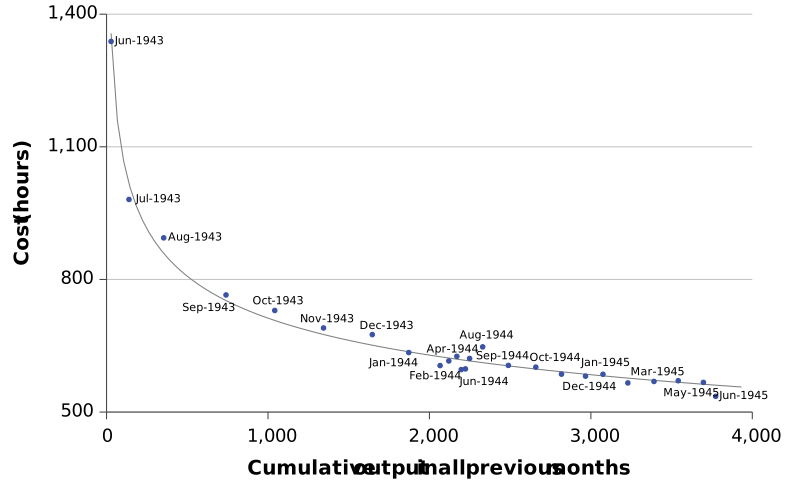
Think back to the example of the M20-GBK truck’s economies of scale, introduced in Figure 4.9 in Chapter 4 (reproduced below). We saw that learning by doing resulted in Ford lowering its costs as the company produced more output. As the workers and managers made more trucks, they learned how to produce them more quickly and efficiently, resulting in lower average costs per truck and demonstrating economies of scale.
Firms have fixed costs such as research and development, advertising expenses, license costs, money spent on lobbying or donating to election campaigns to gain favorable treatment from elected officials, and other costs that do not depend on the number of units the firm produces. For example, in 2023, Anheuser-Busch spent $313 million on TV advertising. As firms produce more, they can spread the fixed costs over a larger output, lowering the cost per unit. Anheuser-Busch can spread its $313 million advertising expense over the millions of barrels it sells in one year.
- rules of the game principle
- The rules of the game affect how the players play the game, the size of the gains from cooperation available to the players, and how the gains are divided among the players.
As firms produce more and become larger, they might also be able to purchase inputs—such as raw materials, equipment, and labor—at lower prices because they have more bargaining power with suppliers than smaller firms do. Small brewers that produce a few kegs of beer each week purchase smaller amounts of hops, malt, and other grains from growers than large breweries that purchase more ingredients. Bargaining power is one of the advantages exploited by large food retailers, which buy a high proportion of the output of producers of fruit, vegetables, fish, and dairy products. This example illustrates the rules of the game principle because firm size becomes a strategic advantage, shaping the distribution of economic benefits. In other words, larger firms receive discounts because the current rules suggest that firm size governs supplier relationships.
While managing costs is important for maximizing your profits, you also want to know how demand, or buyers’ willingness to pay for your beer, plays a role in profit maximization. We turn to this topic next.
Exercise 12.3 Thinking About Sustainable Production
- Suppose CORE Brewing Co. is considering incurring two new potential costs: installing a heat recovery system costing $5,000 or investing in more efficient packaging materials costing $100 per keg of beer. Identify each cost as a fixed cost or variable cost. Explain how these costs will affect CORE Brewing’s total costs.
- Let’s apply the concept of opportunity costs to the case of sustainable craft beer to see how factoring in these costs can help us understand whether a firm can adopt a sustainable practice. Suppose you install solar panels costing $12,000 at CORE Brewing Co. Also suppose that the value of your next-best alternative is the additional $3,000 in beer sales you will generate if you spend the $12,000 on advertising instead. What is the total cost of installing solar panels?
- Alternatively, you may decide to spend $12,000 on advertising. In that case, the value of your next-best alternative might be the $5,000 in energy savings generated from solar panels. What is the total cost of advertising?
Question 12.3
If CORE Brewing Co. decides to spend $10,000 on training workers instead of using the funds to buy new brewing equipment that will increase production by $3,000 worth of beer, choose all statements that are correct.
- The total cost of the training program includes the forgone benefits from the new brewing equipment, $10,000 + $3,000 = $13,000.
- Opportunity costs are relevant for all types of expenditures, including those related to employees.
- Opportunity costs are crucial for cost analysis, regardless of profitability.
- The opportunity cost is the $3,000 increase in production that is forgone by not buying new brewing equipment.

