1.2 What is economics and why do people cooperate?
The dramatic tale of mining and making a living in Kellogg is a story of cooperation and conflict that affected the people of Kellogg and the environment.
Cooperation and conflict
Everyday Economics 1.1
Think of an example from your own life in which you cooperated with another person. In which ways was that activity mutually beneficial? Did one party come out ahead of the other one?
- cooperation
- Cooperation means participating in a common project that is intended to produce mutual benefits.
The main actors introduced in the Bunker Hill story—the owners of Bunker Hill and the workers they employed—were not friends. Nonetheless, they worked together to produce metals because—before the fire at the plant—both expected to benefit from the smelter’s operations. In other words, they cooperated by producing something jointly. Unlike its everyday meaning, in economics cooperation does not refer to the goodwill that people often feel while engaging in common projects. Instead, it means participating in a common project that is intended to produce mutual benefits. For example, when someone sells a good or service to another person at a price such that both people benefit, we say that the people cooperated, even though their only reason for trading was their own self-interest and they didn’t have to know about each other.
The people of Kellogg wanted decent jobs, and they wanted their children to get a good education and grow up healthy. The owners of the smelter, who did not live in Kellogg, wanted to make a profit by employing the people of Kellogg and the surrounding towns and by selling the lead, silver, and zinc which their workers produced. To do this, they had to employ people from the local area. Their actions show the gains from cooperation because together they could do better than either party could do on its own.
But there was also a conflict of interest between the workers and the owners. Sustaining a healthy environment for the people of the town required costly systems to filter and capture the emissions of the smelting process. This meant lower profits for the owners, which may explain why they did not repair these systems following the fire. The owners knew that their profits depended on their workers working hard on the job. Their profits would be greater if they could require workers to work harder and accept lower wages.
The environment of the town—and the entire planet—was not an actor in this story of conflict and cooperation. It was more like an innocent bystander. How the interaction between the owners and the workers turned out would affect the quality of the air, water, and other aspects of the environment not only for the people of Kellogg, but also far beyond Kellogg and for years to come.
Everyday Economics 1.2
Is the area in which you live facing any environmental problems? What are the causes of those problems? Are people actively working to solve them, or is there no solution in sight? That is, are people cooperating? If they are, what are they doing? If not, how might they cooperate better?
Figure 1.1 illustrates some of the actors in the story of Kellogg. The three main actors are the Bunker Hill Company, the government of Kellogg, and the citizens and workers of the town, including Bill Yoss, the welder, and his family. The green represents Kellogg’s environment, which is called the biosphere. Arrows show the relationships between the actors or between the actors and the environment. For example, the red arrow at the top right shows pollution moving from Bunker Hill to the biosphere, and the green arrows show the natural resources that Bunker Hill converts into lead, zinc, and other metals.
The arrows also show that both Bunker Hill and its citizens and workers pay taxes to the government and are affected by environmental regulations issued by the government. The blue arrows show that citizens work for Bunker Hill and vote, pay taxes, and work for the government. The blue arrow labeled “Care, household work” shows that people also perform those services for their own household (and possibly for other households in Kellogg, too). Follow the steps to see the connections between the different parts of the economy.
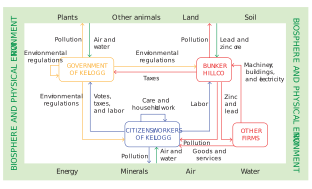
The economy of Kellogg in the biosphere.
Figure 1.1 The economy of Kellogg in the biosphere. Think of the figure as a map that includes the main connections among the actors, but which leaves out a lot of detail.
The role of the government

The biosphere and physical environment
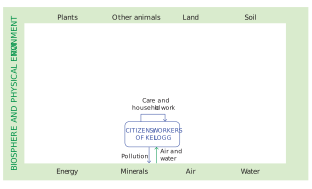
Adding households
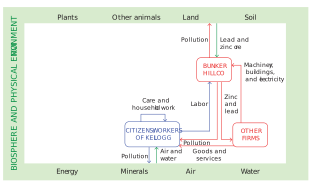
Introducing firms and production
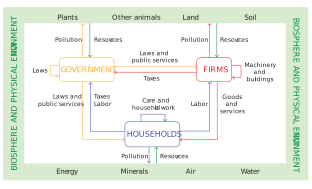
The economy and the biosphere
Economics
- economics
- Economics is the study of how people interact with each other and with their natural environment in producing and acquiring their livelihoods, and how this changes over time and differs across societies.
The story of Kellogg and the figure illustrating its economy is our introduction to economics, which is the study of how people interact with each other and with the natural environment in producing their livelihoods.
This definition has three parts:
- “producing their livelihoods”
- “interact with each other”
- “interact with the natural environment”.
Let’s examine each part of this definition in terms of the Kellogg story.
The people of Kellogg “produce their livelihoods” by taking actions, whether paid or unpaid, that enable them to have the food, clothing, housing, healthcare, childcare, and eldercare on which their quality of life depends.
People in Kellogg also “interact with others” to produce their livelihoods. They work for companies (such as Bunker Hill) in return for wages, and their work pollutes the environment. Other interactions include the following:
- People (members of the workers’ and owners’ families) interact with sellers in supermarkets when they shop to acquire the food and other goods that they live on.
- The Bunker Hill Company sells in the market for metals, interacting with buyers of lead, silver, and zinc.
- Family members care for young people and elderly people in their own families and for other families.
- The government regulates, taxes, and supports the actions of people like Bill Yoss and firms like the Bunker Hill Company.
In Kellogg, “interacting with the natural environment” includes Bunker Hill’s pollution of the environment and the impact of workers’ and other people’s use of carbon-based fuels to operate their vehicles and heat their homes.
Everyday Economics 1.3
Explain a recent decision you made and identify how it affected other people. What were those effects?
Interdependence principle
The decisions people make and the outcomes people receive depend on the actions people take and the repetition of actions that other people take, perhaps in response to the actions of others. We live in a world in which our decisions affect other people.
The idea of interacting with others and with the environment illustrates an important principle of economics called the interdependence principle: The decisions people make and the outcomes people receive depend on the actions people take and the repetition of actions that other people take, perhaps in response to the actions of others. We live in a world in which our decisions affect other people.
Exercise 1.2 A model of your town
Redraw Figure 1.1 based on your town (or a town you’re familiar with), your own family (or a family you’re familiar with), a firm that engages in production in the town, and the government of that town. Explain the people in your diagram in terms of the goods or services they produce, the kinds of work they do and the wages they are paid, and the kinds of work the government does.
Question 1.3
Choose all the correct statements.
We say Bill Yoss and the owners of Bunker Hill cooperated because:
- There are gains from cooperation between Bill Yoss and the Bunker Hill Company. Yoss receives a wage and other benefits. The Bunker Hill Company receives output from Bill Yoss’s work time. Therefore the statement is correct.
- The emissions capturing system required to keep the environment clean for Bill Yoss and his family is costly for the owners of Bunker Hill.
- Bill Yoss may still benefit from working for Bunker Hill with a wage lower than the “fair” wage.
- We do not need them to care about each other for them to produce something jointly. It can be in each actor’s self-interest to produce output together in a joint project and receive gains from cooperation. Therefore the statement is true.
- Though it could be the case that outside of work Bill Yoss and a manager at the Bunker Hill Company might be friends and like each other; liking each other by itself isn’t a reason for them to cooperate in a work relationship.

