13.4 The benefits of exchange and market power
Invitation Homes is the largest single-family rental company in the United States, owning roughly 85,000 houses across the country. While Invitation Homes owns less than 1% of all rental houses in the United States, it owns close to 15% of all rental houses in South Florida, and even larger concentrations in certain neighborhoods and communities.
It is not uncommon for a single rental company to own almost all the houses on one street, suggesting that rental companies such as Invitation Homes may exhibit their greatest market share at the neighborhood level.
In this section we explore the implications for buyers when firms have significant market power. Before we begin, we need to understand how buyers and sellers gain from exchanging with each other.
Gains from exchange
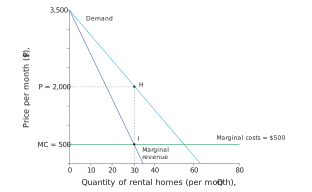
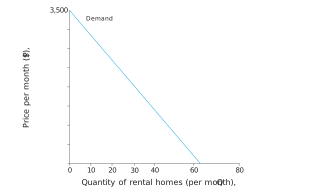
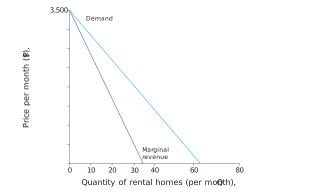
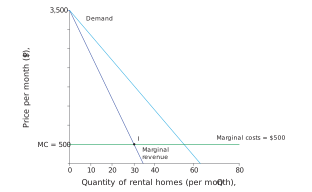
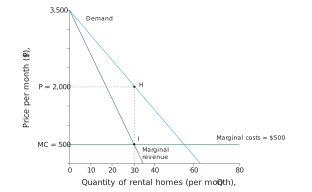
Suppose you are renting a house from a rental company named Step Right In. You are the buyer/renter (or tenant) and Step Right In is the firm/landlord. Figure 13.8 shows the demand, marginal costs, and marginal revenue curves for Step Right In. The figure looks similar to what we saw for CORE Brewing Co. Figure 13.8 shows that Step Right In will rent 30 of the houses it owns in the neighborhood and charge a rental price of $2,000 per month. We will assume that the homes that are rented are pretty similar in size and features. Step Right In determines the price and quantity of rental houses by comparing the additional revenue it would gain from renting another house (that is, marginal revenue) with the additional cost of providing another house rental (that is, marginal cost). Step Right In will want to rent an additional house as long as the additional costs of renting the house do not exceed the additional revenue. This strategy will allow Step Right In to earn as much profit as possible.
Quantity of houses that Step Right In rents per month.
Figure 13.8 Quantity of houses that Step Right In rents per month. Like CORE Brewing, Step Right In compares the additional costs of renting a house with the additional revenue of renting a house. Step Right In will want to rent an additional house as long as the marginal costs do not exceed the marginal revenue.
Step Right In’s demand curve
Adding the marginal revenue curve
Adding the marginal cost curve
Finding the profit-maximizing price and quantity
Once Step Right In determines how many houses to rent and the price it will charge, renters decide how many houses to rent. We can assume that the rules of the game, which determine how rental houses are allocated to renters, are as follows:
- The firm decides how many rental houses to rent out and sets a single price.
- Individual renters then decide how many houses to rent.
- consumer surplus
- Each consumer who buys a good receives a surplus equal to their willingness to pay minus the price. The term “consumer surplus” normally refers to the sum of these surpluses across all consumers.
- producer surplus
- The producer of a good receives a surplus on each unit, equal to the price minus the marginal cost of producing it. The term “producer surplus” normally refers to the sum of these surpluses across all units sold.
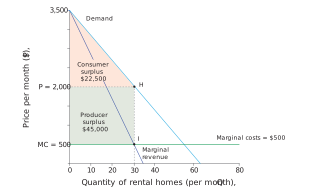
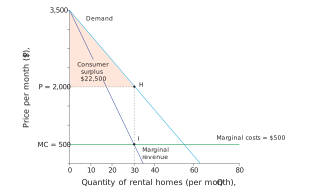
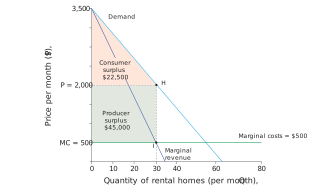
Figure 13.9 (and the panels to the right) shows how both buyers (the renters) and Step Right In (the firm or landlord) could benefit from a transaction. We saw in Chapter 12 that the demand curve reveals buyers’ willingness to pay for quantities of a good or service. Buyers are represented all along the demand curve. For example, some buyers are willing to pay $2,500 or $2,800 to rent one of Step Right In’s houses, a price above the $2,000 that Step Right In charges. Other buyers are willing to pay only $1,000 or $800, prices below what Step Right In charges. The difference between what renters are willing to pay and what they pay is their consumer surplus, which is a benefit to renters.
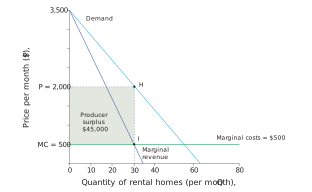
Step Right In also benefits from exchanges with renters. It has a constant marginal cost of $500 to rent a house, and it rents its houses for $2,000 per month. The difference between the rent that the firm charges and the marginal cost to rent a house represents a surplus for Step Right In. This producer surplus is a benefit to Step Right In.
The shaded yellow area represents the consumer surplus to renters because it is the difference between what buyers are willing to pay to rent a single-family house and the rent they have to pay. The green area represents the producer surplus for Step Right In because it is the difference between its marginal cost of providing a rental house and the rent that it receives.
Gains from exchange
Figure 13.9 Gains from exchange The figure represents the gains from exchange between renters (buyers) and corporate landlords (firms). Renters gain the yellow-shaded area, which represents the difference between renters’ willingness to pay and what they actually pay for rent. Step Right In gains the green-shaded area, which represents the difference between its marginal costs of providing an additional rental house and the rent it receives for each rental house.
Step Right In’s original profit-maximizing price and level of output
Identifying consumer surplus
Identifying producer surplus
Identifying total surplus
The landlord’s surplus for each house it rents is the difference between the price and the marginal cost of providing and renting the house. To see Step Right In’s profit, we need to bring in its average total costs, which we introduced in Chapter 12. Let’s redraw our demand, marginal costs, and marginal revenue curves again and include the average total costs in Figure 13.10. We will assume that average total costs are $700. Profit corresponds to the firm’s total revenues (the price it charges per unit multiplied by the units sold) minus its total costs (the fixed costs plus the variable costs). Follow the steps in Figure 13.10 to ensure you can see how to find these values.
Producer surplus tells us the firm’s surplus relative to the outside option of not renting houses but still incurring the fixed costs. In contrast, profit tells us how much surplus the firm receives relative to the outside option of leaving the market altogether.
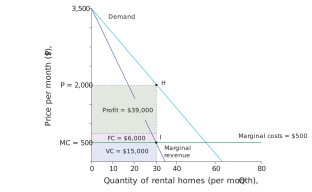
Profit for Step Right In
Figure 13.10 Profit for Step Right In This figure shows how much Step Right In earns in profits when it charges rent of $2,000 and rents 30 houses per month.
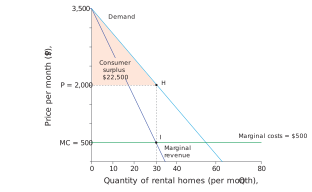
Step Right In’s consumer surplus
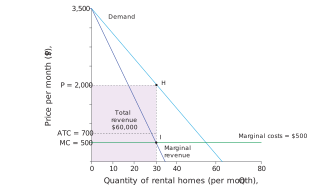
Identifying total revenue on the graph
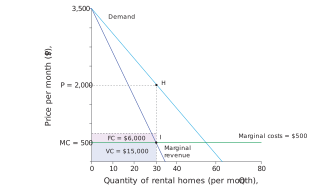
Identifying total variable cost and total fixed cost to the graph
Identifying Step Right In’s profit
Let’s take another look at Figure 13.10. Quite a few possible renters are willing to pay more than Step Right In’s marginal cost. For example, some potential renters are willing to pay $1,300 or even $1,600 for monthly rent. It seems Step Right In would benefit from exchanging with these renters because its marginal costs are only $500. Why does Step Right In rent only 30 houses when both the firm and renters could be better off if it rented more houses?
- price discrimination
- A selling strategy in which different prices are set for different buyers or groups of buyers based on the buyers’ differing willingness to pay.
- deadweight loss
- Deadweight loss is a measure of the total loss of surplus (that is, potential gains from trade) relative to the maximum available in the market.
- principle of individual and societal interests
- Individuals doing the best they can often does not lead to the best outcomes for all people or for the environment.
The answer lies in our assumption that Step Right In charges a single rent to all tenants. This is a simplification, as many real-world companies practice price discrimination, which is charging different prices to different customers (seen, for example, in student discounts or airline fares). If Step Right In could charge some renters $1,600 and others $1,300, it could increase its profit and make these additional renters better off.
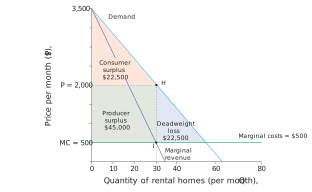
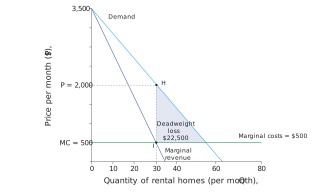
At the single rent Step Right In charges, some renters who value a house above the company’s marginal cost are priced out of the market. The value these renters place on housing, along with the potential profit Step Right In could earn from them, is lost to both sides. The loss is called deadweight loss because it cannot be captured by either renters or the landlord under the single-price assumption. The potential gains from trade that are not realized are represented by the blue-shaded area in Figure 13.11.
Figure 13.11 illustrates the individual and societal interests principle. When individuals or firms act to maximize their own benefit, the result is not always the best outcome for everyone. Step Right In is doing the best it can by setting the single rent that maximizes its profit. However, that choice leaves some potential renters, who value a house more than it costs to provide it, without housing. Those missed transactions represent gains from trade that society as a whole loses.
In other words, Step Right In’s interest in maximizing profit conflicts with the broader social interest of making sure all mutually beneficial trades occur. You can think of the deadweight loss as the gap between what is privately optimal for Step Right In and what is socially optimal.
- deadweight loss
- Deadweight loss is a measure of the total loss of surplus (that is, potential gains from trade) relative to the maximum available in the market.
Deadweight loss
Figure 13.11 Deadweight loss Deadweight loss is a measure of the total loss of surplus (that is, potential gains from trade) relative to the maximum available in the market. In this figure, the deadweight loss is the area shaded in blue. This area represents transactions that do not take place even though some buyers are willing to pay a price greater than the marginal cost (MC) of $500.
Step Right In’s consumer and producer surplus
Identifying the deadweight loss
Consumer surplus, producer surplus, and deadweight loss
Everyday Economics 13.7
Have you ever searched for an airline ticket online and noticed the price wasn’t always the same? The same seat might cost more if you buy it two days before you leave to go home for winter break or if you have searched for airline tickets for several days in a row. Price discrimination means charging different prices to different buyers for the same product, based on factors such as willingness to pay. With the rise of AI, it is becoming easier for firms to practice price discrimination. AI can analyze large amounts of data, such as your browsing history, location, and past purchases, to figure out your willingness to pay.
We have seen that both buyers (renters) and sellers (landlords) gain from exchanging with each other. Now we want to think about how the gains from exchange are distributed.
Bargaining power
- bargaining power
- The extent of a person or firm’s advantage in securing a larger share of the economic rents made possible by an interaction.
- market power
- A firm has market power if it can sell its product at a range of feasible prices without losing many potential buyers to competing firms.
The division of gains from economic interactions depends on the relative bargaining power of the participants: that is, their ability to influence the price in their own favor. The owners of Step Right In have bargaining power—a type of market power—as the only seller or one of a few sellers of rental houses in a particular neighborhood. They can charge a high price for rent, knowing that buyers who value a rental house highly will pay it. An individual renter has little power to bargain for a better deal because the firm has many other potential renters. Step Right In’s market power and ability to set a high price increases its producer surplus and reduces the consumer surplus for buyers. In other words, Step Right In benefits from extracting the maximum willingness to pay from renters.
Step Right In can even attempt to steepen the demand curve for its rental houses by engaging in one of the strategies we mentioned earlier, such as restricting competition. One way to restrict competition is to purchase many of the houses for sale in a particular community so that other corporate landlords (or anyone else) can’t buy houses there. If a corporate landlord is able to buy nearly all the houses in one community, people who want to rent in that community have no choice but to pay the rent that Step Right In charges.
Corporate landlords also benefit from economies of scale. For example, small-scale landlords who own one or two properties often have to hire maintenance companies to service their properties, and property managers to manage their properties. In contrast, corporate landlords have in-house legal teams and maintenance workers, which lowers the costs of acquiring and maintaining properties. These economies of scale make it more challenging for smaller-scale landlords to enter the rental housing market.
Finally, corporate landlords have merged with other landlords to allow them to acquire a larger number of properties, thus increasing the market power of the firms providing rental housing.
As Figure 13.11 shows, the surplus that accrues to the buyer or renter is not always the same as the surplus that accrues to the seller or landlord. When the price of rent is high and the number of houses provided is lower, corporate landlords receive more rent. When the price of rent is lower and the number of houses provided is greater, then renters have greater surplus.
In the end, when corporate landlords are successful in restricting competition and increasing their market power, they can set higher rents and reduce consumer surplus. For some renters, the reduction in surplus might have little impact because they were already willing to pay a high rent. For others, especially those with lower incomes, the loss of surplus can create real hardships. For example, if a renter’s willingness to pay is closer to the market rent, they may have little or no consumer surplus left. With no extra value from their housing transaction, they have less income available to spend on other goods and services.
Exercise 13.4 Collective bargaining
Imagine a scenario where renters form a collective bargaining group to negotiate lower rent prices with a dominant rental company or collectively decide not to rent if their demands are not met.
- How would collective bargaining affect the balance of bargaining power between the two parties?
- What impact might collective bargaining have on rent prices, consumer surplus, and producer surplus? Illustrate these changes on a graph showing the initial and new equilibrium points.
Question 13.4
How does an increase in a firm’s market power influence the division of gains between the firm and consumers? Choose all that apply.
- Firms with market power are able to take a larger share of the economic surplus by raising prices.
- By limiting the quantity supplied, the firm can drive up prices and capture more producer surplus.
- As prices increase, consumer surplus shrinks because consumers pay more for the same goods or services.
- Total surplus typically decreases due to deadweight loss created by higher prices and restricted supply.

