2.3 Changing the rules: Democracy and bargaining
Everyday Economics 2.4
How much bargaining power do you have in everyday interactions? For example, you’re looking to rent an apartment: Do you have enough bargaining power to get the landlord to lower the monthly rent for you? What might give you some bargaining power in this situation?
Even following the improvement in their outside option, the outcome is not very good for the Worker (or for the environment).
Let us now consider a scenario in which the citizens organize to benefit by passing a law that will lower the emissions that Bunker is permitted to emit. The idea we propose here is similar to how workers and organizers came together to help pave the way for the Fair Labor Standards Act: Workers come together to try to get regulation that will limit what the owners of the firm can do. By the citizens “organizing,” therefore, we mean that they engage in participatory democracy. In this case, they campaign to gather votes so that the Worker is democratically elected as the mayor of Kellogg. As the mayor of Kellogg, the Worker will help to craft regulation in Kellogg, such as environmental regulation of the firms operating there. Now the Worker, implementing the citizens’ decision, is the first mover in the game and has control over the level of emissions. That is, they can determine the level of emissions through regulation they enact as mayor.
The Worker chooses between the actions Set low emissions (which means imposing a law that restricts Bunker to low emissions) and Set very low emissions (which means imposing a law that restricts Bunker to very low emissions). For a list of these values, see Table 1.1. Now, Bunker must choose from two actions: Stay or Leave. If Bunker chooses Stay, it must obey whatever law the Worker has imposed.
The outcomes and payoffs therefore become the following, as summarized in Table 1.1 (for points 1 and 3; points 2 and 4 are the outside options):
- The Worker plays Set very low emissions and Bunker plays Stay:
- The Worker receives: 210
- Bunker receives: 10
- The Worker plays Set very low emissions and Bunker plays Leave:
- The Worker receives: 50
- Bunker receives: 60
- The Worker plays Set low emissions and Bunker plays Stay:
- The Worker receives: 159
- Bunker receives: 61
- The Worker plays Set low emissions and Bunker plays Leave:
- The Worker receives: 50
- Bunker receives: 60
The game trees in Figure 2.3 depict the interaction when the Worker, as mayor, is first mover. The Worker’s feasible set of choices for emissions is the full range from very high to very low. But the Worker would never set the level to be high or very high. That is what they and their fellow citizens got before the Worker became mayor, and they are hoping to do better than that. That is why they elected the Worker to be mayor. The Worker and the citizens of the town prefer low and very low levels of emissions over what they got before they took over the town government, so we restrict our analysis to those feasible actions. Follow the steps in Figure 2.3 to see how the game will be played.
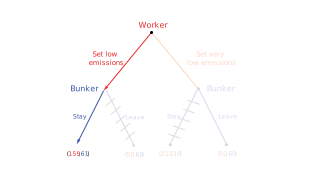
Figure 2.3 The game tree shows what will happen when the Worker moves first and Bunker moves second. The Worker’s actions are shown in red and Bunker’s are shown in blue. The Worker can Set low emissions or Set very low emissions. Bunker can Stay or Leave. The first panel shows the unsolved game and the last shows the solved game. As in Figure 1.7, we determine how the game will be played by pruning the tree, eliminating the actions that the Worker knows that Bunker will not take in response to the Worker’s action as first mover.
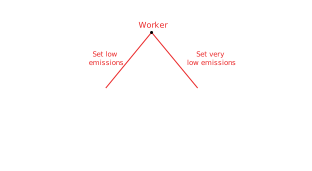
Worker’s possible actions
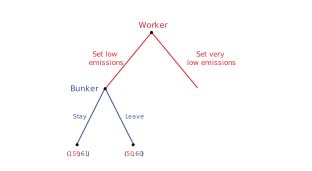
Bunker’s response if Worker sets low emissions
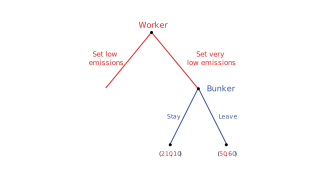
Bunker’s response if Worker sets very low emissions
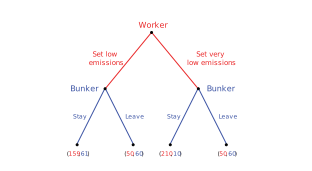
The game tree
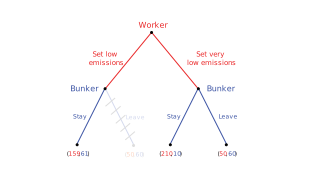
Pruning Bunker’s response to low emissions
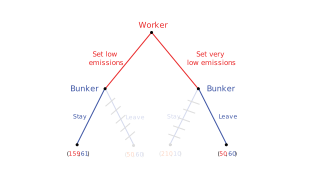
Pruning Bunker’s response to very low emissions
The solved game
Figure 2.3 shows how the game will be played. When both players do the best they can, they arrive at the outcome where the Worker plays Set low emissions and Bunker plays Stay with payoffs (159, 61). This is the best possible outcome for the Worker and the citizens of Kellogg. But Bunker gets barely more than it would have received if it had just closed down and mined ore in some other part of the world.
- power
- The ability to do and get the things we want in opposition to the intentions of others.
The difference in the outcomes is the result of power. In this case, the first mover has the power and gets a payoff significantly greater than their outside option. A difference in the rules of the game—meaning a difference in the institutions governing the interaction of the two players—resulted in a difference in how the benefits of the interaction between Bunker and the Worker are divided up. Here, the player that gains most of the benefits from cooperation in an interaction—that is, what they get above and beyond their outside option—is said to have power. How much each player gets depends on the power they have to get the most of the gains from cooperation and on what they can get from improving their outside options.
In the cases we’ve considered so far, the first mover had all of the power to determine getting the largest share of the gains from cooperation. When Bunker was the first mover, its profits were the most they could be without the Worker leaving town, so it had the greatest power in that case. When the Worker was the first mover, their quality of life was the most it could be without Bunker shutting down, so they had the greatest power in that case.
Exercise 2.3 Improving outside options for better outcomes
Suppose that the Worker has become mayor of the town. Make a list of improvements in Bunker’s outside options that would improve the outcome of the game from Bunker’s perspective. For example, if Bunker were offered a tax incentive to locate its production elsewhere, it would have an improved outside option (see how this works with Amazon for example, “City of Charlotte Approves Tax Breaks for Amazon Center”).
Question 2.2
Consider the following scenarios about power and choose the statements that are true.
- Are you sure the Worker’s power caused the economic depression?
- Check the definitions of power, and make sure you understand which applies here.
- If the outside offers shifted to (30,30) and the players had unequal power, then Bunker would make an offer of 31 to the Worker. The only way that Bunker would make an offer of (110,110) is if the players’ power is relatively equal.
- If Bunker’s outside option has increased to $90m elsewhere, then to ensure that Bunker will participate in exchange, the Worker (who can now regulate Bunker) must offer Bunker at least $91 million, otherwise Bunker would be at least as happy to move somewhere else. You can draw the game tree of this interaction to show that this is true as an exercise.

