2.4 Sharing the economic benefits
Bargaining power does not have to be so all-or-nothing.
Changes to rules of the game can make outcomes fairer for the two parties with a more equal split of the benefits. For example, recent evidence suggests that among US households with union members, wages were 10–20% higher than in households that did not have union members. The unions helped to ensure that their members got a larger share of the gains from cooperation, suggesting that unions can lower inequality between workers and the owners of firms.
In our model, the rules of the game might be altered such that both Bunker and the Worker do better than their outside options, for example, an outcome like point G in Figure 2.4. Follow the steps to see why at point G each party gets 110.
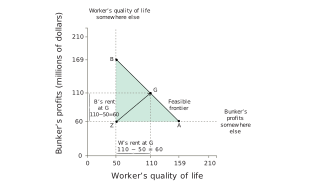
Figure 2.4 Point G is a fairer allocation than either points A or B. At point G, each player receives a payoff of 110 and receives a greater rent than when they are the second mover, but worse than when they are first mover and keeping the other player at just above their participation constraint.
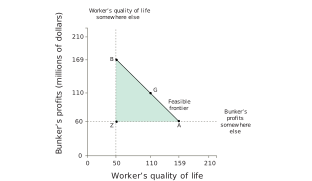
Starting with the feasible gains from cooperation
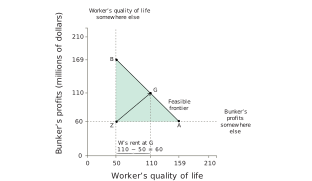
Worker’s rent at point G
Bunker’s rent at point G
Everyday Economics 2.5
Can you identify any examples of public organization to improve quality of life? For example, on many campuses, students advocate for better or more nutritious cafeteria food (good luck with that), more and better parking, and so on. Homeowners may band together to prevent a dense new housing development.
To see how changing the rules of the game to make the outcome fairer might work, recall what happened when Bunker was the first mover, imposing pollution on the Worker just barely less than what would get them to leave town. In that situation, it is likely that the citizens will organize and attempt to elect the Worker as mayor. Bunker will know this and want to avoid that outcome.
Introducing democracy means the citizens can organize. As a result, the Worker has more than the two options they had previously (stay and accept the pollution that Bunker imposes, or leave town). The new option is Stay and Organize. The citizens organizing to change environmental regulations will take a lot of time away from their families, friends, and other activities essential to their quality of life.
To explain whether a point like point G could come about when players stick to the “doing the best you can” principle, we depict the interaction in Figure 2.5. We assign payoffs to the various outcomes to reflect the fact that organizing is costly to the citizens, and that they might not succeed in imposing a low-emissions regulation.
Bunker (in blue) is the first mover and can choose to play Set high emissions or Set moderate emissions. The Worker (in red) can choose to play Accept or Organize. If Bunker plays Set high emissions and the Worker accepts, then they arrive at (169, 51), which is point B in Figure 2.5. When Bunker plays Set high emissions and the Worker plays Organize, they arrive at (61, 159), which is point A in Figure 2.5. The Worker will do the best they can by responding to Bunker setting high emissions by organizing because 159 > 51.
But Bunker, anticipating that the Worker will do the best they can and organize if they set high emissions, knows that it will get profits of only 61. So Bunker will consider the other option: Set moderate emissions. Move through the steps of Figure 2.5 to understand how this happens.
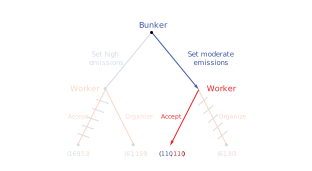
The game tree and how the game will be played when Bunker moves first and the Worker moves second when Bunker sets high or moderate emissions
Figure 2.5 The game tree and how the game will be played when Bunker moves first and the Worker moves second when Bunker sets high or moderate emissions Bunker (in blue) sets a high or moderate level of emissions and the Worker (in red) decides to accept that level or organize. In this version of the game, the fact that the Worker has the option to organize and take over the town government leads Bunker to impose lower emissions so as to deter the Worker from organizing.
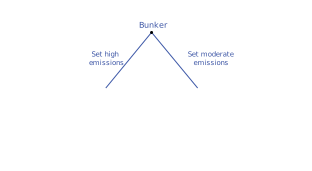
Bunker’s possible actions
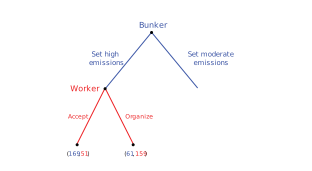
The Worker’s response if Bunker sets high emissions
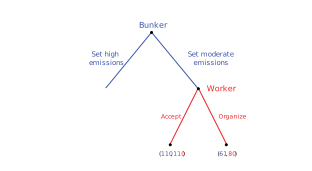
Worker’s response if Bunker sets moderate emissions
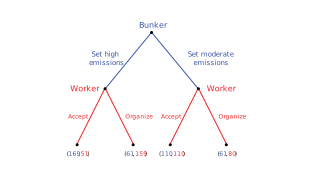
The game tree
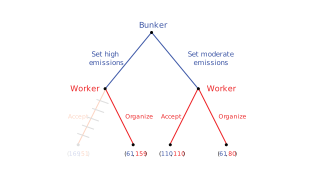
Pruning the Worker’s response to high emissions
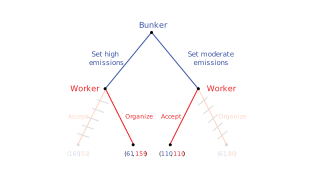
Pruning the Worker’s response to moderate emissions
The solved game
When Bunker plays Set moderate emissions, the Worker can choose between getting 110 from playing Accept and 80 from playing Organize. In this instance, the Worker will do better by playing Accept (110 > 80). Anticipating the Worker’s action, Bunker will get 110 if they set moderate emissions or 61 if they set high emissions. So Bunker will do the best it can and play Set moderate emissions (110 > 61).
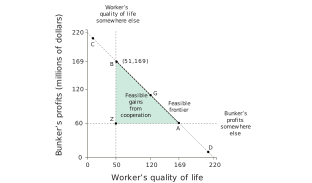
Figure 1.5
Figure 2.5 shows the allocation: point G, where the Worker gets a payoff of 110 and Bunker gets a payoff of 110. We can compare these payoffs to each player’s outside option to understand what their rent will be at that allocation. For the Worker, 110 − 50 = 60 will be the Worker’s rent. For Bunker, 110 − 60 = 50 will be Bunker’s rent. Bunker has a lower rent at the allocation (110, 110) than it did at the outcome of the interaction depicted in Figure 1.5. The Worker has a lower rent than at the outcome depicted in Figure 2.4. But allocation G is fairer, and Bunker has made this accommodation with the Worker to avoid the Worker and their fellow citizens organizing and producing an outcome that Bunker wanted to avoid, and at which Bunker’s rent would have been much lower (a rent of 1 rather than the 50 Bunker receives at this fairer bargain with the Worker).
The players could therefore arrive at a bargain like point G by changing the rules of the game and adopting new strategies.
Exercise 2.4 How do people choose a government
Make a list of changes in the laws regulating how the citizens select their government that might improve the outcome of the game:
- for the Worker
- for Bunker.
Question 2.3
Point G is not the only point that could feasibly occur as a result of a fairer proposal by Bunker to the Worker based on Bunker’s worry that the Worker will organize. Now consider each of the following game trees. Which of them depict a game with a threat of organizing by the citizens with an outcome where the players will definitely reach an accommodation that is fairer than the unequal offers at either points A or B in Figure 2.4 and on the feasible frontier? There may be more than one correct answer.
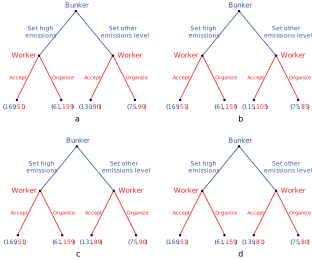
A set of four possible game trees to depict an interaction between Bunker and the Worker.
Question 2.3 Figure (I) A set of four possible game trees to depict an interaction between Bunker and the Worker.
- Even though B would prefer to play Set other emissions here and in the case A plays either Accept or Organize, because A is indifferent between the two we do not know which they will play. Strictly speaking, A would play each with a 50% probability. In the case that A plays Organize, then the set of payoffs (Payoff to A, Payoff to B) of (90, 75) even though the set of payoffs is fairer than the outcomes at points A or B, would the outcome be on the feasible frontier?
- True.
- Here, when B plays Set other emissions level, A will play Organize (90 > 89). Is this outcome on the feasible frontier?
- They both offer outcomes that are fairer than the extremes. In the case of the outcome (105, 115), the players receive equal rents of 55 each (105 - 50 = 55 for A, 115 - 60 = 55 for B). In the case of d, the outcome, though still unequal, is fairer than the outcome where B gets all the benefits. A gets a rent of 81 - 50 = 31 and B gets a rent of 139 - 60 = 79. Although these rents are not as equal as the (110, 110) or (105, 115) allocations (in the payoff space where they are written (Payoff to A, Payoff to B), they are more equal than the allocations (159, 61) and (51, 169) at points A and B).

