4.7 Application: Technology and the Industrial Revolution
The Industrial Revolution transformed life across the world. But why did the Industrial Revolution happen where and when it did? What was special about Britain during that period? We can use the models we’ve developed to help answer these questions.
The Industrial Revolution happened in Britain in the late 1700s and early 1800s. Our discussion will focus on the textile industry, which was central to the Industrial Revolution.
Women’s wages, cheap coal, and innovation
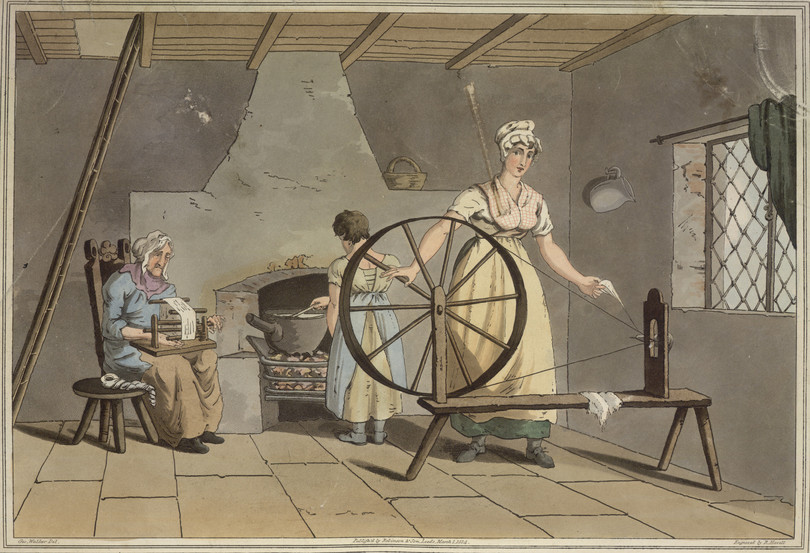
This engraving shows three generations of women in an early 1800s British home. The woman on the right is spinning wool using a spinning wheel. Source: Plate 29 of George Walker. 1814. The Costume of Yorkshire, British Library.
Eve Fisher, a historian, calculated that making a shirt in the years just before the Industrial Revolution required 500 hours of spinning and 579 hours of work in total—making the cost of a single shirt $4,197.75 at the 2022 US federal minimum wage.
For centuries, people used a spinning wheel to spin fibers like cotton or wool into yarn. Then, in 1765, a new invention rapidly began to be adopted across Britain: the spinning jenny. One adult operating a spinning jenny could produce as much as eight women working on eight spinning wheels. The spinning jenny was followed by further innovations, such as the spinning mule. A single spinning mule operated by a small number of people could produce more yarn than 1,000 women working on 1,000 spinning wheels.
You can compare what it was like to use the spinning wheel to the spinning jenny by watching the linked videos.
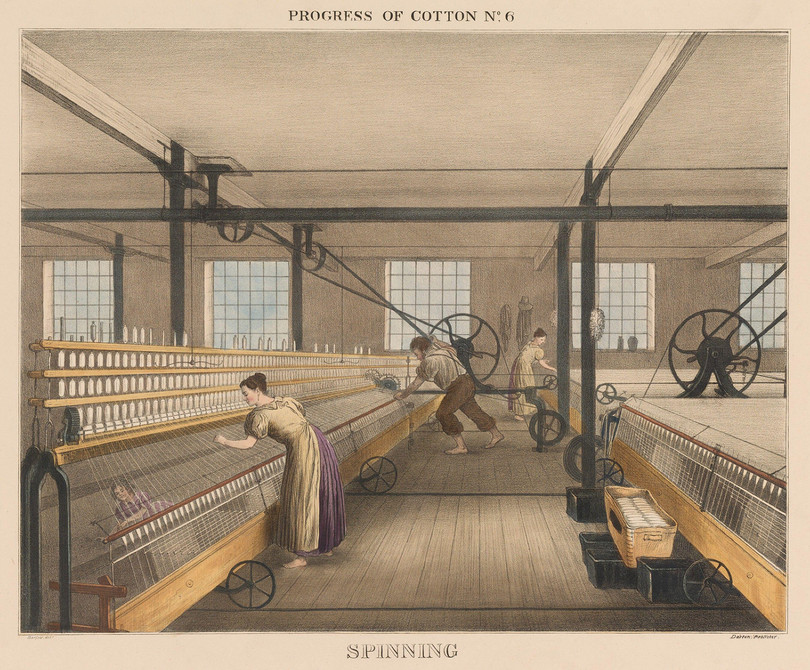
This image from 1835 shows workers spinning cotton with spinning mules, which could be powered by a water wheel or a coal-powered steam engine.
Spinning mules were primarily powered by coal-powered steam engines. Why would someone bother to invent such technologies, and why would firms want to buy and use them?
Earlier we saw that when the cost of labor increases relative to the cost of coal, firms doing the best they can will earn innovation rents by switching to a more capital-intensive technology, one that relies more on coal than on labor. Did that happen in Britain?
At the start of the Industrial Revolution, Britain had high and growing wages compared to the rest of the world. For example, the wages for spinners quadrupled between 1600 and 1750.1 With the wages for spinners increasing rapidly, textile firms had strong incentives to develop more capital-intensive technologies. People knew about the high wages for spinners, so inventors and tinkerers raced to develop new technologies.
The incentive to move to capital-intensive technology came not just from high wages but also from inexpensive energy, particularly coal. The price of Britain’s coal was relatively low because it happened to sit on huge coal reserves. The combination of inexpensive coal and high wages meant the price of labor relative to energy was unusually high in Britain, which helps explain why the capital-intensive technologies of the Industrial Revolution were first adopted in Britain.
Data Extension 4.7 High wages and inexpensive coal
Figure E4.8 shows the price of labor relative to the price of energy in six cities in the early 1700s. Specifically, it shows the wages of building laborers divided by the price of 1 million BTU (British thermal units, a unit of energy). As the figure shows, labor was more expensive relative to the cost of energy in England than the Netherlands (Amsterdam), France (Paris and Strasbourg), and China (Beijing).
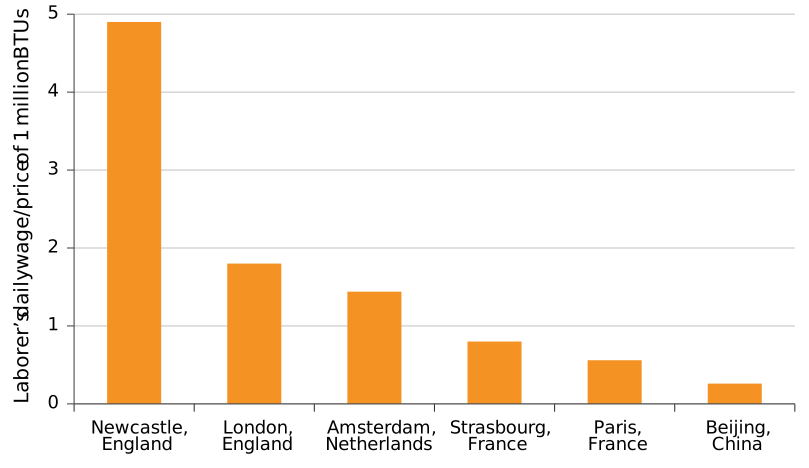
Figure E4.8 Wages relative to the price of energy (early 1700s).
Robert C. Allen. 2008. The British Industrial Revolution in Global Perspective. Cambridge University Press. p. 140.
This relative price was high in England for two reasons: English wages were relatively high, and coal in Britain was relatively inexpensive. The figure also shows that the relative price of labor was higher in some parts of England than in others, with Newcastle having a much higher relative price of labor than London. Those parts of England with a higher relative price of labor were quicker to adopt capital-intensive technologies because their firms had a stronger incentive to do so.
Question E4.5
According to Figure E4.8, which of the following statements are correct about relative input prices in the early 1700s? Choose the correct option(s).
- England had high wages and inexpensive coal.
- While Newcastle did have the highest wages, they were not four times Amsterdam’s.
- Beijing had expensive coal and relatively low wages.
- These relative prices gave England a strong incentive to adopt capital-intensive technologies.
Exercise E4.5 Strasbourg or Newcastle?
Imagine you are a factory owner in early 1700s Strasbourg, France. Based on the relative wage–energy price in your city compared to Newcastle, England, what kind of production methods are you likely to use? Would your decisions about technology adoption be the same as those in Newcastle?
Extension 4.7 Slavery, colonialism, and the Industrial Revolution
For centuries prior to the Industrial Revolution, Indian cotton textiles were highly prized throughout Asia, Africa, and Europe. But it was the highly competitive West African markets, particularly those connected to the slave trade, that first put pressure on British textile manufacturers to develop new technologies. Cotton textiles were a key good that could be traded for slaves. The intense competition in this market, especially from Indian producers, was an important factor pushing British textile firms to improve their technology.
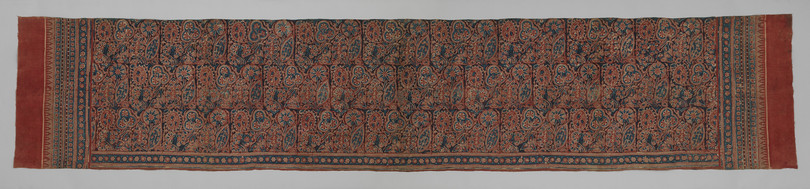
Detail from a late 1300s or early 1400s full-length cotton cloth produced in Gujarat, in Western India, meant for Indonesian markets.
In addition to West Africa, Britain had access to growing markets in India and the Americas. By the late 1700s, the British had established colonies in the Caribbean and North America, to which they had exclusive market access. The United States and other parts of the Americas were also important markets for British goods. This increased market access greatly increased the amount of cotton textiles and other goods that British firms could sell.
In this video, the economist Nathan Nunn investigates the Atlantic slave trade, which played a critical role in providing raw materials for the Industrial Revolution in Great Britain, and its contribution to the persistence of poverty in Africa in the following centuries.
To grow its cotton textile industry, Britain required two key inputs: cotton and calories. Through the 1700s and 1800s, the raw cotton used for textiles in Britain was produced by enslaved Africans, primarily in the British West Indies and then later the southern United States. Back in Britain, the booming factories pulled large quantities of workers off farms. Feeding them required calories from outside Britain, particularly in the form of sugar, which was mostly produced by enslaved workers in the British West Indies. The sugar produced by enslaved workers also helped feed the enslaved workers on the cotton plantations.
In this video, economic historian Bob Allen addresses the question of why Britain industrialized when other regions did not. He shows how the rise in women’s earnings prompted mechanization in spinning.
Applying what we’ve learned in this chapter, we can see how expanded market access, market competition, and access to raw materials created incentives to innovate and huge opportunities for Britain to specialize in textiles and other products in which it had a comparative advantage. There is no question that enslaved labor and Britain’s colonies provided the needed markets and materials for the Industrial Revolution. Although the institutions of capitalism (such as private property, markets, and firms) certainly contributed to the Industrial Revolution in Britain, their development was also shaped by colonial domination and the enslavement of millions of people.2
Question 4.10
Which of the following was an important reason why the Industrial Revolution happened in Britain in the late eighteenth and early nineteenth centuries and not somewhere else? Choose the correct option(s).
- The price of labor relative to coal was higher in Britain than in many other countries, which created an incentive to develop labor-saving, coal-using technologies.
- Britain had extensive trade networks, including colonies, that provided access to raw materials and export markets.
- The price of coal relative to labor was low, not high, making it attractive to develop coal-intensive production methods.
- Britain had high and growing wages compared to the rest of the world.
Exercise 4.13 Why the Industrial Revolution happened in Britain
Watch our video in which Bob Allen, an economic historian, explains his theory of why the Industrial Revolution occurred when and where it did.
- Summarize Allen’s claim using the concept of economic rents. What assumptions are you making?
- What other important factors may explain the rise of energy-intensive technologies in Britain in the eighteenth century?
Exercise 4.14 Six economic principles illustrated by the Industrial Revolution
How does the story of the Industrial Revolution we’ve told in this section illustrate each of the following six principles? You may want to read Extension 4.7 before answering.
- The doing the best you can principle
- The trade-offs and opportunity costs principle
- The interdependence principle
- The mutual gains and conflicts from exchange principle
- The individual and societal interests principle
- The rules of the game principle
-
Allen, Robert C. “Spinning Their Wheels: A Reply to Jane Humphries and Benjamin Schneider.” The Economic History Review 73, no. 4 (2020): 1128–1136. ↩
-
Inikori, Joseph E. 2002. Africans and the Industrial Revolution in England. Cambridge University Press. ↩

