4.6 Specialization, comparative advantage, and markets
Look at the objects around you. Do you know the person who made them? What about your clothing? Or the food you ate at your last meal? Now imagine that it is 1776. The same questions, asked anywhere in the world, would have had very different answers.
- specialization
- Specialization exists when workers, organizations, or countries concentrate on producing a limited set of goods or performing specific tasks. This often happens through the division of labor—a system where production is broken into smaller tasks and different people or groups take on different parts of production.
- interdependence principle, principle of interdependence
- The outcomes people obtain in economic interactions depend on the actions that they and others take in response to each other and on what they believe about the future.
All human societies have had some amount of specialization, and so the principle of interdependence has always held. Today, though, production is far more specialized than it was in the past. Families today rarely produce in full any of the goods and services that they use or consume in their daily lives. Instead, we specialize: some people work as welders, others as teachers or architects. Similarly, firms specialize in particular goods, or sometimes in one part of the production process for a good, such as companies that produce tires or microchips.
Everyday Economics 4.6
If Albert Einstein had to make all his own clothes, grow his own food, and build his own shelter, he would not have had much time or energy to study physics. Similarly, if the people of Florida had to be entirely self-sufficient, they would not produce as much orange juice, because they would have to set aside more labor and resources to produce other necessities. Can you identify other examples of people or regions who do better by specializing, thereby allowing society to produce more of everything, and making people better off by trading what they specialize in with other people or regions?
Countries specialize too. Cambodia’s largest exports are gold and knitwear; Singapore specializes in integrated circuits and financial services. Regions or cities also specialize. For example, most of the corn in the United States is produced in Iowa and Illinois, while most of the cheese is produced in Wisconsin. Our interdependence today stretches far wider, to many people whom we will never meet, and with whom we will never interact.
In this TED Talk, the writer Thomas Thwaites describes the difficulty and expense of trying to build a seemingly simple thing like a toaster by himself. This example highlights how the principle of interdependence applies even for a relatively simple good.
- principle of mutual gains and conflicts from exchange
- People mutually benefit by interacting with others, but there are typically conflicts over the distribution of these gains.
So far, we have assumed that achieving a greater average product of labor requires firms to adopt a new technology. But specialization also produces higher levels of output per worker. The ability to specialize can be beneficial to individuals, firms, and society as a whole, though conflicts may arise over how these benefits are divided. This is a phenomenon known as the principle of mutual gains and conflicts from exchange.
Why specialization promotes productivity
Specialization increases productivity because it can allow people to better take advantage of their differences. By allowing individuals, groups, and regions to focus on what they are good at or the resources to which they have access, specialization increases the amount that can be produced.
Everyday Economics 4.7
What are some examples of learning by doing in your life? What are some tasks you’ve gotten better at just by doing them more?
- learning by doing
- People learn better (less costly) ways of working by developing individual skills and discovering better ways to organize production among members of a team.
A second important advantage of specialization is learning by doing, which is the tendency for people, either as individuals or groups, to get better at a task as they do it more. As an example of a group of people learning by doing, consider Figure 4.9. The figure depicts data from the Ford Motor Company’s production of an armored truck, the M20-GBK, built in Chicago during the Second World War. A total of 3,791 M20-GBK armored trucks were built from 1943 to 1945.
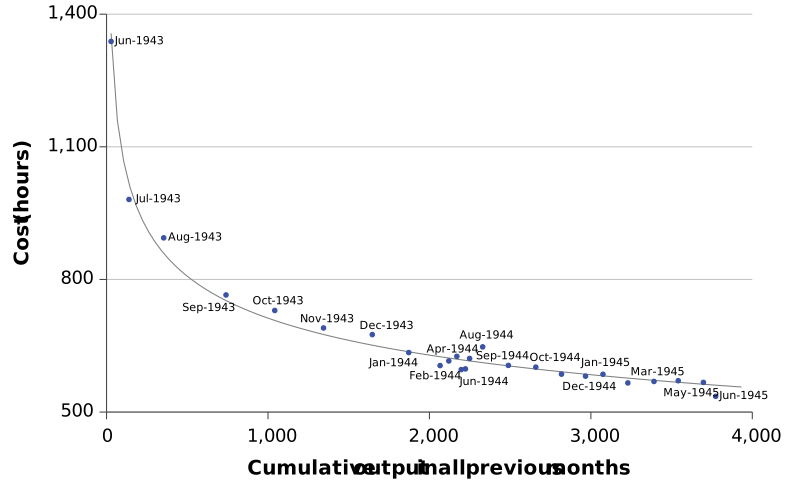
Figure 4.9 Cumulative output of producing a M20-GBK truck.
Lafond, François, Diana Greenwald, and J. Doyne Farmer. 2022. “Can Stimulating Demand Drive Costs Down? World War II as a Natural Experiment.” The Journal of Economic History 82(3): pp. 727–764.
The vertical axis of Figure 4.9 shows the cost per truck, measured not in money but in the average hours of work required to produce one truck. The horizontal axis shows how many units had been produced in all of the previous months. Because the cost per truck decreased as Ford produced more of them, the downward-sloping line is evidence of learning by doing. Costs were cut in half as the entire Ford team—engineers, managers, and workers on the assembly line—learned from experience.

The M20-GBK armored truck built by Ford Motor Company from 1943 to 1945.
The benefits of learning by doing are significant. Although discussions of technological progress tend to focus on new inventions and famous inventors, most of the gains in productivity come from learning by doing—from workers, managers, and technicians figuring out how best to use these inventions, learning how to integrate them with other technologies, and developing the skills and knowledge required to operate them efficiently.
- economies of scale
- When production exhibits increasing returns to scale, increasing all of the inputs to a production process by the same proportion increases the output by a higher proportion.
Learning by doing can also contribute to another advantage of specialization: economies of scale. As discussed in the previous section, a production process exhibits economies of scale (often called increasing returns to scale) when increasing all of the inputs to a production process by the same proportion increases the output by a higher proportion. For example, if a firm doubles its inputs and its output triples, it has economies of scale.
When firms decide to produce more, they usually need to hire more people, often leading to increasingly specialized roles and tasks for each worker. As the workers become more specialized, they will learn and improve more quickly because their time and attention are more focused. The learning by doing will help produce economies of scale as the percentage increase in output will be larger than the percentage increase in input.
Comparative advantage: Gains from specialization
We’ve seen how specialization can make people and societies more productive. To further illustrate the principle of mutual gains and conflicts from exchange, we now examine how specializing and trading or sharing can be mutually beneficial. Indeed, all producers can benefit from specialization, even when one producer specializes in a good that another could produce with greater technical efficiency.
Consider two students, Abed and Britta. Over the course of a semester, they work on a series of group projects for their economics class. The projects require two tasks: writing a paper and making slides for a presentation. Assuming the papers and slides they produce are of sufficiently good quality, the more they can produce, the better their grade will be.
Abed and Britta have different productivities in each task. Table 4.4 shows how much each could do in an hour if they focused on just one task. For example, if Abed spends an hour making slides, he can make four slides. If he spends an hour writing, he can write three hundred words. Britta can make five slides in an hour, or write six hundred words.
| Slides made per hour | Words written per hour | |
|---|---|---|
| Abed | 4 | 300 |
| Britta | 5 | 600 |
Table 4.4 Productivity in making slides and writing words.
- absolute advantage
- A person or a country has an absolute advantage in the production of a particular good if, given a set of available inputs, they can produce more of it than another person or country.
Because Britta is better than Abed at both tasks, she has an absolute advantage in those tasks. Correspondingly, Abed has an absolute disadvantage.
On the first project, they decide to both split their time equally between each task. This means that Abed makes two slides and writes 150 words each hour, and Britta makes 2.5 slides and writes 300 words each hour. In total, then, they make 4.5 slides and write 450 words for each hour working on the project.
After the first project, Abed looks at the output and how long the project took, and wonders if there is a better way to do the next project. He notices that even though Britta is faster at making slides and writing than he is, she’s only a little faster at making slides, but much faster at writing. Look again at Table 4.4. Although Britta can write twice as many words per hour as Abed (600 compared to 300), she can make only 1.25 times as many slides per hour (5 compared to 4).
- comparative advantage
- A person or a country has a comparative advantage in the production of a particular good if their cost of producing it, relative to the cost of another good, is lower than for another person or a country.
- opportunity cost
- The opportunity cost is the net benefit of the next-best alternative—what you give up when you make a choice.
We can draw on the principle of trade-offs and opportunity costs to more precisely analyze the situation. Because Britta has a bigger advantage in writing than in making slides, Britta has a comparative advantage in writing. Meanwhile, despite having an absolute disadvantage, Abed has a comparative advantage in making slides. This comparative advantage comes from the fact that his opportunity cost of making slides is lower than Britta’s—he has to sacrifice fewer words written in order to make a slide than Britta does. Table 4.5 shows the opportunity cost of producing 100 words and one slide for both Britta and Abed. The opportunity cost for Abed of making one slide is lower than for Britta, whereas the opportunity cost of writing 100 words is lower for Britta (0.833 slides) than for Abed (1.33 slides).
This video, featuring the economist Don Boudreaux, walks through a similar example of comparative advantage, featuring two people producing two goods: bananas and fish.
This difference in opportunity costs is what Abed noticed. Britta has such an advantage in writing that she was, in effect, wasting her time by working so much on making slides. Abed therefore proposes that for the second project, he will spend all his time making slides, whereas Britta will make one slide per hour and spend the remainder of each hour on writing. Each hour they work, they will produce a total of five slides and 480 words, both of which are higher than when they each split their time between both tasks. Compare these numbers to the 4.5 slides and 450 words they produced in their first collaboration.
The Arabic scholar, Ibn Khaldun, made a similar point in 1377 when he wrote that “what is obtained through the co-operation of a group of human beings satisfies the need of a number many times greater than themselves.”1
Abed and Britta are better off by specializing. The surprising thing is that Britta ended up benefiting from Abed’s specialization in making slides even though she could have produced those slides more quickly. Specializing and cooperating is a better way to spend their time because, while Britta has an absolute advantage in both tasks, Abed has a comparative advantage in making slides. Therefore they both benefit from specializing in what they have a comparative advantage in.
Specialization in capitalism
- division of labor
- The specialization of producers to carry out different tasks in the production process.
All societies have a division of labor, which refers to specialization within a firm or a family, across the economy, or among countries around the world. For example, firms might employ thousands or even hundreds of thousands of individuals, most of them working at specialized tasks under the direction of the firm’s owners or managers. You can think of the firm as a means for large numbers of people, each with distinct skills and capacities, to contribute to a common outcome: the goods and services being produced. Firms facilitate cooperation among specialized producers, which increases productivity.
The advent of capitalism, which changed the rules of the game and expanded the role of private property, markets, and firms, has enhanced our opportunities for specialization. The more access to markets that a person or group of people has, the narrower the set of things they need to produce themselves, and the more opportunity they have to specialize in producing those things in which they have a comparative advantage. The products of that specialization then allow them to trade for or purchase what others are producing.
In the next section, we combine the models and lessons we’ve learned and use them to better understand the Industrial Revolution.
Data Extension 4.6 The falling cost of solar panels
In Figure 4.9, we saw how quickly the cost of producing an armored truck fell over the course of just a few years. Solar panels provide an even more remarkable example of decreasing costs.
Photovoltaic modules are the underlying components of solar panels. Figure E4.7 shows the average yearly price of photovoltaic cells from 1975 to 2023. The prices are expressed in 2023 dollars per watt (a unit of electricity) in order to adjust for the effects of inflation. The average price in 2023 was an astounding 0.2% of the average price in 1975.
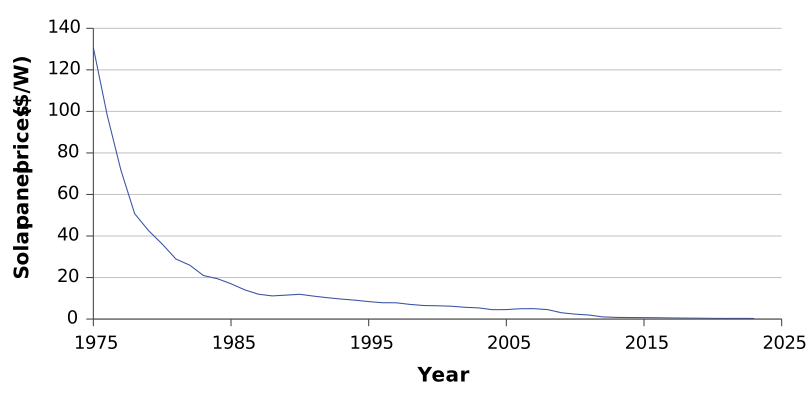
Figure E4.7 The declining cost of photovoltaic modules used to generate solar power, 1975–2023.
In contrast to the armored truck, the major contributor to the decline in the price of photovoltaic modules was research and development. Governments and firms contributed about equal amounts of money to the research and development of photovoltaic modules.
Learning by doing accounts for about 10% of the price reduction, while economies of scale account for about 25% of the cost reduction. Economies of scale are common in capital-intensive industries such as manufacturing. As production of solar panels expanded, the cost fell relative to output, pushing the price down.
Question E4.4
Which of the following helps explain the fall in photovoltaic module prices? Choose the correct option(s).
- Higher demand enabled mass production, lowering average costs.
- The fall in prices was supported by government subsidies, not their removal.
- Technological improvements and experience-based learning reduced costs over time.
- Specialization allowed producers to focus on what they did best, improving productivity.
Exercise E4.4 Economies of scale and global solar adoption
Watch this video on how solar energy got so cheap.
- According to the video, why did the cost of solar energy remain high in the early decades, and what factors began to change this?
- How did policies in Germany and China help drive global adoption and cost reductions in solar panel technology?
- What role did economies of scale play in reducing the price of solar panels?
Question 4.8
Which of the following statements about specialization in firms are correct? Choose the correct option(s).
- Specialization involves dividing labor so that each worker focuses on a limited set of tasks, improving their skill and productivity.
- Specialization doesn’t necessarily reduce the need for coordination within firms.
- Firms can organize production at lower cost than households due to specialization, economies of scale, and the coordination of multiple workers.
- By using specialization, firms can lower production costs through improved productivity and faster task execution.
Question 4.9
Alex and Jose live alone on separate islands that can produce oranges and melons. The table shows how many oranges and melons Alex and Jose can produce if they spend 100% of their time on one good. Based on this information, read the following statements and choose the correct option(s).
| Production if 100% of time is spent on one good | |
|---|---|
| Alex | 10,000 melons or 15,000 oranges |
| Jose | 15,000 melons or 30,000 oranges |
- Jose can produce 15,000 melons vs Alex’s 10,000, and 30,000 oranges vs Alex’s 15,000. He can produce more of each with the same amount of time.
- Alex’s opportunity cost of one melon equals 1.5 oranges (15,000 oranges ÷ 10,000 melons). Jose’s opportunity cost of one melon equals two oranges (30,000 ÷ 15,000). Because Alex gives up fewer oranges per melon, Alex has the comparative advantage in melons, not Jose.
- Alex has the lower opportunity cost in melon production. He should specialize in melons, and Jose should specialize in oranges.
- Jose gives up 0.5 melons per orange (15,000 ÷ 30,000), while Alex gives up 0.67 melons per orange (10,000 ÷ 15,000). Therefore, Jose has the lower opportunity cost in orange production and hence a comparative advantage in oranges.
Exercise 4.10 Monoculture farming: Benefits, risks, and specialization
Read this article on monoculture farming and answer the following questions.
- What is monoculture farming?
- What are the possible advantages of monoculture farming?
- What are the possible disadvantages of monoculture farming?
- What do your answers above suggest about the value of specialization in agriculture?
Exercise 4.11 Understanding specialization: Trade profiles of two countries
Go to the OEC website, which contains data on countries and the goods they trade. Choose two countries and read their country profiles (under the “Profiles” heading, select “Countries” to access the full list of country profiles).
For both of your chosen countries, read the list of their top exports and top imports. Suggest some explanations for the patterns of specialization that you observe. (It may be helpful to do some internet research on the background of these countries.)
Exercise 4.12 Learning by doing: Implementation of new technologies
As the economist James Bessen writes in his book, Learning by Doing, “Economic historians have long understood that most of the economic benefit from many major new technologies does not come from the initial commercialization of the original invention but from the eventual implementation.”
- Why does the way a technology is used and implemented often matter more than the technology itself?
- Can you think of an example from your life that fits this pattern?
-
Ibn Khaldun, Franz Rosenthal, N. J. Dawood, and Bruce Lawrence. 2015. The Muqaddimah: An Introduction to History. Princeton University Press. p. 273. ↩

