2.6 The economy: Government, firms, households, and the environment
The case of Kellogg illustrates how people interact with each other and with their natural environment in producing their livelihoods. It captures some of the main themes in economics, including the following:
- We often benefit by working together with other people—cooperating—compared to going it alone.
- When we work together, there is typically a conflict over how the benefits of cooperation will be divided among the participants.
- Our opportunities for cooperation and how the benefits of cooperation are divided up are determined by the institutions governing our interactions, that is, the rules of the game.
- We can often use game theory and the principle that people do the best they can to understand the likely outcomes of interactions.
- The rules of the game also determine how our economic interactions affect the environment.
- Important aspects of the rules of the game include who the first mover is and what people’s outside options are.
- Governments and citizens exercising their democratic rights can alter the rules of the game.
We introduced Kellogg as a miniature version of the whole economy. In the whole economy, the players are not a particular company, the government of a single town, and a citizen or worker, but instead millions of households and firms and many levels of government (including city, state, and national). The “map” of the whole economy in Figure E2.1 expands the map of the local economy in Figure 1.1.
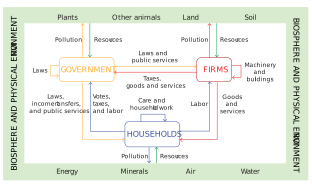
Figure 2.7 Players and their interactions: a map of the whole economy.
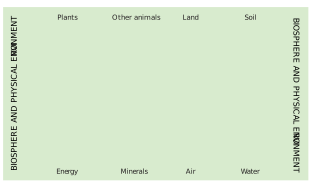
The biosphere and physical environment
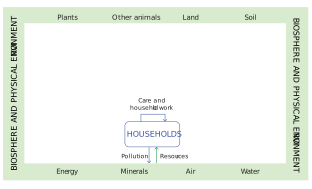
Adding households
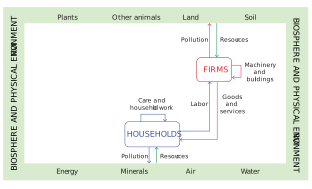
Introducing firms and production
The role of the government
Like all maps, this one is a simplification. A more complete picture would include firms, households, and governments in other countries, men and women, people of different ages, ethnic communities among the households, and private organizations other than firms (such as trade unions, churches, and community groups). Some households would be poor, living on low wages and transfers from the government, and others would be very wealthy, owning the firms and not being employed by anyone. Transfers are payments from the government that typically help poor households or people who qualify for the transfer for other reasons, such as social security benefits, Medicaid, and the earned income tax credit.
The relationships (shown by the arrows) among the actors differ. In some situations, people make choices on their own and in other situations they take directions or obey regulations imposed by others. The goods and services that firms sell to each other and to households are exchanged by people choosing what they would like to buy or sell on markets. The labor that households provide to firms is directed by managers and owners, not chosen by workers. Taxation policy and other government policies are implemented by governments that in a democracy are elected by the votes of household members.
In later units, we will use the same ideas from game theory to explain how individuals and households do the best they can and how this often involves caring about others and valuing fairness. We also explain how firms make decisions about hiring household members, and how they set prices and make other decisions when they compete with other firms in selling their goods. And we explain the activities of governments as economic actors, because well-designed public policies are essential to facilitating our economic interactions with others in ways that result in fair outcomes and environmental sustainability.
Exercise 2.5 Interdependence in an economy
- interdependence principle, principle of interdepence
- No definition available.
Return to Figure 2.7—the flowchart of the structure of the economy—and explain how it demonstrates the principle of interdependence explained in Chapter 1.
Question 2.4
When thinking about how the rules of the game could be changed, it is important to take into account which of the following? (More than one answer may be correct.)
- The numbers of households and firms are mentioned in the section, but they not necessarily important for thinking about changing the rules of the game.
- The relationships among the actors is mentioned in the section, but these are not necessarily important for thinking about changing the rules of the game.
- Democratic rights are mentioned in the section, but they are not necessarily important for thinking about changing the rules of the game.
- The important lever is the citizens exercising their democratic power.
- Voluntary choice is mentioned in the section, but it is not necessarily important for thinking about changing the rules of the game.

