12.6 Doing the best you can as the owner of a firm

Let’s summarize your decision-making process with a graph.

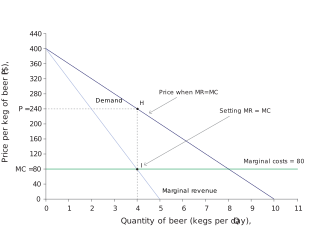
We’ll take the price, quantity, marginal revenue, and marginal costs data from Table 12.9 and graph CORE Brewing Co.’s demand, marginal revenue, and marginal cost curves. Figure 12.7 shows that the marginal revenue curve intersects the marginal cost curve at point I. At point I, MR = MC, the price you charge per keg of beer is $240 (point H), and the quantity is 4 kegs.

If you follow the step-by-step guide linked with Figure 12.7, you can see how this decision links back to the heat map (Figure 12.4). It visually reinforces how CORE Brewing Co. identifies the price and quantity combination (point H) that maximizes profit.
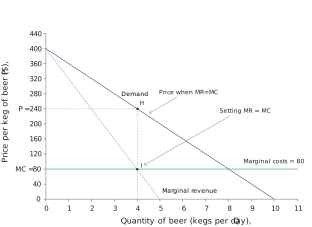
This diagram shows the profit-maximization process of CORE Brewing Co. The horizontal axis displays the quantity of beer in terms of kegs per day. The vertical axis displays the price per keg of beer, measured in dollars. The diagram includes a downward-sloping demand curve, a downward-sloping marginal revenue curve, and a horizontal marginal cost curve, indicating a constant marginal cost of 80. The diagram shows that the optimal quantity is determined by the intersection of marginal revenue curve and marginal cost curve, labelled as point I, where the quantity is 4. The optimal price is determined by the corresponding point on the demand curve where the quantity is 4, which is labelled as point H, where price is 240.
Fullscreen
https://books.core-econ.org/uoe-101/12-06.html#figure-12-7

Figure 12.7 CORE Brewing Co.’s price and quantity.

CORE Brewing will earn the most profit by charging a price and producing where marginal cost equals marginal revenue. This occurs when the quantity equals 4 kegs and the price per keg is $240.
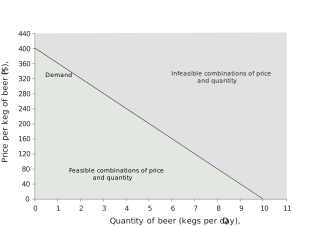
CORE Brewing Co.’s price and quantity: demand curve: This diagram shows the demand curve for CORE Brewing Co. The horizontal axis displays the quantity of beer in terms of kegs per day. The vertical axis displays the price per keg of beer, measured in dollars. The diagram shows a downward-sloping demand curve, which is a straight line connecting points (0, 400) and (10, 0). The area above the demand curve represent infeasible combinations of price and quantity. The area on and below the demand curve represent feasible combinations of price of quantity.
Fullscreen
https://books.core-econ.org/uoe-101/12-06.html#figure-12-7a

CORE Brewing Co.’s price and quantity: demand curve

Let’s start by redrawing CORE Brewing Co.’s demand curve from earlier. We have removed each of the points from Table 12.9 that were shown on the demand curve in Figure 12.5, and we have highlighted the fact that the demand curve separates the price and quantity combinations into feasible price and quantity combinations and infeasible price and quantity combinations. Even if the firm would like to charge high prices and sell a high quantity, that course of action is not feasible. The demand curve—which shows the buyers’ willingness to pay—indicates what prices and quantities are feasible for CORE Brewing to sell. Moreover, even though CORE Brewing could sell at price–quantity combinations below the demand curve, it will always pick combinations on the border of the set of feasible price–quantity combinations because it can make more profit by doing so. How much profit can CORE Brewing make?

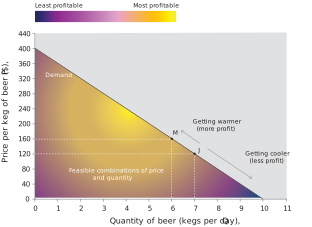
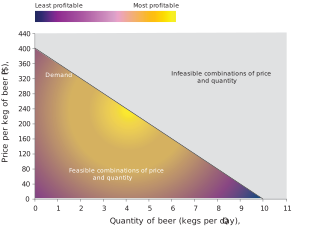
CORE Brewing Co.’s price and quantity with the heat map of feasible economic profits: This diagram shows the demand curve for CORE Brewing Co and a heatmap for the feasible combinations of price and quantity. The horizontal axis displays the quantity of beer in terms of kegs per day. The vertical axis displays the price per keg of beer, measured in dollars. The diagram shows a downward-sloping demand curve, which is a straight line connecting points (0, 400) and (10, 0). The area above the demand curve represent infeasible combinations of price and quantity. The area on and below the demand curve represent feasible combinations of price of quantity, which is shown as a heatmap. A combination of higher price and higher quantity will lead to higher profit, vice versa. A combination of highest quantity but lowest price will lead to lowest profit.
Fullscreen
https://books.core-econ.org/uoe-101/12-06.html#figure-12-7b

CORE Brewing Co.’s price and quantity with the heat map of feasible economic profits
Previously, CORE Brewing Co., when not constrained by the demand curve showing buyers’ willingness to pay, thought of its potential profits using Figure 12.4. Now, because the owners realize they can’t just charge any price and sell any quantity they want, they have to think about how to do the best they can given the constraint imposed on them by the buyers’ demand. Here we see a heat map of the profits that the company can make at the different price–quantity combinations, with dark purple corresponding to lowest profits or losses, and bright yellow corresponding to the highest feasible profits. Let’s now think about possible choices the owners of CORE Brewing might make while working out what price–quantity combination they should choose.

CORE Brewing Co.’s price and quantity with the heat map of feasible economic profits and the initial price–quantity combination at point J: This diagram shows the demand curve for CORE Brewing Co and a heatmap for the feasible combinations of price and quantity. The horizontal axis displays the quantity of beer in terms of kegs per day. The vertical axis displays the price per keg of beer, measured in dollars. The diagram shows a downward-sloping demand curve, which is a straight line connecting points (0, 400) and (10, 0). The area above the demand curve represent infeasible combinations of price and quantity. The area on and below the demand curve represent feasible combinations of price of quantity, which is shown as a heatmap. The diagram assumes that the owners of this firm initially choose a quantity of 7 and a price of 120. This point is labelled as J. The diagram shows that if the owners choose any point alone the demand curve below point J, they will get less profit. However, if the owners choose a point on the demand curve which is slightly above point J, they can get more profit. For instance, they can get more profit if they choose a quantity of 6 and a price of 160. This point is labelled as M.
Fullscreen
https://books.core-econ.org/uoe-101/12-06.html#figure-12-7c

CORE Brewing Co.’s price and quantity with the heat map of feasible economic profits and the initial price–quantity combination at point J
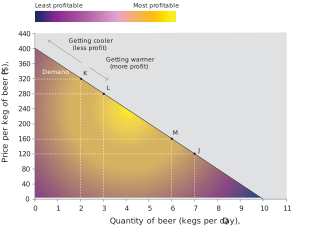
The owners of the company had hoped that they could sell a high quantity at a high price, so they started off making many kegs of beer. They then realized that, when doing so, they could only charge a low price and they didn’t make much profit. Their price–quantity combination is shown by point J. Then they asked themselves: Should we sell more beer or less beer? Which choice would bring more profit? They thought: Let’s try to experiment! In experimenting, they realized that if they sell more beer at a lower price, they are “walking down” the demand curve and getting into the cooler (less profit) area of the heat map: the trade-offs of selling more output are outweighed by the opportunity costs of the lower price needed to sell more kegs. Having learned this lesson, they went back to point J. They then decided to “walk up” the demand curve and started to sell fewer kegs of beer at a higher price at point M. How do they evaluate the shift from J to M?

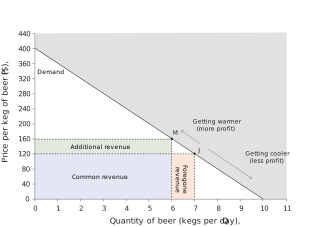
CORE Brewing Co.’s price and quantity, the initial price–quantity combination at point J, and the common revenues, forgone revenue, and additional revenue from producing at point M: This diagram shows the demand curve for CORE Brewing Co. The horizontal axis displays the quantity of beer in terms of kegs per day. The vertical axis displays the price per keg of beer, measured in dollars. The diagram shows a downward-sloping demand curve, which is a straight line connecting points (0, 400) and (10, 0). The area above the demand curve represent infeasible combinations of price and quantity. The area on and below the demand curve represent feasible combinations of price of quantity. The diagram assumes that the owners of this firm initially choose a quantity of 7 and a price of 120. This point is labelled as J. The diagram shows that if the owners choose any point alone the demand curve below point J, they will get less profit. However, if the owners choose a point on the demand curve which is slightly above point J, they can get more profit. For instance, they can get more profit if they choose a quantity of 6 and a price of 160. This point is labelled as M. Comparing point M and J, they both have a common revenue, which is represented by the rectangular area with vertex (0,0), (0, 120), (6, 120) and (6, 0). Moving from J to M will cause a foregone revenue, which is represented by the rectangular area with vertex (6, 120), (7, 120), (7, 0) and (6, 0). But there will also be some additional revenue gained, which is represented by the rectangular area with vertex (0, 120), (0, 160), (6, 160) and (6, 120).
Fullscreen
https://books.core-econ.org/uoe-101/12-06.html#figure-12-7d

CORE Brewing Co.’s price and quantity, the initial price–quantity combination at point J, and the common revenues, forgone revenue, and additional revenue from producing at point M
Comparing point J to point M, the owners realize they are “getting warmer” and starting to make more profits: The trade-offs from the greater profit of selling at a higher price outweigh the opportunity costs from fewer goods sold. In evaluating their choice, they compared their revenues. This graph shows three shaded areas comparing point J to point M. First, in blue, we have the common revenue across the two price–quantity combinations. When shifting from producing fewer kegs at M compared to J, though, the owners give up some revenue. Specifically, they aren’t selling the additional 7th keg at $160. They lose—or forgo—the revenue in orange. But they also gain revenue, as shown in the shaded green area of additional revenue. They now make an additional $40 ($160 – $120 = $40) per keg that they sell. Having made this additional revenue from changing the output from 7 to 6, they continue to “walk up” the demand curve and reduce the number of kegs of beer they sell and sell them at an even higher price. But at what point should they stop reducing the number of kegs they sell and increasing their price?

CORE Brewing Co.’s price and quantity with the heat map of feasible economic profits and a second price–quantity combination at point K: This diagram shows the demand curve for CORE Brewing Co and a heatmap for the feasible combinations of price and quantity. The horizontal axis displays the quantity of beer in terms of kegs per day. The vertical axis displays the price per keg of beer, measured in dollars. The diagram shows a downward-sloping demand curve, which is a straight line connecting points (0, 400) and (10, 0). The area above the demand curve represent infeasible combinations of price and quantity. The area on and below the demand curve represent feasible combinations of price of quantity, which is shown as a heatmap. The diagram assumes that the owners of this firm initially choose a quantity of 2 and a price of 320. This point is labelled as K. The diagram shows that if the owners choose any point alone the demand curve above point K, they will get less profit. However, if the owners choose a point on the demand curve which is slightly below point K, they can get more profit. For instance, they can get more profit if they choose a quantity of 3 and a price of 280. This point is labelled as L.
Fullscreen
https://books.core-econ.org/uoe-101/12-06.html#figure-12-7e

CORE Brewing Co.’s price and quantity with the heat map of feasible economic profits and a second price–quantity combination at point K
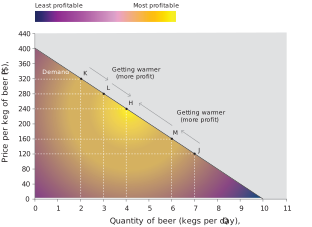
While experimenting, the owners of CORE Brewing Co. reduced their output of kegs of beer substantially to point K. Comparing point K to point J, at J the owners charged a price of $120 per keg and sold 7 kegs, whereas at K they sell 2 kegs and charge a price of $320 per keg. Their profits are higher at K compared to J, which we can see by the fact that the area is more yellow than the pinker-purpler area at J. But are they making the most profit they can? The owners realized that they may have overshot the point where they do the best they can.

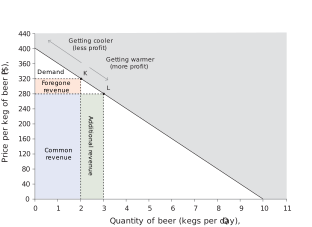
CORE Brewing Co.’s price and quantity, the price–quantity combination at point K, and the common revenues, forgone revenue, and additional revenue from producing at L: This diagram shows the demand curve for CORE Brewing Co. The horizontal axis displays the quantity of beer in terms of kegs per day. The vertical axis displays the price per keg of beer, measured in dollars. The diagram shows a downward-sloping demand curve, which is a straight line connecting points (0, 400) and (10, 0). The area above the demand curve represent infeasible combinations of price and quantity. The area on and below the demand curve represent feasible combinations of price of quantity. The diagram assumes that the owners of this firm initially choose a quantity of 2 and a price of 320. This point is labelled as K. The diagram shows that if the owners choose any point alone the demand curve above point K, they will get less profit. However, if the owners choose a point on the demand curve which is slightly below point K, they can get more profit. For instance, they can get more profit if they choose a quantity of 3 and a price of 280. This point is labelled as L. Comparing point K and L, they both have a common revenue, which is represented by the rectangular area with vertex (0,0), (0, 280), (2, 280) and (2, 0). Moving from K to L will cause a foregone revenue, which is represented by the rectangular area with vertex (0, 280), (0, 320), (2, 320) and (2, 280). But there will also be some additional revenue gained, which is represented by the rectangular area with vertex (2, 0), (2, 280), (3, 280) and (3, 0).
Fullscreen
https://books.core-econ.org/uoe-101/12-06.html#figure-12-7f

CORE Brewing Co.’s price and quantity, the price–quantity combination at point K, and the common revenues, forgone revenue, and additional revenue from producing at L
The owners experiment more and realize that if they reduce their output further and charge an even higher price, they make even less profit: The trade-offs from the benefits of a higher price are outweighed by the opportunity cost of reduced profits from selling fewer goods. If, instead, they increase their output to point L and sell more kegs of beer at a lower price ($280), they make more profit: The trade-offs from the higher profit of selling more output outweigh the opportunity costs of a reduced price. Comparing points K and L like we did earlier with J and M, we can see the common revenue, the forgone revenue from lowering output from 3 to 2 and selling at a lower price, and the additional revenue from selling more kegs at the lower price. The owners decide to “walk down” the demand curve and choose a price–quantity combination where they sell more beer at a lower price. What price–quantity combination do they finally settle on?

CORE Brewing Co.’s price and quantity with the heat map of feasible economic profits where the owners have experimented to find the point at which they do the best they can: This diagram shows the demand curve for CORE Brewing Co and a heatmap for the feasible combinations of price and quantity. The horizontal axis displays the quantity of beer in terms of kegs per day. The vertical axis displays the price per keg of beer, measured in dollars. The diagram shows a downward-sloping demand curve, which is a straight line connecting points (0, 400) and (10, 0). The area above the demand curve represent infeasible combinations of price and quantity. The area on and below the demand curve represent feasible combinations of price of quantity. The diagram shows that if the owners of this firm initially choose a quantity of 2 and a price of 320, which is labelled as K, they can get more profit by choosing a point on the demand curve which is slightly below point K. For instance, they can get more profit if they choose a quantity of 3 and a price of 280, which is labelled as L. If the owners of this firm initially choose a quantity of 7 and a price of 120, which is labelled as J, they can get more profit by choosing a point on the demand curve which is slightly above point J. For instance, they can get more profit if they choose a quantity of 6 and a price of 160, which is labelled as M. They can reach maximum profit at quantity 4 and price 240, which is labelled as point H on the demand curve. Point H is between point L and M.
Fullscreen
https://books.core-econ.org/uoe-101/12-06.html#figure-12-7g

CORE Brewing Co.’s price and quantity with the heat map of feasible economic profits where the owners have experimented to find the point at which they do the best they can
Having experimented and evaluated the opportunity costs of the forgone revenue from a higher price with fewer units sold compared to the revenue of more units sold at a lower price, the owners “walk down” the demand curve toward point H. If, for whatever reason, they overshoot point H and move towards point J, they will realize the differences in their revenues and profits (weighing the opportunity costs from the demand curve vs. the trade-offs from the changes in their profits) and see that they need to “turn around” and walk back up the demand curve toward point H, where they do the best they can and make the highest feasible profits, producing an output of 4 kegs of beer and charging a price of $240 per keg. In so doing, they have thought at the margin: comparing their marginal revenues to their marginal costs, without even realizing they were doing so. So what do we observe when we include marginal revenue and marginal cost in the figure?

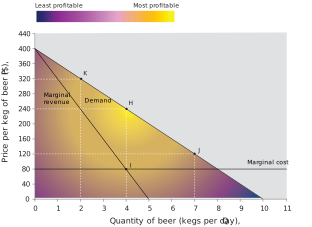
CORE Brewing Co.’s price and quantity with the heat map of feasible economic profits where the owners do the best they can at point H: This diagram shows the demand curve for CORE Brewing Co and a heatmap for the feasible combinations of price and quantity. The horizontal axis displays the quantity of beer in terms of kegs per day. The vertical axis displays the price per keg of beer, measured in dollars. The diagram shows a downward-sloping demand curve, which is a straight line connecting points (0, 400) and (10, 0). The area above the demand curve represent infeasible combinations of price and quantity. The area on and below the demand curve represent feasible combinations of price of quantity, which is shown as a heatmap. The diagram also includes a marginal revenue curve, which is a downward-sloping straight line connecting points (0, 400) and (5, 0). Apart from that, the diagram includes a marginal cost curve, which is a horizontal straight line, indicating a constant marginal cost of 80. The diagram shows that the optimal quantity is determined by the intersection of marginal revenue curve and marginal cost curve, labelled as point I, where the quantity is 4. The optimal price is determined by the corresponding point on the demand curve where the quantity is 4, which is labelled as point H, where price is 240.
Fullscreen
https://books.core-econ.org/uoe-101/12-06.html#figure-12-7h

CORE Brewing Co.’s price and quantity with the heat map of feasible economic profits where the owners do the best they can at point H

We have included marginal revenue and marginal costs in the figure. The marginal cost curve is flat and constant at $80 per unit. The marginal revenue curve slopes downward and has a steeper slope than the demand curve. Marginal revenue equals marginal cost at point I, which corresponds to an output of 4 kegs of beer. At 4 kegs of beer, the owners of the firm choose the price that buyers are willing to pay at that price on their demand curve: $240 per keg. These numbers correspond to point H, which is the point the owners had settled on after experimenting with raising and lowering their output and raising and lowering the corresponding price given what buyers were willing to pay at each output. It is shown by the bright yellow area on the curve corresponding to highest feasible profits.

CORE Brewing Co.’s price and quantity showing profit maximization: This diagram shows the profit-maximization process of CORE Brewing Co. The horizontal axis displays the quantity of beer in terms of kegs per day. The vertical axis displays the price per keg of beer, measured in dollars. The diagram includes a downward-sloping demand curve, a downward-sloping marginal revenue curve, and a horizontal marginal cost curve, indicating a constant marginal cost of 80. The diagram shows that the optimal quantity is determined by the intersection of marginal revenue curve and marginal cost curve, labelled as point I, where the quantity is 4. The optimal price is determined by the corresponding point on the demand curve where the quantity is 4, which is labelled as point H, where price is 240.
Fullscreen
https://books.core-econ.org/uoe-101/12-06.html#figure-12-7i

CORE Brewing Co.’s price and quantity showing profit maximization

We can now remove the heat map of profits and simply show the demand, marginal revenue, and marginal cost curves. CORE Brewing Co. does the best it can by maximizing profits at the output where MR = MC. Marginal revenue equals marginal cost when CORE Brewing Co. produces 4 kegs of beer per day. When it produces 4 kegs per day, CORE will price each keg at $240, which is the price from the demand curve that corresponds to an output of 4 kegs.

Math Extension 12.6 Why don’t the table and the graph match exactly?

To understand why the graph and the table don’t match exactly, we need to think about the difference between marginal revenue measured by comparing two specific levels of output, such as 1 keg and 2 kegs, and marginal revenue measured at a specific point on a curve.

A stepwise marginal revenue curve

Table 12.9 compared the revenue at each specific number of kegs—1 through 10—that CORE Brewing Co. could produce. To think about the difference between the graphed marginal revenue and the instantaneous measurement of marginal revenue at one point compared to the numbers in the table, let us think about how to convert the numbers from the table into a stepwise curve like Figure 8.2 in Chapter 8 for Karim making a decision about how many hours to work.
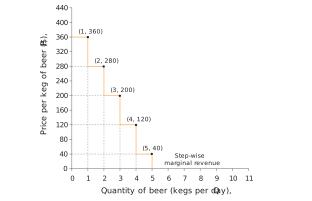
This diagram shows the stepwise marginal revenue curve for CORE Brewing Co. The horizontal axis displays the quantity of beer in terms of kegs per day. The vertical axis displays the price per keg of beer, measured in dollars. The diagram shows that the marginal revenue is 360 at 1 keg of beer, 280 at 2 kegs of beer, 200 at 3 kegs of beer, 120 at 4 kegs of beer, and 40 at 5 kegs of beer. The stepwise marginal revenue curve is formed by directly connecting these points.
Fullscreen
https://books.core-econ.org/uoe-101/12-06.html#figure-e12-7

Figure E12.7 Stepwise marginal revenue curve.

The quantities and corresponding marginal revenues from Table 12.9 are labeled in the figure. The stepwise marginal revenue is shown in orange.

Figure E12.7 MR_step shows the marginal revenue between the specific quantities and the marginal revenue (that is, how total revenue changes between two levels of output, such as 1 and 2, 2 and 3, and so on). The values correspond to those in Table 12.9.

A stepwise and a continuous marginal revenue curve

Having graphed the stepwise marginal revenue, we can now superimpose the smooth linear marginal revenue, the demand curve, and marginal costs, as shown in Figure E12.8 MR_Step_smooth. We also identify the price and quantity for CORE Brewing Co. doing the best it can by setting MR = MC.
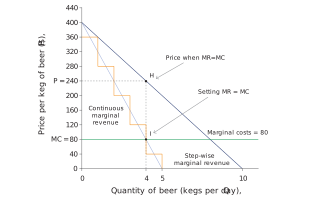
This diagram shows the stepwise and smooth marginal revenue curve for CORE Brewing Co and its profit maximization decision. The horizontal axis displays the quantity of beer in terms of kegs per day. The vertical axis displays the price per keg of beer, measured in dollars. The diagram shows that the marginal revenue is 360 at 1 keg of beer, 280 at 2 kegs of beer, 200 at 3 kegs of beer, 120 at 4 kegs of beer, and 40 at 5 kegs of beer. The stepwise marginal revenue curve is formed by directly connecting these points. The smooth marginal curve is a downward-sloping straight line connecting points (0, 400) and (5, 0). The diagram also plots a downward-sloping demand curve, which is a straight line connecting points (0, 400) and (10, 0). The diagram also includes a horizontal marginal cost curve, indicating a constant marginal cost of 80. The profit-maximizing quantity is 4 kegs, which is determined by the intersection between the marginal cost curve and both marginal revenue curves. The profit-maximizing price is 240, which is read from the demand curve at quantity 4.
Fullscreen
https://books.core-econ.org/uoe-101/12-06.html#figure-e12-8

Figure E12.8 Stepwise and smooth marginal revenue curve and profit maximization.

The stepwise marginal revenue curve with the values from Table 12.9, overlaid with the smooth continuous marginal revenue curve, demand curve, and marginal cost curve from Figure 12.7.

Notice that at an output of 4, the smooth, continuous MR curve (in blue) intersects the stepwise MR curve (in orange), and both curves intersect the marginal cost curve (in green). Both curves find the correct quantity where the firm does the best it can.

So why are the values different? The continuous linear MR curve “averages out” the steps in the stepwise curve and treats each keg of beer as though we could divide a keg of beer into small amounts (which we can do with liquid, even though we only sell beer units of 1 keg)—for example, half a keg, one-quarter of a keg, and so on down to the smallest possible amounts. The smooth continuous curve also allows us to identify MR at exactly one point on the curve, such as a quantity of 4, whereas the stepwise curve (and the values in Table 12.9) only allow us to identify marginal revenue between specific values of output. For the smooth curve, we could hypothetically know the value of marginal revenue for an output of 1.25 kegs, 2.125 kegs, or 3.142 kegs. Each provides a value of marginal revenue for each potential quantity and identifies the corresponding marginal revenue for that output. This explains why the values from the table and the values from the continuous MR curve differ.

Illustrating the firm’s economic profits

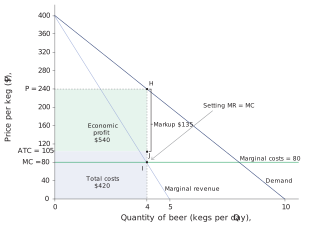
We can graphically illustrate the economic profits that CORE Brewing Co. makes. Figure 12.8 shows CORE’s profits and costs when it produces 4 kegs of beer and charges $240 per keg. Economic profit is the shaded green area. Let’s walk through the different areas in the figure to understand why the shaded green area represents profits. As we get started, it is helpful to recall that the area of a rectangle is found by multiplying its width times its length. You might also find it helpful to carefully review the step-by-step link for Figure 12.8, which breaks down the areas in the figure in more detail.

CORE’s total revenue is the area bounded by \(P\) = $240 and $0 up to 4 kegs of beer per day. We can calculate the area by multiplying 4 (the width of the rectangle) times $240 (the length of the rectangle) to get $960 of total revenue per day. This amount is represented in Figure 12.8 as the combination of the green and blue-shaded areas.

CORE’s total costs are represented by the area bounded by its average total costs and zero up to 4 kegs of beer per day. When CORE Brewing Co. produces 4 kegs of beer, ATC equals $105, denoted by point J. We can find this number by referring back to Math Extension 12.3, where we calculated CORE’s average total costs. We calculate this area by multiplying 4 times $105 to get $420 in total costs, represented in Figure 12.8 as the blue-shaded area. See the step-by-step link for Figure 12.8 for a breakdown of the total fixed and variable costs.

Now that we know CORE’s total costs, we can subtract them from total revenue to get profits. Total costs are represented by the blue-shaded area ($420). Total revenue is represented by the combined green- and blue-shaded areas ($960). Economic profits are the difference, or $540. The shaded green area represents profits because that is the area by which total revenue exceeds total costs.

price markup
The price markup is the price a firm charges per unit minus the unit costs.

Another way to analyze CORE’s profits is to look at its price markup. A firm’s price markup is the price it charges per unit minus the unit costs. The price that CORE charges for a keg of beer is $240, but what is the unit cost? It is the average total cost when CORE produces 4 kegs of beer (the quantity where MR = MC). As we saw above, the average total cost when \(Q\) = 4 is $105. This means that the markup is the difference between \(P\) = $240 and ATC = $105, which is $135, or the difference between points H and J in Figure 12.8. The markup tells you on average how much profit you earn for each keg of beer that you produce and sell. You are earning an average profit of $135 per keg of beer when you produce 4 kegs and charge a price of $240. The markup measures the degree to which CORE Brewing “marks up” the price above the cost of producing a keg of beer.

Everyday Economics 12.10

When gasoline prices go up from one week to the next, how do you react? Are you an “all or nothing” person: Do you stop driving completely and let the car sit idle until gas prices go down? Or are you a “more or less” person who drives less (for example, walking instead of driving to the supermarket down the street) but does not stop driving completely (for example, you may have to drive to campus to attend classes)? Thinking in a “more or less” way means that you are thinking incrementally, as some firms do when deciding how much to produce.

You are able to charge a price higher than the unit cost of producing a keg of beer because even though you compete with many other brewers, your beer is not identical to their beer —your beer has a unique taste and is produced in a sustainable way. The fewer close substitutes for your beer, the bigger your markup because buyers will be willing to pay a higher price for your unique beer.
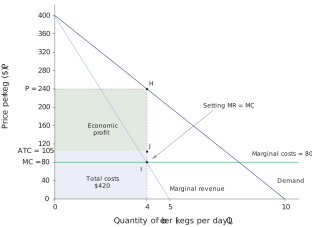
This diagram shows the profit-maximization process of CORE Brewing Co. The horizontal axis displays the quantity of beer in terms of kegs per day. The vertical axis displays the price per keg of beer, measured in dollars. The diagram includes a downward-sloping demand curve, a downward-sloping marginal revenue curve, and a horizontal marginal cost curve, indicating a constant marginal cost of 80. The diagram shows that the optimal quantity is determined by the intersection of marginal revenue curve and marginal cost curve, labelled as point I, where the quantity is 4. The optimal price is determined by the corresponding point on the demand curve where the quantity is 4, which is labelled as point H, where price is 240. At quantity 4, the average total cost is 105. This leads to a markup of 135, which is shown by the vertical distance between the price and average total cost at this quantity. This combination of price and quantity will result in an economic profit of 540, which is represented by the rectangular area with vertex (0, 105), (0, 240), (4, 240) and (4, 105). The total cost is 420, which is  represented by the rectangular area with vertex (0,0), (0, 105), (4, 105), and (4,0).
Fullscreen
https://books.core-econ.org/uoe-101/12-06.html#figure-12-8

Figure 12.8 CORE Brewing Co.’s profits when it sets MR = MC.

CORE Brewing will earn the most profit by charging a price and producing where marginal cost equals marginal revenue. The profit earned when it sets MR = MC is the green-shaded area, which represents how much CORE’s revenue exceeds its total costs when it produces 4 kegs of beer.
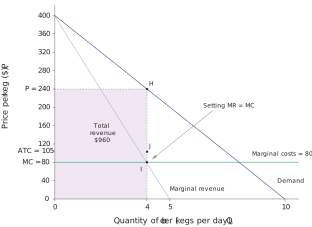
CORE Brewing Co.’s total revenue when it sets MR = MC: This diagram shows the optimal total revenue of CORE Brewing Co. The horizontal axis displays the quantity of beer in terms of kegs per day. The vertical axis displays the price per keg of beer, measured in dollars. The diagram includes a downward-sloping demand curve, a downward-sloping marginal revenue curve, and a horizontal marginal cost curve, indicating a constant marginal cost of 80. The diagram shows that the optimal quantity is determined by the intersection of marginal revenue curve and marginal cost curve, labelled as point I, where the quantity is 4. At this quantity, the average total cost is 105. The point corresponding to this quantity and average total cost is labelled as point J. The optimal price is determined by the corresponding point on the demand curve where the quantity is 4, which is labelled as point H, where price is 240. At this price and quantity, the total revenue is 960 dollars, which is represented by the rectangular area with vertex (0, 240), (4, 240), (4, 0), and (0,0).
Fullscreen
https://books.core-econ.org/uoe-101/12-06.html#figure-12-8a

CORE Brewing Co.’s total revenue when it sets MR = MC

Let’s start by shading in the area that represents total revenue. Total revenue is the area bounded between the price of $240 and $0 up to 4 kegs per day. We calculate the area of that rectangle by multiplying 4 × $240 to get $960 for CORE’s total revenue, as shown by the rectangle shaded in pink.

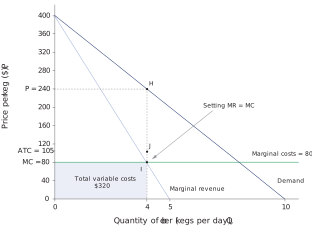
CORE Brewing Co.’s total variable costs when it sets MR = MC: This diagram shows the optimal total variable costs of CORE Brewing Co. The horizontal axis displays the quantity of beer in terms of kegs per day. The vertical axis displays the price per keg of beer, measured in dollars. The diagram includes a downward-sloping demand curve, a downward-sloping marginal revenue curve, and a horizontal marginal cost curve, indicating a constant marginal cost of 80. The diagram shows that the optimal quantity is determined by the intersection of marginal revenue curve and marginal cost curve, labelled as point I, where the quantity is 4. At this quantity, the average total cost is 105. The point corresponding to this quantity and average total cost is labelled as point J. The optimal price is determined by the corresponding point on the demand curve where the quantity is 4, which is labelled as point H, where price is 240. At this price and quantity, the total variable cost is 320 dollars, which is represented by the rectangular area under the marginal cost curve between 0 keg and 4 kegs, with vertex (0, 80), (4, 80), (4, 0), and (0,0).
Fullscreen
https://books.core-econ.org/uoe-101/12-06.html#figure-12-8b

CORE Brewing Co.’s total variable costs when it sets MR = MC

We can also identify the area that represents total variable costs. They are represented by the rectangle that is bounded between the marginal costs of $80 and $0 up to 4 kegs of beer per day. We calculate this area by multiplying 4 × $80 for total variable costs of $320, as shown by the rectangle shaded in light blue.

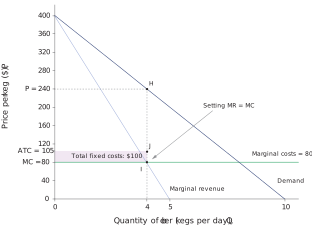
CORE Brewing Co.’s total fixed costs when it sets MR = MC: This diagram shows the optimal total fixed costs of CORE Brewing Co. The horizontal axis displays the quantity of beer in terms of kegs per day. The vertical axis displays the price per keg of beer, measured in dollars. The diagram includes a downward-sloping demand curve, a downward-sloping marginal revenue curve, and a horizontal marginal cost curve, indicating a constant marginal cost of 80. The diagram shows that the optimal quantity is determined by the intersection of marginal revenue curve and marginal cost curve, labelled as point I, where the quantity is 4. At this quantity, the average total cost is 105. The point corresponding to this quantity and average total cost is labelled as point J. The optimal price is determined by the corresponding point on the demand curve where the quantity is 4, which is labelled as point H, where price is 240. At this price and quantity, the total fixed cost is 100 dollars, which is represented by the rectangular area under the average total cost but above the marginal cost curve between 0 keg and 4 kegs, with vertex (0, 105), (4, 105), (4, 80), and (0,80).
Fullscreen
https://books.core-econ.org/uoe-101/12-06.html#figure-12-8c

CORE Brewing Co.’s total fixed costs when it sets MR = MC

We can also identify the area that represents total fixed costs. They are represented by the rectangle that is bounded between the average total costs of $105 and the marginal costs of $80 up to 4 kegs of beer per day. We calculate the area by multiplying 4 × $25 (or $105 – $80) for total fixed costs of $100, as shown by the rectangle shaded in purple.

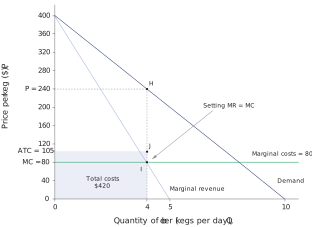
CORE Brewing Co.’s total costs when it sets MR = MC: This diagram shows the optimal total costs of CORE Brewing Co. The horizontal axis displays the quantity of beer in terms of kegs per day. The vertical axis displays the price per keg of beer, measured in dollars. The diagram includes a downward-sloping demand curve, a downward-sloping marginal revenue curve, and a horizontal marginal cost curve, indicating a constant marginal cost of 80. The diagram shows that the optimal quantity is determined by the intersection of marginal revenue curve and marginal cost curve, labelled as point I, where the quantity is 4. At this quantity, the average total cost is 105. The point corresponding to this quantity and average total cost is labelled as point J. The optimal price is determined by the corresponding point on the demand curve where the quantity is 4, which is labelled as point H, where price is 240. At this price and quantity, the total variable costs is 420 dollars, which is represented by the rectangular area under the average total cost between 0 keg and 4 kegs, with vertex (0, 105), (4, 105), (4, 0), and (0,0).
Fullscreen
https://books.core-econ.org/uoe-101/12-06.html#figure-12-8d

CORE Brewing Co.’s total costs when it sets MR = MC

CORE’s total costs are its fixed costs plus its variable costs. In the previous two steps, we shaded the total fixed costs in purple ($100) and the total variable costs in light blue ($320). We can now shade both of those areas in dark blue to denote CORE’s total costs of $420.

CORE Brewing Co.’s profits when it sets MR = MC: This diagram shows the profit-maximization process of CORE Brewing Co. The horizontal axis displays the quantity of beer in terms of kegs per day. The vertical axis displays the price per keg of beer, measured in dollars. The diagram includes a downward-sloping demand curve, a downward-sloping marginal revenue curve, and a horizontal marginal cost curve, indicating a constant marginal cost of 80. The diagram shows that the optimal quantity is determined by the intersection of marginal revenue curve and marginal cost curve, labelled as point I, where the quantity is 4. The optimal price is determined by the corresponding point on the demand curve where the quantity is 4, which is labelled as point H, where price is 240. At quantity 4, the average total cost is 105. This leads to a markup of 135, which is shown by the vertical distance between the price and average total cost at this quantity. This combination of price and quantity will result in an economic profit of 540, which is represented by the rectangular area with vertex (0, 105), (0, 240), (4, 240) and (4, 105). The total cost is 420, which is  represented by the rectangular area with vertex (0,0), (0, 105), (4, 105), and (4,0).
Fullscreen
https://books.core-econ.org/uoe-101/12-06.html#figure-12-8e

CORE Brewing Co.’s profits when it sets MR = MC

We can also identify the area that represents the profits. If we subtract CORE’s total costs (dark blue area or $420) from its total revenue (pink area or $960) we are left with its economic profits of $540, as indicated by the green-shaded area. Another way to see profits on the graph is to take the area bounded by the price of $240 and average total costs of $105 up to 4 kegs of beer. In other words, we multiply 4 × $135 ($240 – $105) to get $540.

Exercise 12.6

BrightCharge manufactures premium electric bicycles. Daily fixed cost (factory lease, salaried engineers) is $300. Each additional bike costs $100 in materials and assembly (constant MC = $100). Market research gives the demand curve \(P = 900 − 80Q\), so the firm can at most sell 10 bikes per day before the price falls to $100.

Q (bikes) Price (P) Variable Cost (VC) Total cost (TC = VC + FC) Marginal cost
(MC)
Total revenue (TR) Marginal revenue (MR) Profit
(TR − TC)
0 900 0 300 0 –300
1 820 100 400 100 820 820 420
2 740 200 500 100 1480 660 980
3 660 300 600 100 1,980 500 1,380
4 580 400 700 100 2,320 340 1,620
5 500 500 800 100 2500 180 1700
6 420 600 900 100 2520 20 1620
7 340 700 1,000 100 2,380 –140 1,380
8 260 800 1,100 100 2,080 –300 980
9 180 900 1,200 100 1,620 –460 420
10 100 1000 1,300 100 1,000 –620 –300

Exercise 12.6 Table (i)

  1. Verify the MR = MC output.
    1. Highlight the row(s) where MR ≥ MC and the row(s) where MR ≤ MC.
    2. Identify the single quantity at which MR = MC as closely as possible.
    3. Find the total profit at that quantity and one unit above and below it and show that total profit is maximized when MR = MC.
  2. Using the profit-maximising quantity from part (a), calculate the markup.
  3. Suppose BrightCharge’s license fees rise, adding $100 to the fixed cost while variable cost and demand remain unchanged.
    1. Recompute the new TC and new profit.
    2. Does the profit-maximizing quantity change? Briefly justify with numbers.
    3. How do total profit and markup compare with the original outcome?

Question 12.6

When CORE Brewing Co. chooses the output where marginal revenue equals marginal cost (MR = MC), which of the following statements are correct? Choose all that apply.

  • Profit is maximized at this output level.
  • At the MR = MC point, price always equals average total cost.
  • Whenever MR > MC, producing an additional unit raises profit.
  • The MR = MC rule applies even when a firm’s fixed costs are zero.
  • Profit reaches its maximum where MR = MC.
  • Price equals ATC only in zero-profit (normal-profit) situations, not necessarily at MR = MC.
  • As long as the extra revenue from another unit exceeds the extra cost, profit rises.
  • Fixed costs do not affect the marginal comparison; MR = MC still gives the profit-maximizing quantity.

Question 12.7

In the figure below, which of the following statements are true? Choose all that apply.
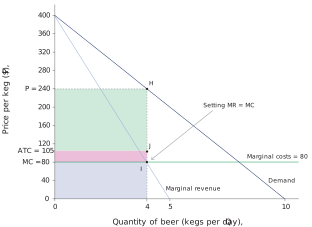
This diagram shows the profit-maximization outcome of CORE Brewing. The horizontal axis displays the quantity of beer in terms of kegs per day. The vertical axis displays the price per keg of beer, measured in dollars. The diagram includes a downward-sloping demand curve, a downward-sloping marginal revenue curve, and a horizontal marginal cost curve, indicating a constant marginal cost of 80. The diagram shows that the optimal quantity is determined by the intersection of marginal revenue curve and marginal cost curve, labelled as point I, where the quantity is 4. At this quantity, the average total cost is 105. The point corresponding to this quantity and average total cost is labelled as point J. The optimal price is determined by the corresponding point on the demand curve where the quantity is 4, which is labelled as point H, where price is 240. The economic profit is represented by the rectangular area whose vertex are points (0, 240), (4, 240), (4, 105), and (0,105). The total fixed cost is represented by the rectangular area with vertex (0, 105), (4, 105), (4, 80), and (0,80). The total variable costs is represented by the rectangular area with vertex (0, 80), (4, 80), (4, 0), and (0,0).
Fullscreen
https://books.core-econ.org/uoe-101/12-06.html#question-12-7-i

Question 12.7 (i)

  • CORE Brewing’s markup is calculated as P – ATC.
  • In the diagram, the markup is $80 per keg.
  • Total economic profit equals the markup per unit multiplied by the quantity sold.
  • The blue-shaded area represents total fixed costs.
  • Total costs are the sum of the blue- and purple-shaded areas.
  • markup = price – average total cost.
  • The figure shows a markup of $135 ($240 – $105).
  • Total profit is markup × quantity (here $135 × 4 kegs = $540).
  • The purple area is the total fixed costs.
  • Total cost comprises both variable (blue) and fixed (purple) costs.