12.4 Demand and buyers’ willingness to pay
To decide what price to charge and how much to produce, a firm must understand demand.
- demand
- Demand refers to the relationship between a product’s price and how much buyers are willing and able to buy at each possible price. See also demand curve (firm) and quantity demanded.
- demand curve (firm)
- A firm’s demand curve is a graph that shows how much of the firm’s product people want to buy at different prices. See also demand and quantity demanded.
- quantity demanded
- Quantity demanded is the amount of a product people are willing to buy at a particular price. It refers to a specific point on the demand curve where price is fixed at a given level. See also demand and demand curve (firm).
- differentiated product
- A differentiated product is a product with some unique characteristics compared to similar products produced by other firms.
The firm’s demand curve illustrates the quantity of a product buyers are willing to purchase at different prices. In this section, we explore how firms selling differentiated products face a downward-sloping demand curve. When CORE Brewing Co. sets a high price for its beer, only buyers with a strong preference for the brand will purchase it, resulting in low quantity demanded. As you lower the price, more buyers, who might have otherwise chosen a different craft beer, will be willing to buy CORE’s beer, leading to an increase in quantity demanded.
Everyday Economics 12.7
Think about the last time you visited a grocery store. Did you have a differentiated product in your shopping cart, such as cereal, chips, or soft drinks? Why did you put those items in your cart? Was it because you really prefer that brand of chips or soft drink to any other brand, and you were willing to pay a higher price for it? Or did you put it in your cart because the price was low enough to make you prefer it over a different brand that you normally buy? As you decide which items to place in your cart based on your preferences and willingness to pay for those items, you are helping a firm derive the demand curve for its product.
The firm’s demand curve
- willingness to pay
- Willingness to pay is an indicator of how much a buyer values a good, measured by the maximum amount they will pay to acquire a unit of that good.
The firm’s demand curve provides an answer to the hypothetical question “For each possible price that might be charged, how many kegs of beer will be purchased?” Potential buyers answer this question based on their willingness to pay, denoted as WTP. For CORE Brewing Co.’s beer, willingness to pay depends on how much buyers value the beer: If you value it more, then you are willing to pay more for it. If you value it less, then you are willing to pay less for it. Firms often conduct surveys of potential buyers or experiment with different prices to determine how much buyers are willing to pay for their products.
Everyday Economics 12.8 Asking about willingness to pay
To find out willingness to pay, you might offer small samples of your beer to friends who manage bars and restaurants and ask them what they are willing to pay for a keg of your beer. Their willingness to pay for your beer might depend on how much they value the taste of your beer, how much they value your brand, and/or how much money they can afford to spend on beer. How else might you go about finding out the price that people are willing to pay for your beer?
- demand
- Demand refers to the relationship between a product’s price and how much buyers are willing and able to buy at each possible price. See also demand curve (firm) and quantity demanded.
Buyers’ willingness to pay constrains how much profit the firm can make. In doing the best you can, you need to consider the price that buyers are willing to pay for a keg of your beer. You might want to charge a high price for your beer, but not all buyers are willing to pay a higher price. To maximize your profit, you need to balance your pricing strategies with the reality of buyer demand.
Let’s assume that based on the information you gather from a small survey of potential customers, you estimate the demand for your beer that is shown in Table 12.5. For simplicity, we use the data we have been working with throughout this chapter and assume that you produce just one type of beer.
| [1] Quantity (Q) (kegs per day) |
[2] Price (P) |
|---|---|
| 0 1 2 3 4 5 6 7 8 9 10 |
$400 $360 $320 $280 $240 $200 $160 $120 $80 $40 $0 |
Table 12.5 CORE Brewing Co.’s estimated product demand for its beer per day.
CORE Brewing can use a survey of buyers to estimate the amount of beer that potential buyers might demand at different prices.
Data Extension 12.4 How do firms determine willingness to pay?
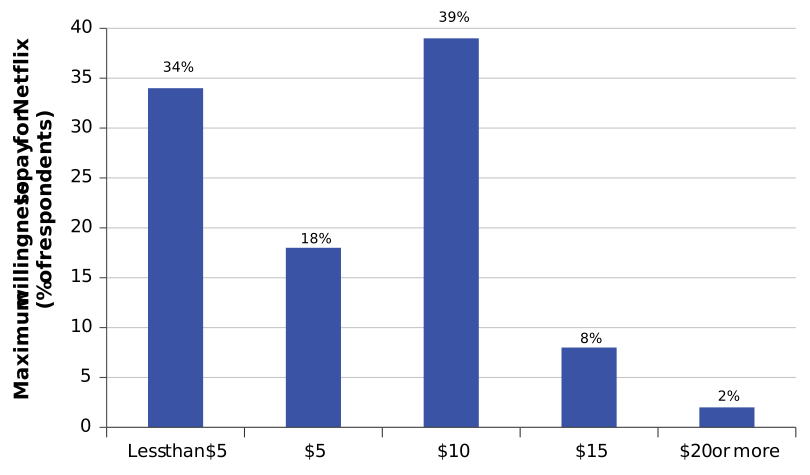
Figure E12.6 Willingness to pay for Netflix.
The figure shows the share of people surveyed who are willing to pay less than $5 per month, $5 per month, $10 per month, $15 per month, and $20 or more per month for a Netflix subscription.
Economist Jerry Hausman analyzed cash-register data on weekly sales of breakfast cereals from US grocery stores in large metropolitan areas. Based on those data, he estimated how the weekly quantity of cereal that buyers in a typical city are willing to buy varies with each cereal’s price per pound (Table E12.2). This approach differs from surveys of buyers, as in the Netflix example above, in that Hausman’s data were based on what consumers actually paid for a product as opposed to what they are willing to pay. In other words, Hausman used real price and quantity data generated from transactions at the checkout.
| Brand | Company | Average price ($) per pound |
|---|---|---|
| Cheerios | General Mills | 2.644 |
| Honey Nut Cheerios | General Mills | 3.605 |
| Apple Cinnamon Cheerios | General Mills | 3.480 |
| Corn Flakes | Kellogg | 1.866 |
| Raisin Bran | Kellogg | 3.214 |
| Rice Krispies | Kellogg | 2.475 |
| Frosted Mini-Wheats | Kellogg | 3.420 |
| Frosted Wheat Squares | Nabisco | 3.262 |
| Raisin Bran | Post | 3.046 |
Table E12.2 Sales of major ready-to-eat breakfast cereals in the United States (1992).
Jerry A. Hausman. 1996. “Valuation of New Goods Under Perfect and Imperfect Competition.” In Timothy F. Bresnahan and Robert J. Gordon (eds). The Economics of New Goods. University of Chicago Press. pp. 207–248.
Firms can also use price experiments to better understand what buyers are willing to pay. For example, on March 15, 2011, shoppers at The Gap had an opportunity to name the price they were willing to pay for a pair of men’s khaki pants. Buyers logged onto the Gap’s website, were able to name their price, and win exclusive store coupons at their winning price. The promotion was intended to offer a discount to buyers, but there is no doubt that The Gap collected a lot of data about buyers’ willingness to pay that can help it price its products in the future.
Often, firms are not sure what buyers are willing to pay until they change prices and see how buyers respond. Firms experiment with the prices of their products to determine if buyers are willing to pay more. If buyers are willing to pay a higher price, then firms will be able to cover the higher costs of producing their products, which may be due to rising inflation. If buyers are not willing to pay a higher price, then firms might see their profits shrinking and will need to find other ways to manage rising costs.
See the article “How Much More Will Your Oreos Cost? Companies Test Price Increases”, which explains how firms that are dealing with higher input costs are experimenting with prices to determine if buyers are willing to pay more for their goods and services.
Willingness to pay and quantity demanded
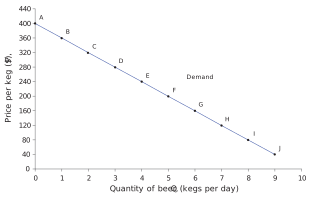
We can also visualize the relationship between quantity and price graphically by plotting the demand curve for CORE Brewing Co. using data from Table 12.5. By plotting the data from the table and connecting the points with a line, we illustrate the firm’s demand curve, which shows the quantity demanded at different price levels.
This curve, shown in Figure 12.5, shows us that zero buyers are willing to pay $400 for a keg of CORE’s beer (point A). A firm cannot simply charge any price it wants: if you set your price too high, buyers will not be willing to buy your beer.
At a price of $360, buyers are willing to purchase 1 keg of beer per day (point B), because their willingness to pay (WTP) is equal to or greater than $360 per keg. When the price (\(P\)) drops to $320, buyers are willing to purchase 2 kegs of beer per day (point C), because their WTP is equal to or greater than $320 per keg.
We can draw the following conclusions:
- When \(P\) is high, the quantity demanded is low because the only buyers who will buy your beer are those who strongly prefer it over other beer.
- When \(P\) is lower, a larger number of people are willing to buy, so the quantity demanded is higher. These buyers may be individuals who would have bought beer from a different firm, but who are now attracted to your beer because the price is lower.
The inverse relationship between price and quantity demanded explains why the demand curve in Figure 12.5 slopes downward. In an inverse relationship, if one variable increases, the other variable decreases.
CORE Brewing Co.’s estimated product demand for its beer.
Figure 12.5 CORE Brewing Co.’s estimated product demand for its beer. We can draw the demand curve for CORE’s beer using data from Table 12.5. CORE’s demand curve is a downward-sloping line, which shows that at lower prices buyers demand more beer, and at higher prices, buyers demand less beer.
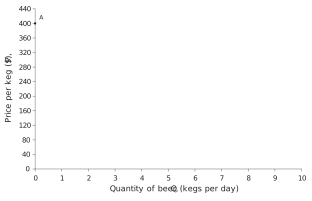
CORE Brewing Co.’s estimated product demand for its beer.
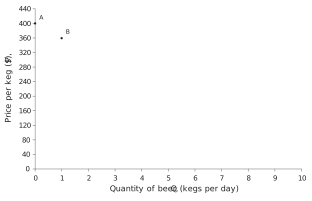
CORE Brewing Co.’s estimated product demand for its beer: showing just one point
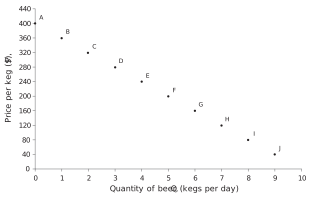
CORE Brewing Co.’s estimated product demand for its beer: showing two points
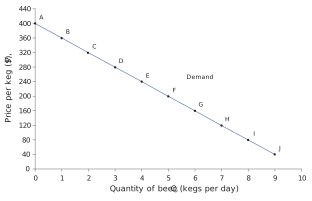
CORE Brewing Co.’s estimated product demand for its beer: showing all points
CORE Brewing Co.’s estimated product demand for its beer: showing all points connected.
Demand curves are often drawn as straight lines, as in this example, but there is no reason to expect them to be straight in reality. Figure 12.6 illustrates a non-linear demand curve. The demand curve is still downward-sloping, indicating that as price decreases, quantity demanded increases. However, the shape of the curve suggests that buyers’ willingness to pay decreases more quickly at higher prices and decreases more slowly at lower prices. For example, a small number of beer enthusiasts might be willing to pay a high price for your beer, but as the price decreases, more casual users purchase your beer.
Everyday Economics 12.9
What do you value as a buyer? A buyer’s willingness to pay is determined by their preferences, which are partly shaped by what they value. Are you willing to pay more for certain types of products? If so, which ones, and why are you willing to pay more for them? Your answers to these questions determine what the firm’s demand curve will look like.
- law of demand
- According to the law of demand, a decrease in the price of a good will result in an increase in the quantity of the good demanded.
Whether they are straight lines or not, demand curves slope downward: As the price rises, the quantity demanded falls. Conversely, as the price falls, the quantity demanded rises. This relationship between price and quantity demanded is known as the law of demand.
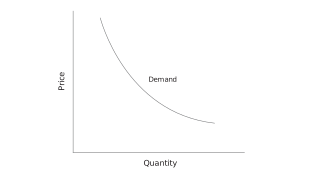
Figure 12.6 Non-linear demand curve.
In the next section, we combine demand and costs to learn more about the price you should charge. Deciding what price to charge is important because that price, in combination with the amount of beer you produce, determines how much profit you earn.
Exercise 12.4 Understanding Demand and the Willingness to Pay by Buyers
CORE Brewing Co. is considering expanding its product line to include a non-alcoholic beer option. The company surveyed buyers and obtained the following information:
| Price per keg ($) | Quantity demanded (Kegs) |
|---|---|
| 800 | 0 |
| 720 | 2 |
| 640 | 4 |
| 560 | 6 |
| 480 | 8 |
| 400 | 10 |
Exercise 12.4 Table (i)
- Plot the demand curve for the non-alcoholic beer using the data provided.
- Using the demand curve, determine the quantity demanded when the price is set at $600.
- Explain how the plotted demand curve illustrates the relationship between price and quantity demanded.
- Think about a personal experience in which you made a purchase decision based on your WTP for a product or service. Describe the situation and analyze how factors such as price, personal preferences, and available alternatives influenced your WTP. How do these factors relate to the demand curve for the product you purchased?
Question 12.4
Which of the following statements about willingness to pay (WTP) are true? Choose all that apply.
- WTP reflects the value a buyer places on a good.
- WTP is influenced by many factors, such as demographic, customer loyalty, advertising, and so on.
- Surveys are a common method for estimating WTP.
- WTP does not imply that demand curves are always linear.

