5.7 Evaluating outcomes: Fairness and efficiency
Whatever the economic interaction—shopping, negotiating wages, managing fish stocks, or playing an experiment like the ultimatum game—we want to be able to describe and evaluate the outcome: Is it better or worse than alternative outcomes? Description involves facts; evaluation involves values.
Efficiency
Economists use efficiency to describe an outcome—of a game, an employment relationship, or a market exchange—where people don’t leave anything on the negotiating table. If the question is dividing up a pie, economists want to know whether all of the pie has been eaten. To understand efficiency we need to compare different outcomes of economic interactions.
- allocation
- In an economic interaction, an allocation is a particular distribution of goods or other things of value to all participants.
We call the outcome of an economic interaction an allocation. In a game, an allocation is a particular distribution of goods or other things of value among the players. For example, if two firms compete to sell goods in a market, the allocation might consist of each firm’s profits.
Suppose that we want to compare possible allocations in the ultimatum game, such as those in Figure 5.7. Can we say which allocation is “better”? So far, we have highlighted how differences in institutions, policies, technology, and power can produce different outcomes. We have not yet made any judgments about how good an outcome is compared to other outcomes.
Efficiency
This definition of efficiency is sometimes called Pareto efficiency, after the Italian economist and sociologist Vilfredo Pareto (1848–1923), who came up with the idea.
- efficiency
- A standard for evaluating an outcome that asks whether all the mutual gains from an interaction have been realized: whether anything of value has been left on the table.
- inefficient
- No definition available.
- efficient
- An allocation is efficient if there is no feasible alternative allocation that would make at least one participant better off without making anyone else worse off. At an efficient allocation, all the mutual gains have been captured: the only way to give someone more is to give someone else less.
One way to evaluate an allocation is to assess its efficiency. If we are thinking about an interaction with just two people:
- An outcome is inefficient when there is an alternative outcome that would have made both people better off (win-win) or at least made one person better off without harming the other person.
- An outcome is efficient when there is no alternative outcome in which one person can be better off without the other being worse off.
To see what efficiency means in economics, think about the ultimatum game, and imagine two players who care only about their own payoffs from the game (they do not have social preferences). If we think of the $100 as a “pie” that can be split between players, then efficiency means that we have eaten all the pie. An allocation in which the Proposer gets the entire pie ($100) and the Responder gets nothing is efficient because for the Responder to get more, the Proposer would have to get less. So there are no win-win alternatives to the (100,0) allocation.
But an allocation where the Proposer could somehow offer a 40-40 split where $20 is thrown away must be inefficient. The Proposer could have proposed any allocation between (60,40) and (40,60), and because they could have made any such offer with greater mutual gains from cooperation (at least one player being better off and none being harmed), (40,40) is inefficient. Any of the allocations between (60,40) and (40,60) where all the money is allocated to both players are efficient allocations because no one can be made better off without harming one of the other players.
The allocations (60,40) and (40,60) and the initial example of (100,0) show that unequal outcomes can be efficient outcomes. As we saw in Section 5.6, however, Responders often reject unequal allocations, suggesting that efficiency does not determine what people will accept. Instead, people make decisions based on their judgments of what they consider fair.
Fairness
Efficiency tells us whether the win-win allocations from an interaction have been realized, but it tells us nothing about whether those gains are distributed fairly or whether the process determining the gains was fair. Therefore, a second important consideration when trying to evaluate outcomes is fairness.
Everyday Economics 5.10
Consider the example of finding $100 on the street. Why could the offer of 1 cent from a total of $100 be efficient? Imagine that instead of being able to give your friend 1 cent from the $100, you had found the $100 as a roll of five $20 notes. What are the efficient splits you could make with your friend, knowing that they have no option to refuse? Which of these splits do you think is fair? Why?
Suppose, in the ultimatum game, the Proposer offers one cent from a total of $100. Responders in experiments around the world typically reject such an offer, preferring to get nothing rather than the penny, apparently judging the offer to be unfair. They have applied a standard of justice to the outcome of the game, deciding that the inequality of the final distribution was unfair.
- subjective well being
- Subjective well-being is a person’s self-reported measure (in a survey) of their happiness or life satisfaction, as well as on more objective measures of brain activity, hormone levels, and palm temperatures.
Substantive fairness and well-being
Though more income often means that people are better off in terms of measures like life expectancy and education, we might use an outcome like subjective well-being instead of income as a measure of how well off or happy someone perceives themselves to be in terms of substantive fairness.
- equality of opportunity
- Equality of opportunity is the absence of advantage in gaining higher incomes due to accidents of birth based on one’s race, gender, parental wealth, or similar categories.
We can also apply a standard of fairness not to the outcome of the game, but to the rules of the game. Suppose we had observed a Proposer proposing an even split, allocating $50 to the Responder. Good for the Proposer, you say; that seems like a fair outcome. But if the Proposer made this offer because the Responder had threatened the Proposer with violence unless she offered an even split, we would probably judge the outcome to be procedurally unfair. One of the most commonly held components of fairness is called equality of opportunity, which is the absence of advantage in gaining higher incomes due to accidents of birth based on one’s race, gender, parental wealth, or similar categories.
These examples make a basic point about fairness. Allocations can be judged unfair because of:
- Who gets what, sometimes called substantive or outcome fairness, for example, in terms of income.
- How the allocations came about, sometimes called procedural fairness—for example, by force or by competition on a level playing field.
People are concerned about both kinds of fairness, which Extension 5.7a explores in greater depth.
Evaluating fairness
The rules of the game in the real economy are a long way from the fair procedures of the ultimatum game (where each player had an equal chance to be the Proposer or the Responder), and people’s values about what is fair differ. Some, for example, regard any amount of inequality as fair, as long as the rules of the game are fair. Others judge an allocation to be unfair if some people are seriously deprived of basic needs while others consume luxuries.
Neither philosophy, nor economics, nor any other way of thinking can resolve all disagreements about questions of value, but economics can help us reason more carefully about the trade-offs involved. Economics can clarify:
- How the dimensions of unfairness may be connected: for example, how the rules of the game that give special advantages to one group or another group may affect the degree of inequality.
- The trade-offs between the dimensions of fairness: for example, do we have to compromise on income equality if we also want equality of opportunity? Or, do we think that hard work should be rewarded while also trying to reduce inequality among people?
- How public policies can address concerns about unfairness, and the trade-offs of these potential policies: for example, whether the policies compromise other objectives, such as efficiency.
Figure 5.8 summarizes the concepts of and connections between evidence, efficiency, and fairness that we can use to judge the impact of an economic policy. Having gathered evidence to describe the resulting allocation, we ask: Is the new outcome efficient, fair, and better than the original?
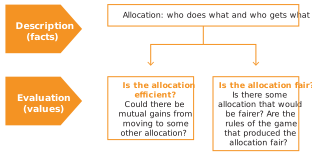
Figure 5.8
Allocations, efficiency, and fairness.
We start with the facts or data, which describe a given situation. We then evaluate those facts or data and consider whether an allocation is efficient and fair.
People care about fairness, and it affects their choices about policy
Everyday Economics 5.11
Do you think your views are closer to the US or Scandinavian pattern? Why do you think you have those views?
Different preferences about fairness and efficiency may lead people to make different policy choices or to enforce different social norms around what they think is fair or efficient. Economists Ingvild Almås, Alexander Cappelen, and Bertil Tungodden used experiments to study how people in the United States and Scandinavia think about fairness and efficiency. They found that people in both places care about rewarding effort and helping people who are unlucky, but they differed in the levels of inequality they found acceptable. Scandinavians seem to consider the lower levels of market income inequality in their society to be more unfair than Americans consider the higher level of market income inequality in America. The societies therefore differ in what they think of as fair, and people in both countries say that their fairness preferences are important to how they vote, suggesting a further connection to policies and institutions.
To think about whether people’s attitudes regarding fairness may affect their policy choices, we need to study whether someone’s attitudes toward fairness would affect their choice of policy to tax and redistribute income. Economist Stefanie Stantcheva studies the preferences of people in the United States regarding redistribution and taxation. She uses surveys and experiments to study people’s attitudes toward the taxation of incomes and inheritances. In one set of experiments, respondents read short scenarios describing individuals who had earned high incomes through effort versus through accidents of birth, such as being born into a wealthy family. Respondents then indicated how much of that income should be taxed. Stantcheva found that social preferences—like those we explored in Section 5.4—and people’s attitudes toward the government explain their attitudes with respect to greater or lesser taxation. Specifically, if people want to see fairer outcomes, they want more taxation. If they trust the government more, then they are in favor of more taxation, and if they trust the government less, then they want less taxation. Stantcheva found that people’s fairness and trust attitudes were more important than their concerns about the economic costs of high tax rates, such as reduced incentives to work or invest.
Exercise 5.10 Splitting the profits in a partnership
Suppose you and a partner are starting a business in which each of you will sell a new app to the public. You are deciding among four methods to divide the profits:
- equally
- in proportion to how many apps each of you sells
- in inverse proportion to how much income each of you has from other sources (for example, if one of you has twice the income of the other, the profits could be split one-third to the former and two-thirds to the latter)
- in proportion to how many hours each of you has spent selling.
Order these alternatives according to your preference and defend your choices based on the concepts of fairness introduced in this section. If the order depends on other facts about this joint project, specify what other facts you would need. Think about the substance of the outcome itself and the procedure by which the outcome arose.
You will likely be able to make deeper arguments if you draw on Extensions 5.7a and 5.7b. Substantive fairness asks whether the final outcomes are fair; procedural fairness asks whether the process for reaching those outcomes was fair.
Exercise 5.11 Beliefs about success and support for redistribution
Economist Christina Fong studied whether people’s support for government programs that redistribute income to the poor depends on what they believe causes economic success. Drawing on a US survey, she measured how strongly each of a range of beliefs about “what it takes to get ahead in life” is associated with supporting or opposing redistribution, holding respondents’ other characteristics constant. Her results are shown in Exercise 5.11 Figure (i).
In the figure, the horizontal axis lists possible explanations for getting ahead (for example, hard work, risk-taking, luck, connections, inheritance, and a person’s race or gender). The vertical axis is an index of support for redistribution: positive values indicate that holding the belief is associated with greater support for redistributing income to the poor, and negative values indicate greater opposition.
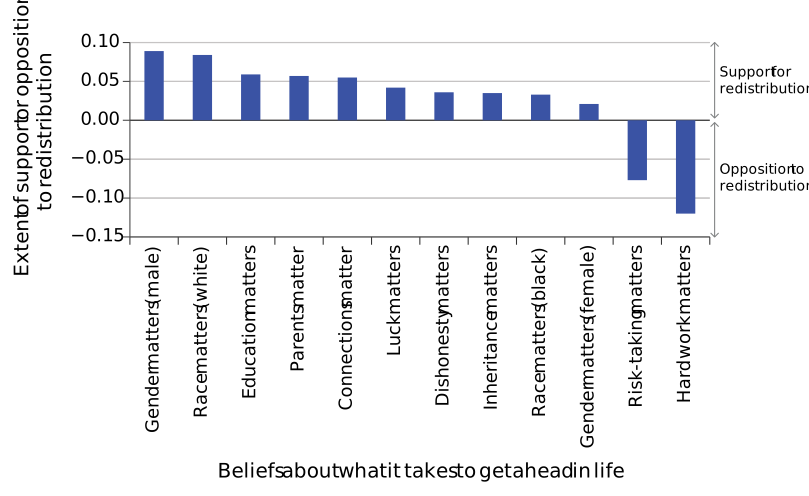
Exercise 5.11 Figure (i) How beliefs about what it takes to get ahead predict support for or opposition to redistribution in the United States. Positive values indicate support for redistributing income to the poor; negative values indicate opposition.
Christina Fong, Samuel Bowles, and Herbert Gintis. 2005. “Strong Reciprocity and the Welfare State.” Adapted from Samuel Bowles. 2012. The New Economics of Inequality and Redistribution, Figure 5.3. Cambridge University Press.
Use Exercise 5.11 Figure (i), together with Sections 5.3 and 5.7, to answer the following.
- Read the figure. Which beliefs are associated with the strongest opposition to redistribution, and which with the strongest support? Describe the overall pattern that separates the two groups of beliefs.
- Using the distinction between procedural and substantive fairness (Section 5.7) and the idea of accidents of birth (Section 5.3), explain why a person’s belief about the causes of success predicts whether they support redistribution. In particular, why might someone who believes success comes mainly from hard work oppose redistribution, while someone who believes it comes mainly from connections or inheritance support it?
- Fong found that white respondents who believe that being White helps a person get ahead tend to support redistribution. Explain why this is hard to account for using self-interest alone, and what it suggests about the role of social preferences and fairness (Sections 5.4–5.6). What would a purely self-interested model predict for these respondents?
Question 5.11
Section 5.7 distinguishes between efficiency and two kinds of fairness. Assume that both players are self-regarding—that is, they care only about their own monetary payoffs. Which of the following statements correctly apply these concepts? Choose all that apply.
- Because the players are self-regarding, their welfare is determined solely by their monetary payoff. The (100,0) allocation is therefore efficient: the only way to increase the Responder’s payoff is to reduce the Proposer’s. The chapter states this directly: “for the Responder to get more, the Proposer would have to get less.” Note: If players had social preferences—such as a Responder who cares about fairness—their welfare would depend on more than money alone, and the efficiency analysis could change.
- Judging who gets what is an example of substantive (or outcome) fairness, not procedural fairness. Procedural fairness concerns how the allocation came about—for example, whether it involved coercion or followed fair rules. The chapter explicitly distinguishes “who gets what” (substantive fairness) from “how the allocations came about” (procedural fairness). Students should not confuse an unequal outcome with an unfair process.
- The chapter defines equality of opportunity as “the absence of advantage in gaining higher incomes due to accidents of birth based on one’s race, gender, parental wealth, or similar categories.” Option c is a near-direct restatement of this definition.
- The chapter explicitly shows that efficient allocations can be unfair. The (100,0) allocation is efficient yet highly unequal. The chapter states that “unequal outcomes can be efficient outcomes” and treats efficiency and fairness as two separate and independent criteria for evaluating allocations. An outcome can be efficient and unfair, efficient and fair, inefficient and fair, or inefficient and unfair.
Question 5.12
According to Stefanie Stantcheva’s research on taxation preferences in the United States, which factors are most important in explaining people’s attitudes toward taxation?
- Although people were concerned about efficiency, they were concerned more with other issues.
- Their fairness attitudes and trust in government were the most important predictors of their preferences regarding taxation.
- Although Stantcheva’s research does highlight the role of political party affiliation and a person’s age, these were not the most important predictors of their taxation attitudes.
- Though Dr. Stantcheva does investigate the importance of education levels and concerns about inequality, fairness and trust in government were the more important predictors of attitudes toward taxation.

