11.2 Profits and ownership
Imagine that, before you and your friend opened your Mexican restaurant (as described in Chapter 10), the two of you owned and operated a food truck selling tacos.
- the principle of doing the best you can
- Doing the best you can means that, from the set of actions available to them, people will choose the action that they believe will result in the outcome that they value the most, taking into account what they believe the other player will do in response to their choice.
- opportunity cost
- The opportunity cost is the net benefit of the next-best alternative—what you give up when you make a choice.
- profit claimant
- The person or persons who receive a firm’s remaining income after the payment of all contractual costs (for example, the cost of hiring workers and paying taxes). Also known as residual claimant because the profit is “the residual” after contractual costs have been paid.
As both the owners and the workers, how did you and your friend do the best you can? Your decision-making process would have been similar to Karim’s in Chapter 8. You would have figured out where to locate, which hours to work, and what price to charge, along with other business decisions. You aimed to make the most profit you could, considering the opportunity cost of your time spent working. As the owners, you received any profits made. You were the profit claimants.
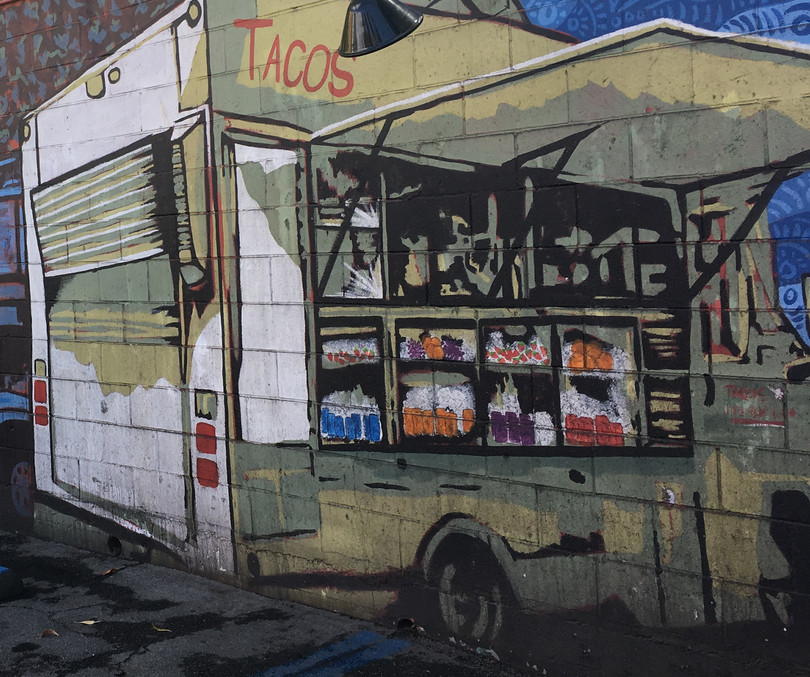
A mural of a food truck selling tacos. It is located in the parking lot of the Echo Park location of the Mexican restaurant Guisados in Los Angeles.
Because you were the profit claimants and the only workers, you both had skin in the game. The harder you worked, the more profit you could make. And any losses hit your wallet directly—your incentives as workers and as profit claimants aligned.
Who gets the profits?
Everyday Economics 11.1
A worker-owned cooperative (also known as a co-op) is a form of business organization in which the workers are the owners and profit claimants. Workers in cooperatives also select the managers who run the company on a day-to-day basis. Well-known examples in the United States include Cooperative Home Care Associates, Equal Exchange, and Namaste Solar. Well-known examples elsewhere include the British retailer John Lewis Partnership and the Mondragon Corporation in Spain. Do you know of any local worker cooperatives?
- interdependence principle, principle of interdependence
- The outcomes people obtain in economic interactions depend on the actions that they and others take in response to each other and on what they believe about the future.
When you and your friend opened your restaurant and began to employ people, the situation changed. While the outcomes for workers and profit claimants are interdependent, you cannot assume that the workers’ incentives align with the profit claimants’ interests. None of the restaurant workers directly benefits if the restaurant’s profitability increases. Nor do they lose if the restaurant performs poorly (unless it shuts down and they lose their jobs). The workers you hire have no direct skin in the game because they are not profit claimants. Unless you want to share ownership with the workers, the only profit claimants are you and your friend.
Extension 11.2 discusses who the profit claimants are for corporations and how they affect the corporation’s workers. In neither corporations nor other firms are the workers profit claimants. Even if they work hard, do their job well, and increase the firm’s profits, there is no guarantee they will be any better off. Therefore workers have little reason to care about increasing profits beyond what is needed to keep the firm in business and to avoid being fired.
Extension 11.2 The separation of ownership and control in corporations
- shares
- Shares (also known as stocks) are financial assets that can be bought and sold, giving their owners (the shareholders) a right to vote on certain matters, such as who is on the Board of Directors, and a right to receive a corresponding share of the firm’s profit should any of that profit be paid out to the shareholders.
- separation of ownership and control
- The attribute of some firms by which top managers are a separate group from the profit claimants.
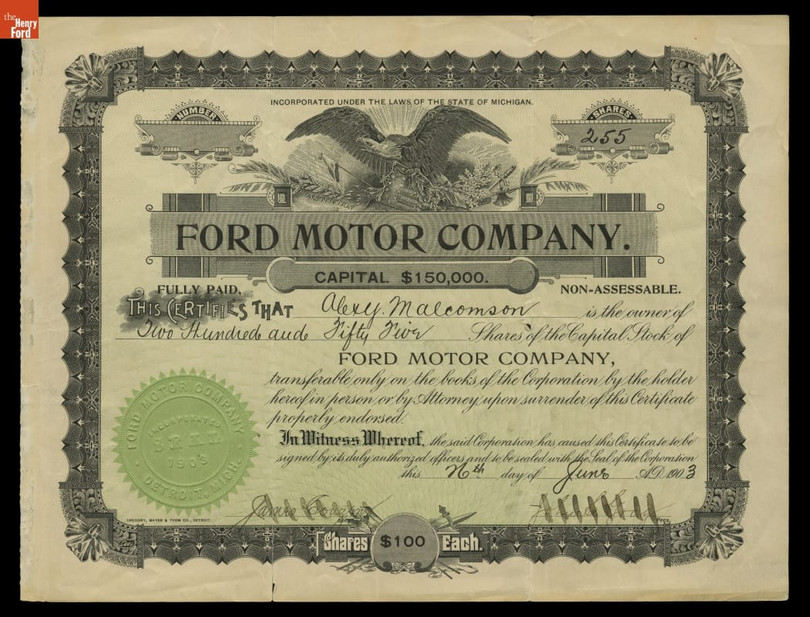
One of the first shares of the Ford Motor Company, issued in 1903 to Alexander Malcomson, a wealthy Detroit coal merchant.
In a corporation, the top management—those making the big decisions and running the corporation day to day—are not necessarily profit claimants. So there can be a serious disconnect between those who benefit from the corporation being more profitable and those running the corporation. This feature of corporations is called the separation of ownership and control.
In the eighteenth century, the philosopher and economist Adam Smith observed that senior managers tend to serve their own interests, rather than those of shareholders:
[B]eing the managers rather of other people’s money than of their own, it cannot well be expected that they should watch over it with the same anxious vigilance with which the partners in a [firm managed by its owners] frequently watch over their own … Negligence and profusion, therefore, must always prevail, more or less, in the management of the affairs of such a company. (The Wealth of Nations, 1776)
This separation can result in a potential conflict of interest. Because managers do not directly benefit from increased profitability, they may make decisions that benefit them but not the shareholders. Such decisions could include paying themselves higher salaries, giving themselves better benefits, overusing corporate cars or jets, buying personal items on corporate credit cards, and/or using their position to build power and status.
Shareholders typically use two methods to try to incentivize managers to serve shareholders’ interests:
- Tie a manager’s pay to the share price. This way, if the share price increases, the manager makes more money. Managers therefore have a strong incentive to act in the shareholders’ interests.
- Monitor managers’ performance and fire them if they are doing poorly. The board of directors, whose members are often large shareholders themselves, can make sure managers are working in the interest of the shareholders. Similarly, the shareholders can replace board members who are doing a poor job. This doesn’t happen often, though, because most shareholders are part of a large and diverse group and cannot easily coordinate their behavior.
So, although shareholders in a corporation have some ability to get top managers (and possibly other senior managers) to work in their interest, there is still the matter of all the other workers and managers.
One option that corporations have is to grant workers shares in the company, which will strengthen workers’ and managers’ incentive to act with the company’s best interests in mind. The most common way to do this is an employee stock ownership plan (ESOP), in which a corporation sets up a trust fund that holds shares of the company until an employee retires. Compared to normal shareholders, employees in an ESOP usually have more limited voting rights and claims on dividends, since these are often held by the trust fund rather than by the employees directly. According to the National Center for Employee Ownership, as of 2022, there are 6,548 ESOPs at 6,358 companies, covering a total of 14.9 million participants.
Exercise E11.2 CEO pay and stock options: Incentives and trade-offs
In the article, ‘Paying CEOs with stock options doesn’t drive their business strategy: research’, two finance professors explain their research on how tying CEOs’ compensation to stock market performance affects their decisions. Read the article and answer the following questions.
- What are stock options? Why do many people believe granting stock options to CEOs will improve their performance?
- Describe the natural experiment that the authors used to study the effect of stock options on CEO decision-making. Do you see any possible limitations of the institutional change they use?
- Describe the findings of their research.
- What might explain these findings?
Question E11.2
Read the following statements about the separation of ownership and control, and select the correct option(s).
- The shareholders are the profit claimants.
- Managers may choose to take actions that provide benefits for themselves at the owners’ expense.
- The board of directors has the authority to dismiss managers, which can incentivize managers to serve the owners’ interests.
- When a company has many shareholders, there is not only a coordination problem but also a free-rider problem, in that every shareholder relies on other shareholders to do the costly monitoring (and hence no monitoring is undertaken as a result).
Exercise 11.2 Incentives and conflicts in shared ownership
When you and your friend were the owner-operators of the taco truck, you both had a strong incentive to work hard to increase its profitability.
- What kind of issues or conflicts might nonetheless arise in such a situation that would lead one of you to decrease your effort at work? How might these issues be resolved?
- What other conflicts could arise between you and your friend in terms of running the business?
Exercise 11.3 Coordination structure of big and small firms
Research a real-world example of a firm that transitioned from a small, owner-run operation to a large company still owned by the original owners (for example, a startup that grew into a major tech firm). How did the firm’s coordination structure evolve? What were the main challenges it faced during this transition?
Question 11.2
Which of the following individuals in these hypothetical scenarios will count as profit claimants? Choose all that apply.
- Jean is the owner of HyperReality, so she receives any residual profits after costs are paid. She is therefore a profit claimant.
- Dinesh is an employee who receives wages, but he does not share directly in the company’s profits, so he is not a profit claimant.
- As a co-owner of the firm, Jesús shares in the residual profits after costs, so he is a profit claimant.
- Francis is paid per contract for services provided, but he does not share in the profits of HyperReality. He is not a profit claimant.

