3.2 History’s income hockey sticks

In the last 200 years, living standards have increased much more in some countries than in others.

gross domestic product (GDP)
A measure of the total output of goods and services produced in an economy in a given period. GDP combines in a single number all the output (or production) carried out by the firms, nonprofit institutions, and government bodies within a country. Household production is part of GDP if it is sold.

To compare living standards in each country, we start with gross domestic product (GDP), which measures how much is produced in a particular country in a year. GDP is a country’s “output.” The economist Diane Coyle explains that GDP “adds up everything from nails to toothbrushes, tractors, shoes, haircuts, management consultancy, street cleaning, yoga teaching, plates, bandages, books, and the millions of other services and products in the economy.”1

Listen to Diane Coyle talking about the benefits and limitations of measuring GDP.

gross domestic product (GDP) per capita
A measure of the market value of the output of the economy in a given period (GDP) divided by the population.

GDP equals the total market value of all goods and services produced in an economy in a given period, which corresponds to the total income of everyone in the country. We divide GDP by the total population and use the resulting number—GDP per capita—as a measure of average income or living standards. The higher the GDP per capita is, the higher the average income and living standards are.

purchasing power parity (PPP)
Purchasing power parity is a price index that measures how much it costs to purchase a basket of goods and services in a specific country compared to how much it costs to purchase the same basket in a reference country in a particular year, such as the United States in 2011.

To compare average living standards across countries and over time, economists use the concept of purchasing power parity (PPP) to account for the differences in prices of goods and services. PPP is a price index that measures how much it costs to purchase a basket of goods and services in a specific country compared to how much it costs to purchase the same basket in a reference country in a particular year, such as the United States in 2011.

correlation
A statistical association observed between two variables in a sample of data. If high values of one variable (such as people’s earnings) commonly occur along with high values of another variable (such as years of education), then the variables are positively correlated. When high values of one variable (such as air pollution) are associated with low values of the other variable (such as life expectancy), then the variables are negatively correlated. Correlation doesn’t mean that there is a causal relationship between the variables. For example, air pollution may not have caused the lower life expectancy we observed.

Although GDP per capita takes into account the total output of goods and services that we want or need, such as haircuts, toothbrushes, or education, it does not consider things that directly affect how “well off” we feel, such as the quality of our physical environment, including clean air and personal safety, and the goods and services produced within households, such as home-cooked meals or child care. Nonetheless, GDP per capita correlates highly with several measures of well-being, such as life expectancy and people’s satisfaction with their life.

Our world in data (OWiD) shows the relationship between GDP and happiness and GDP and life expectancy. Read Data Extension 3.2 to learn about an alternative indicator of well-being.

In Figure 3.1, the height of each country’s line is an estimate of average living standards at the date on the horizontal axis. Notice the following:

  • In 1600, living standards were higher in Italy than in any of the other countries for which we have data.
  • By 2018, people were six times better off, on average, in Japan than in India, while people in the United States were three times better off than people in Mexico. People in Japan were nearly as rich as those in the United Kingdom, but people in the United States were even better off.
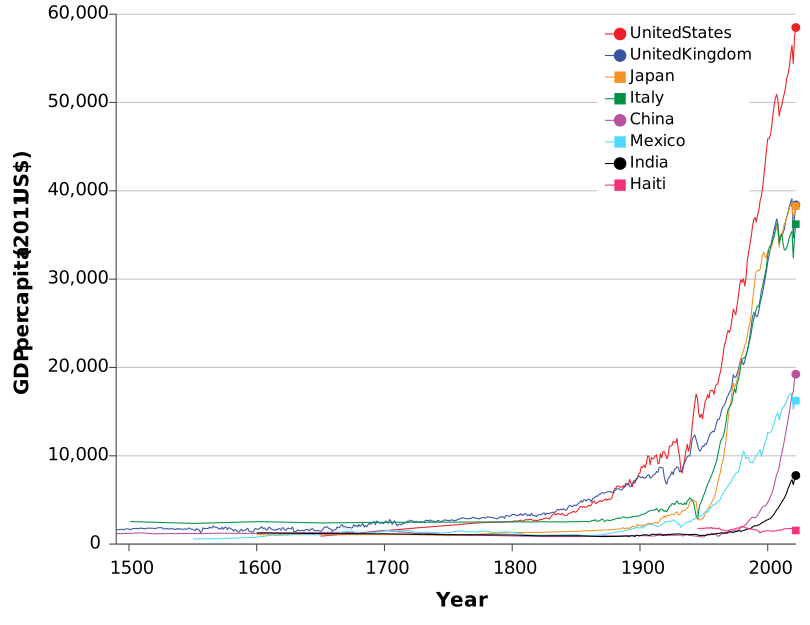
History’s hockey stick: gross domestic product per capita in eight countries (1490–2022).
Fullscreen
https://books.core-econ.org/uoe-101/03-02.html#figure-3-1

Figure 3.1 History’s hockey stick: gross domestic product per capita in eight countries (1490–2022).

Bolt, Jutta and Jan Luiten van Zanden. 2024. Maddison style estimates of the evolution of the world economy: A new 2023 update, Journal of Economic Surveys; Broadberry, Stephen. 2021.Accounting for the Great Divergence: Recent findings from historical national accounting, Cage Research Centre Working Papers (549/2021). Total Economy Database.

Hockey sticks and growth

An ice hockey stick.
Fullscreen

An ice hockey stick.

We call figures like Figure 3.1 hockey stick curves because of the lines’ resemblance to the shape of an ice hockey stick: a flat part, then a sharp twist or “kink” where the curve begins to grow steeply. History’s hockey stick is shaped differently for different countries. Notice the following facts from the graph in Figure 3.1:

  • The flat part of the hockey stick shows that living standards did not grow in any sustained way for much of history (1490 to around 1800 for most countries).
  • The hockey stick kink is less abrupt in the United Kingdom, where gradual growth began around 1650.
  • In Italy and Japan, growth began around 1870 with a sharper kink occurring around 1940.
  • In China and India, the kinks happened much later—in the second half of the twentieth century.
growth
We say that a country’s economy grows when its GDP per capita increases over time (positive growth rate). If the GDP per capita decreases over time, then the economy shrinks (negative growth rate). A growth rate is a percentage change. The formula to calculate a percentage change is: \(\frac{(\text{new number} ‐ \text{old number})}{\text{old number}}\). For example, if Country A had GDP per capita of 10,000 in Year 1 and GDP per capita of 10,200 in Year 2, then Country A experienced economic growth of 2% \(\frac{(10,200 ‐ 10,000)}{10,000} = 0.02\), or 2% growth in per capita GDP.

Continuous positive growth began at different times and rates in different countries, leading to vast differences in living standards between countries. Since late in the twentieth century, India and China have been catching up with the richer nations, but for some countries, such as Haiti, living standards remain below the level of the United Kingdom’s living standards 200 years ago. Understanding why some countries have prospered while others have not is one of the most important topics that economists have studied. One founder of the field, Adam Smith, gave his most important book the title An Inquiry into the Nature and Causes of the Wealth of Nations.2 What lies behind the upward kink in the hockey sticks that we have seen in some countries, but not others?

An entertaining video by Hans Rosling, a statistician, shows how some countries got richer—and healthier—much earlier than others.

Question 3.2

Refer to Figure 3.1 on the OWiD website. Which of the following statements are supported by the data? Choose all that apply.

  • All countries in Figure 3.1 have experienced a hockey stick “kink” at some point in the last 200 years.
  • The United States and the United Kingdom began sustained growth earlier than India and China.
  • India’s GDP per capita in 2018 exceeded Japan’s GDP per capita in 1950.
  • By 2018, China had caught up to the United States in terms of GDP per capita.
  • Japan experienced faster GDP per capita growth in the second half of the twentieth century than Italy did in the nineteenth century.
  • The hockey stick kink does not appear in all countries (for example, Haiti).
  • The United States and United Kingdom show sustained growth from the 1800s, while India and China’s take-off happened much later, post-1980.
  • India’s GDP per capita in 2018 was $6,806.50, which is well above Japan’s 1950 figure of $3,062.
  • China’s 2018 GDP per capita ($13,101.71) was still far below that of the United States ($55,334.74).
  • Japan saw around a 12 times increase from 1950 to 2018. Italy’s increase from 1800 to 1950 was much smaller.

Go to the interactive version of Figure 3.1 at OWiD. Notice that you can edit the countries.

  1. Create a similar graph for three countries of your choice: an early industrializer, a latecomer, and one country of your choosing.
  2. Compare when GDP per capita began to rise significantly in each country and comment on the steepness of the rise once it began.
  3. How do average living standards compare between 1900 and in 2018? What does this comparison reveal about differences in the timing and speed of economic growth and transformation?

Exercise 3.3 Does income buy a happy and long life?

Look at the GDP and happiness and GDP and life expectancy graphs.

  1. Describe the general relationship between GDP per capita and both life satisfaction and life expectancy shown in the graphs.
  2. Identify a country with moderate or low GDP per capita but relatively high life satisfaction.
  3. Identify a country that has higher life expectancy than other countries with similar GDP per capita.
  4. What do these examples suggest about the limitations of using GDP per capita alone to measure well-being?

Math Extension 3.2 GDP per capita and averages

GDP is not always a satisfactory measure of living standards. In addition to leaving out some things that are important for our daily lives and the impact on our natural environment, GDP fails to account for differences between people.

There is no such person as the average member of a population. When we talk about how well off a nation or group is, we sum up the experiences of the many individual members of a population and average them. GDP tells us how big the total pie is (the total output to be divided among the members of the group). GDP per capita tells us how large each person’s slice of the pie would be if everyone received the same amount.

But of course that is not how the GDP “pie” is actually divided up. That is, GDP does not account for how the output is distributed among the members of a population. To see why this matters, compare two societies. In the first one, output is equally divided and everyone has enough to satisfy their needs. In the second one, one person gets all the output, and the rest get nothing. GDP per capita would be the same in both societies. We might say that the first society is at least moderately well off, but it would not make sense to say that the second society is well off. All but one person in the population are miserable—and perhaps not even likely to survive.

In our economy, some people get more than others because most of the output is for sale, and to get goods for your own use you have to buy them. How much you can buy depends on your income—that is, the wages, salaries, rents, profits, government transfers, or other payments that you receive. People with higher incomes from all sources can buy more goods and services.

Scenario A Scenario B Scenario C
People and incomes 10 people have incomes of $5,000 each 10 people have incomes of $5,500 each 5 (now rich) people have incomes of $9,000
5 (now poor) people have incomes of $1,000
Total neighborhood monthly income $50,000 $55,000 $50,000
Average income $50,000/10 = $5,000 $55,000/10 = $5,500 $50,000/10 = $5,000

Table E3.1 Three different scenarios to understand income distributions and average well-being.

To see why this matters, consider a little economy—say a neighborhood with ten people in it—in which each person initially has an income of $5,000 a month. In this baseline scenario (Scenario A in Table E3.1), each person has the same income, and per capita income is the same as each person’s income. Scenario A reflects a perfectly equal income distribution. The term income distribution refers to who has how much money and therefore how money is distributed among people in the economy. Now let us consider two different scenarios.

In Scenario B, the neighborhood experiences economic growth. Imagine that, with no change in prices, incomes rise for every person in the economy, from $5,000 to $5,500. We can conclude that living standards have increased because, with no change in prices, everyone can buy the same goods and services they could buy before economic growth, and they will have additional income to buy more.

Now think about a different change, Scenario C. Suppose that the income of half the neighborhood rises to $9,000 while the income for the other half of the neighborhood falls to $1,000. The average monthly income is unchanged compared to Scenario A (it remains $5,000). Would we say that living standards are “unchanged” after the income distribution in the neighborhood economy becomes unequal? The additional income of the lucky (now-)rich half of the neighborhood is unlikely to matter as much to the rich people (because they have so much already) as the loss in income suffered by the unlucky (now-)poor half of the neighborhood. Although average income has not changed, people are less well off on average than before.

Because income distribution affects well-being, and because the same average income may result from very rich people and very poor people within a group having different levels of income, average income or GDP per capita may fail to reflect the entire group’s well-being.

Question E3.1

Which of the following statements about GDP per capita are correct?

  • GDP per capita measures the average well-being of a country’s residents.
  • GDP per capita is calculated by dividing total GDP by the number of people.
  • Two societies with the same GDP per capita can have very different levels of well-being depending on income distribution.
  • It is possible for GDP per capita to rise while average living standards fall.
  • GDP per capita does not measure some aspects of well-being, such as the quality of our social and physical environment.
  • GDP per capita is defined as total GDP divided by the population.
  • As shown in the scenarios, unequal income distributions can produce the same average but lead to different levels of well-being in different groups.
  • For example, if the incomes of the richest residents rise substantially while the incomes of all other residents fall, GDP per capita may increase but the average living standard will fall. The additional income for the richest people matters less to their well-being than the decrease in income for everyone else.

Data Extension 3.2 Living standards and the Human Development Index

Many aspects of our well-being are not measured by GDP per capita, including:

  • the quality of our social and physical environment, including such important factors as friendships, clean air, and personal safety
  • the amount of free time we have to relax or spend time with friends and family
  • goods and services that are produced within the household, such as meals or child care.

Recognizing the shortcomings of per capita income as a measure of living standards, economists have tried to develop other measures that include non-monetary considerations, such as health and well-being. One such measure is the Human Development Index (HDI).

The HDI is based on the ideas of Mahbub ul Haq (a Pakistani economist), Amartya Sen (an Indian economist), and Martha Nussbaum (an American philosopher). Amartya Sen says that we should think of human development as “the process of expanding the real freedoms that people enjoy.”3 Nussbaum argues that to understand human flourishing we need to ask: “What are people actually able to do and to be?”4 The HDI therefore includes three key dimensions of well-being that enhance human capabilities and create conditions for human development:

  • A long and healthy life: measured by life expectancy
  • Knowledge: measured by current average years of education and the years of expected education for children currently in school
  • A decent standard of living: measured by GDP per capita

Amartya Sen, born in 1933 in what was then the British colony of India, is a Nobel Laureate in economics. He has combined economic and philosophical reasoning to propose a new view of human well-being based not on what we have, but on what we can do—our capabilities. His book Development as Freedom makes the case that the success of an economy should be judged by the scope of the real choices that are open to all. His essay “More than 100 Million Women Are Missing” documents the differential mortality of males and females—especially as infants—associated with limited rights and power of women.

The HDI combines these dimensions into a number ranging from 0 to 1. A higher value of the HDI corresponds to a greater measure of human development. Countries with a value below 0.55 are considered to have a low HDI. This Technical note explains exactly how the Human Development Index is calculated. Table E3.2 shows the HDI values for the countries in Figure 3.1.

Country HDI in 1990 HDI in 2023 % change in HDI over 1990–2023
United Kingdom 0.812 0.946 16.5%
United States 0.878 0.938 6.8%
Italy 0.787 0.915 16.3%
Japan 0.853 0.925 8.4%
China 0.491 0.797 62.3%
India 0.446 0.685 53.6%
Mexico 0.668 0.789 18.1%
Haiti 0.461 0.554 20.2%

Table E3.2 Human Development Index measures for a range of countries in 1990 and 2023.

United Nations Development Programme, Human Development Report. 2023. “Human Development Index”. We use data from 1990 to 2023 because reliable data are not available before 1990.

Exercise E3.1 Differences in the HDI within the United States

Look at this interactive HDI map.

  1. Find the HDI value for the ZIP code where you live.
  2. Find two nearby ZIP codes, one with a higher HDI, and one with a lower HDI.
  3. Using what you’ve learned about the HDI in the chapter and data brief, explain why these differences might exist. (Hint: Think about the three main dimensions of HDI: health, education, and standard of living.)
  1. Diane Coyle. 2014. GDP: A Brief But Affectionate History. Princeton University Press. 

  2. Adam Smith. (1776). 2003. An Inquiry Into the Nature and Causes of the Wealth of Nations. Random House. 

  3. Amartya Sen. 1999. Development as Freedom. Oxford: Oxford University Press. 

  4. Martha Nussbaum. 2009. “The Capabilities of People with Cognitive Disabilities.” Metaphilosophy 40 (3/4): pp. 331–351.
