4.4 Technology, innovation, and costs
Relative prices are an important factor for households and firms as they try to do the best they can. When managers of firms decide how many workers to hire, or when shoppers decide what and how much to buy, prices affect their decisions.
- relative prices
- The price of one good or service compared to another (usually expressed as a ratio of the two prices).
But what matters is not a single price in isolation. Rather, what matters is the relative price, or the price of one option compared to another.
How does a firm evaluate the cost of production using different technologies?
Let’s return to the example of your cloth-making firm. We assume that your goal is to make as much profit as possible, so doing the best you can means producing cloth at the lowest possible cost. Because your only inputs are workers and coal, you calculate the total input cost by (1) multiplying the number of workers by the wage you have to pay them, and (2) the tons of coal by the price of coal. The total cost formula is:
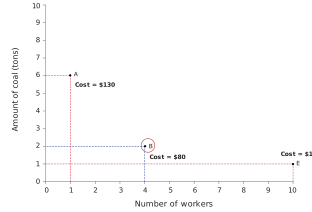
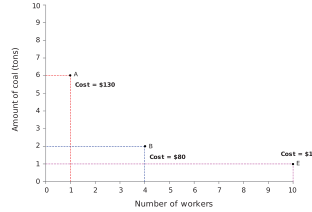
\[\text{total cost} = (\text{wage} \times \text{number of workers}) + (\text{price per ton of coal} \times \text{tons of coal})\]Suppose the wage is $10 and the price of coal is $20 per ton. With these prices, we can use the formula above to model how you would choose the technology that maximizes your profit. Figure 4.5 summarizes the cost of adopting technologies A, B, and E.
| Technology | Number of workers | Price of workers | Total cost of workers | Coal required (tons) | Price of one ton of coal | Total cost of coal | Total cost |
|---|---|---|---|---|---|---|---|
| A | 1 | 10 | 10 | 6 | 20 | 120 | 130 |
| B | 4 | 10 | 40 | 2 | 20 | 40 | 80 |
| E | 10 | 10 | 100 | 1 | 20 | 20 | 120 |
Figure 4.5 The costs of using different technologies to produce 100 meters of cloth.
| Technology | Number of workers | Price of workers | Total cost of workers | Coal required (tons) | Price of one ton of coal | Total cost of coal | Total cost |
|---|---|---|---|---|---|---|---|
| A | 1 | 10 | 10 | 6 | 20 | 120 | 130 |
| B | 4 | 10 | 40 | 2 | 20 | 40 | 80 |
| E | 10 | 10 | 100 | 1 | 20 | 20 | 120 |
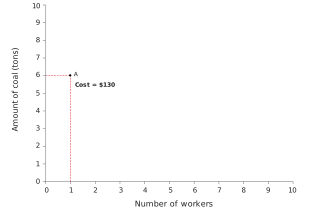
Technology A costs most when the relative price of coal is high
| Technology | Number of workers | Price of workers | Total cost of workers | Coal required (tons) | Price of one ton of coal | Total cost of coal | Total cost |
|---|---|---|---|---|---|---|---|
| A | 1 | 10 | 10 | 6 | 20 | 120 | 130 |
| B | 4 | 10 | 40 | 2 | 20 | 40 | 80 |
| E | 10 | 10 | 100 | 1 | 20 | 20 | 120 |
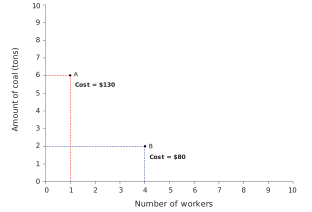
B costs less than A
| Technology | Number of workers | Price of workers | Total cost of workers | Coal required (tons) | Price of one ton of coal | Total cost of coal | Total cost |
|---|---|---|---|---|---|---|---|
| A | 1 | 10 | 10 | 6 | 20 | 120 | 130 |
| B | 4 | 10 | 40 | 2 | 20 | 40 | 80 |
| E | 10 | 10 | 100 | 1 | 20 | 20 | 120 |
E costs more than B but less than A
| Technology | Number of workers | Price of workers | Total cost of workers | Coal required (tons) | Price of one ton of coal | Total cost of coal | Total cost |
|---|---|---|---|---|---|---|---|
| A | 1 | 10 | 10 | 6 | 20 | 120 | 130 |
| B | 4 | 10 | 40 | 2 | 20 | 40 | 80 |
| E | 10 | 10 | 100 | 1 | 20 | 20 | 120 |
B is the best option at these prices
Everyday Economics 4.3
Why did we eliminate options C and D (from Table 4.2)? What would be the total cost of C and D at these prices? Compare the total cost of C to the total cost of A. Do the same for D and B. Why wouldn’t you choose either C or D?
Doing the best you can, you will choose B, which allows your firm to produce at the lowest cost. Importantly, it is the relative price—the ratio of the price of coal to the price of labor—that matters for the choice. If both prices doubled, B would still be the best choice. In that case, it would cost $160 instead of $80.
What happens when coal gets relatively cheaper and wages relatively more expensive?
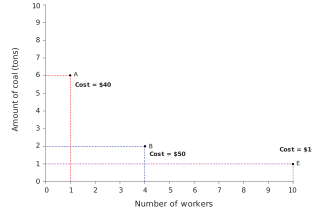
Suppose that the price of coal falls from $20 per ton to $5 per ton, while the wage remains at $10. Though the price of labor has not changed, its relative price has changed. Before, the price of labor was relatively low. Now it is relatively high. Figure 4.6 shows how this price change will change the cost of each technology. Because neither price has increased, and one price has decreased, every technology has become less expensive.
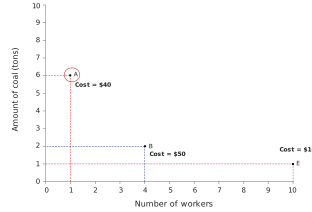
| Technology | Number of workers | Price of workers | Total cost of workers | Coal required (tons) | Price of one ton of coal | Total cost of coal | Total cost |
|---|---|---|---|---|---|---|---|
| A | 1 | 10 | 10 | 6 | 5 | 30 | 40 |
| B | 4 | 10 | 40 | 2 | 5 | 10 | 50 |
| E | 10 | 10 | 100 | 1 | 5 | 5 | 105 |
Figure 4.6 The cost of using different technologies to produce 100 meters of cloth: high relative price of labor.
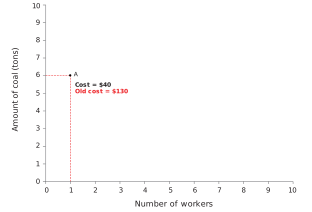
| Technology | Number of workers | Price of workers | Total cost of workers | Coal required (tons) | Price of one ton of coal | Total cost of coal | Total cost |
|---|---|---|---|---|---|---|---|
| A | 1 | 10 | 10 | 6 | 5 | 30 | 40 |
| B | 4 | 10 | 40 | 2 | 5 | 10 | 50 |
| E | 10 | 10 | 100 | 1 | 5 | 5 | 105 |
A costs much less at new prices
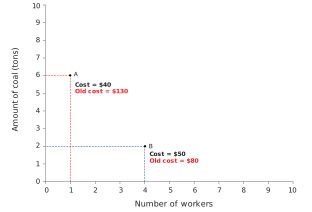
| Technology | Number of workers | Price of workers | Total cost of workers | Coal required (tons) | Price of one ton of coal | Total cost of coal | Total cost |
|---|---|---|---|---|---|---|---|
| A | 1 | 10 | 10 | 6 | 5 | 30 | 40 |
| B | 4 | 10 | 40 | 2 | 5 | 10 | 50 |
| E | 10 | 10 | 100 | 1 | 5 | 5 | 105 |
B costs less than before, and is now more costly than A
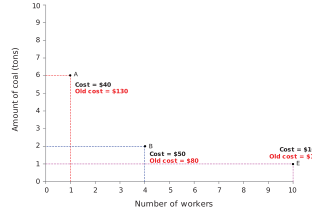
| Technology | Number of workers | Price of workers | Total cost of workers | Coal required (tons) | Price of one ton of coal | Total cost of coal | Total cost |
|---|---|---|---|---|---|---|---|
| A | 1 | 10 | 10 | 6 | 5 | 30 | 40 |
| B | 4 | 10 | 40 | 2 | 5 | 10 | 50 |
| E | 10 | 10 | 100 | 1 | 5 | 5 | 105 |
E has a comparatively small drop in cost, and is now the most expensive
| Technology | Number of workers | Price of workers | Total cost of workers | Coal required (tons) | Price of one ton of coal | Total cost of coal | Total cost |
|---|---|---|---|---|---|---|---|
| A | 1 | 10 | 10 | 6 | 5 | 30 | 40 |
| B | 4 | 10 | 40 | 2 | 5 | 10 | 50 |
| E | 10 | 10 | 100 | 1 | 5 | 5 | 105 |
A, B, and E have all seen their cost decrease
| Technology | Number of workers | Price of workers | Total cost of workers | Coal required (tons) | Price of one ton of coal | Total cost of coal | Total cost |
|---|---|---|---|---|---|---|---|
| A | 1 | 10 | 10 | 6 | 5 | 30 | 40 |
| B | 4 | 10 | 40 | 2 | 5 | 10 | 50 |
| E | 10 | 10 | 100 | 1 | 5 | 5 | 105 |
A is now the lowest-cost option
As a firm owner, how would you react to the change in relative prices? Assuming you had chosen B when a ton of coal was $20, you would initially be happy that your overall production cost has dropped from $80 to $50. However, assuming A is still available to you, you will realize that A is now the least expensive way to produce 100 meters of cloth and, doing the best you can, you will switch over to A.
With labor becoming relatively more expensive than coal, you are incentivized to switch to a more capital-intensive technology. The change in relative price also made the labor-intensive E more than twice as costly as A. Before the change in relative price, A was more costly than E.
This example highlights the idea that firms doing the best they can means minimizing cost, not favoring some specific factor of production.
Is innovation profitable?
Your firm’s profits are equal to the revenue it gets from selling cloth, minus the cost of producing that cloth. How are your profits affected by the switch from B to A after the change in relative prices?
Assume that the price you charge for 100 meters of cloth remains constant. Because the revenue will remain constant, the change in profit is equal to the decrease in costs associated with adopting the new technology. When the price of a ton of coal drops from $20 to $5, the cost of B is $50 per 100 meters of cloth. When you switch to A, the cost drops to $40. Therefore, your profits will increase by $10 for each 100 meters of cloth produced and sold. Mathematically:
\[\begin{aligned} \text{profit} &= \text{revenue} - \text{costs} \\ \\ \text{change in profit from} \\ \text{switching from B to A} &= \text{change in revenue} - \text{change in costs} \\ &= 0 - (40 - 50) \\ &= 10 \end{aligned}\]- economic rent
- Economic rent is the difference between the net benefit (monetary or otherwise) that an individual receives from a chosen action, and the net benefit from the next-best alternative (or reservation option).
- innovation rent
- Profits in excess of the opportunity cost of capital that an innovator gets by introducing a new technology, organizational form, or marketing strategy.
- principle of trade-offs and opportunity cost
- The gains you make by choosing some action typically come at the cost of gains that would have been possible had you acted differently.
The extra $10 in profit per 100 meters of cloth is your economic rent (a payoff greater than your next-best alternative) for switching from B to A. This form of economic rent is called innovation rent, which is any extra profit you get from adopting a new technology. Following the principle of trade-offs and opportunity cost, we consider not only the profit with the new technology, but also the opportunity cost, which is the profit from the old technology. Mathematically:
\[\text{innovation rents} = \text{profits from new technology} - \text{profits from old technology}\]- entrepreneur
- A person or firm who creates or is an early adopter of new technologies, organizational forms, and other opportunities.
In our example, A was available but not in use until some firm responded to the incentive to gain innovation rents created by the increase in the relative price of labor. We call an early adopter of a technology an entrepreneur.
Innovation and competition
Assume that your firm was an entrepreneur in this case—you were the first to switch from B to A. Because you are an entrepreneur, you earn innovation rents. However, these rents will not last. Other firms, noticing the innovation rents you are making, will begin to adopt A. The process will continue until all the surviving firms in the market are using the new technology, thereby eliminating any innovation rents. Those firms that stuck to B will now be unable to compete, and they may go out of business.
One consequence of technological progress is the elimination of many jobs that this progress made obsolete. For example, the employment website Indeed.com compiled a list of “51 Jobs That Don’t Exist Anymore (And What to Do About It)”.
But this is not the end of the story. As we explained in Chapter 3, firms in a capitalist economy have strong incentives to adopt and develop more productive technologies. Once the innovation rents due to the switch from B to A are gone, firms will begin trying to invent or seek out even better technologies. They will do so because they want innovation rents and because they know other firms are trying to do the same, and they do not want to fall behind.
Data Extension 4.4 How rising wages affected farms
In Figure 4.1, we saw that tractors almost entirely replaced horses and mules on American farms between 1935 and 1960. We can use the model developed in this chapter to explain three features of that graph:
- Very few tractors were purchased prior to 1920.
- Very few tractors were purchased from 1930 to 1935.
- The adoption of tractors increased rapidly between 1930 and 1960.
Figure E4.1 shows data on three prices: real wages of agricultural workers, real prices of tractors, and real prices of horses and mules. We can use this data to observe how the relative prices of each factor changed over time. Doing so will help us explain why Figure E4.1 has the shape it does.
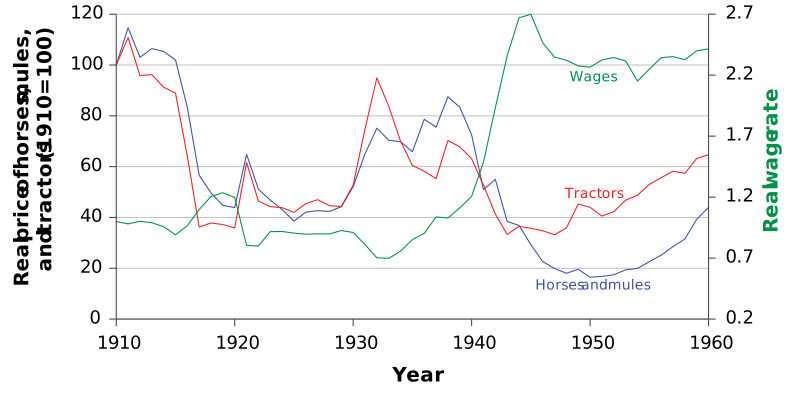
Figure E4.1 Real prices for tractors, horses, and labor, 1910–1960.
Manuelli, Rodolfo E. and Ananth Seshadri. 2014. “Frictionless Technology Diffusion: The Case of Tractors.” American Economic Review 104 (4): pp. 1368–1391.
The vertical axis on the left shows a real price index for tractors and horses and mules. The word “real” here indicates that these prices are adjusted for the overall change in prices over the period 1910–1960. In other words, it’s a measure of the relative price of tractors and horses and mules in each year. These real prices make it easier to see how much the relative price changes in percentage terms from year to year. To do this, we first take an arbitrary year, called a base year, and assign it a value of 100. For this graph, 1910 is the base year. The relative prices for each year will then be calculated as a percentage of the relative price in 1910. The real price of tractors in 1910 is therefore 100, because the relative price in 1910 is 100% of the relative price in 1910. By 1920, however, the relative price was about 40. This means that between 1910 and 1920 the relative price of tractors fell by about 60%. If the price had then gone from 40 to 80, the price would have doubled.
The vertical axis on the right is the real wage rate of agricultural workers in dollars. Wages were an important relative price because workers were required to handle the animals.
We can use the data in Figure E4.1 to help explain the three features listed above.
- Very few tractors were purchased prior to 1920. During this period, we can see that the real price of tractors and horses and mules were quite high compared to wages. With wages being relatively low, farmers had little incentive to buy either tractors or horses and mules.
- Very few tractors were purchased from 1930 to 1935. Although the real price of tractors was substantially lower during the 1920s than during the 1910s, we can see that real wages dropped during this period, which was the height of the Great Depression. Additionally, the real price of tractors doubled in the early 1930s, and remained higher than the real price of horses and mules until about 1935. The drop in real wages and increased real price of tractors dramatically increased the relative price of tractors, incentivizing farmers to stick with their more labor-intensive technology.
- The adoption of tractors increased rapidly between 1935 and 1960. Starting around 1935, and especially after 1940, the real wage for agricultural workers rapidly increased. During this same period, the real price of tractors and horses and mules dropped initially then slowly increased after 1950. The real price of horses and mules stayed lower than tractors after about 1945. In other words, the relative price of workers increased rapidly, creating a strong incentive for farmers to adopt more capital-intensive technology. Even though tractors were more expensive than horses and mules during this period, the high relative price of workers and productivity of tractors made them an increasingly attractive technology for replacing workers. This is exactly what we see in Figure 4.1.
Although the quality of tractors was also improving over the entire period from 1910 to 1960, it was not until wages rapidly increased that farmers widely adopted tractors.
Question E4.1
Which of the following help explain why very few tractors were purchased from 1930 to 1935? Choose the correct option(s).
- No quota or policy restricted tractor purchases.
- Falling real wages made labor cheaper, reducing the incentive to invest in tractors.
- Tractor prices rose in real terms, making tractors more expensive relative to earlier years and to horses or mules.
- While preferences may have played a minor role, the key explanation lies in economic incentives—not in resistance to change.
Exercise E4.1 Technology adoption and relative prices
Imagine that from 1935 to 1960, the real price of tractors stayed at $80 while wages rose. Would adoption of tractors still have happened rapidly? What additional information might help you answer this question?
Math Extension 4.4 Isocost lines
- isocost line
- A line that represents all combinations of inputs that cost a given total amount.
We can deepen our model by using isocost lines, which are lines that represent all combinations of inputs that cost a given total amount.
Using the same example as above, suppose the relative prices are where they started: $10 for the wage and $20 for a ton of coal. Technology G requires two workers and three tons of coal to produce 100 meters of cloth. At these prices, G costs:
\[\begin{aligned} \text{total cost} &= (\text{wage} \times \text{number of workers})\\ &+ (\text{price of a ton of coal} \times \text{tons of coal}) \\ &= (10 \times 2) + (20 \times 3) \\ &= \$80 \end{aligned}\]You can see G in Figure E4.2. If the firm were to instead use technology H, which employs more workers—specifically, six—but reduces the input of coal to one ton, that combination will also cost $80.
- isocost line
- A line that represents all combinations of inputs that cost a given total amount.
The line running through G and H is the isocost line—it joins all the combinations of workers and coal that cost $80. A simple way to draw any line is to find the endpoints. For example, the $80 isocost line joins point J (no workers, four tons of coal) and point K (eight workers, no coal). A firm would be equally happy with any technology on this line because all incur the same cost. The steps in Figure E4.2 explain in more detail how to construct isocost lines to compare the costs of all combinations of inputs.
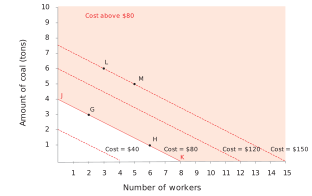
Figure E4.2 Isocost lines for different technologies when the wage is $10 and the price of coal is $20.
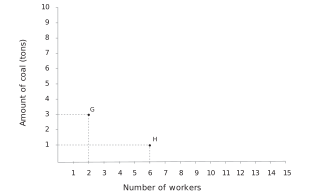
Technologies G and H both cost $80
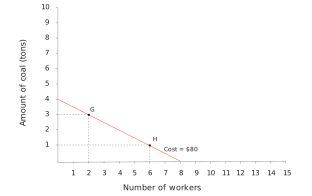
The isocost line for $80
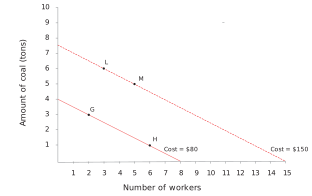
A higher isocost line
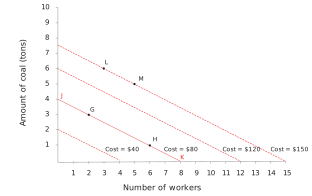
Isocost lines are parallel
Points above an isocost line cost more
Notice in Figure E4.2 that all the isocost lines are parallel. Why? At any point, if you increase the number of workers by one, your costs rise by $10 (the wage). But the price of coal is $20, so if you decrease the coal input by 0.5 tons at the same time, costs will stay the same. The slope of the isocost line is –0.5 (the change in energy divided by the change in labor).
The slope depends on the relative prices of labor and coal:
\[\text{slope of isocost lines} = -\frac{\text{wage}}{\text{price of capital}}\]We can use isocost lines to compare the technologies in Figure 4.5. As we saw there, when the wage is $10 and the price of a ton of coal is $20, B is the lowest-cost technology of the available options. In Figure E4.3, we have drawn the isocost line through the point representing technology B. This line shows that, at these input prices, the other two technologies are more costly.
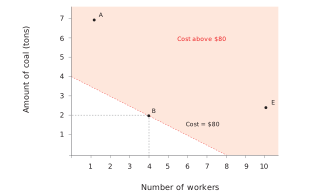
Figure E4.3 The costs of using different technologies to produce 100 meters of cloth.
At these input prices, the other available technologies (A and E) will not be chosen. If both prices doubled, the diagram would look almost the same: The isocost line through B would have the same slope, although the cost would be $160 instead of $80. Once again, it is the relative price (the wage divided by the price of coal) that matters.
When the relative price changes, the slope of the line will change. Depending on the extent of the change, a different technology might become the lowest-cost option.
Consider now how the isocost line will change if the prices shift to what they were in Figure 4.6, where the wage stayed at $10 but the price of a ton of coal dropped to $5. This change will result in A being the lowest-cost technology. Figure E4.4 shows this change using isocost lines.
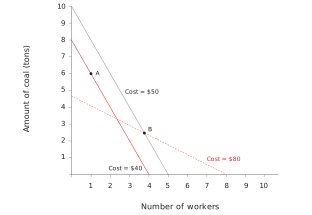
Figure E4.4 The cost of using different technologies to produce 100 meters of cloth: high relative price of labor.
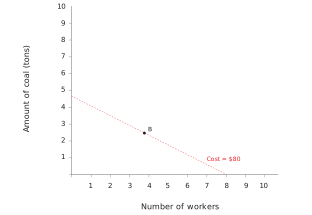
At the original relative price, B is the lower-cost technology
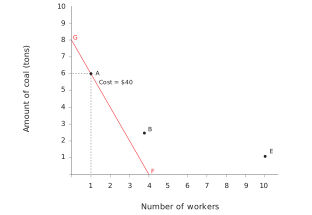
Steeper isocost lines as price of coal drops to $5
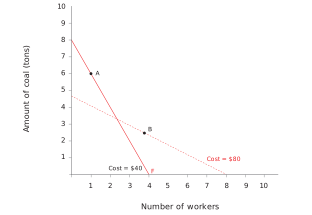
At new prices, A is lowest-cost technology
B now costs more than A
With the new relative price, A lies on the $40 isocost line, and the other two available technologies lie above it. They will not be chosen if A is available.
Question E4.2
Which of the following statements about isocost lines is correct? Choose the correct option(s).
- Isocost lines show combinations of inputs that cost the same, regardless of output.
- The slope depends on the relative prices of the inputs.
- Slope = – (15 ÷ 5) = –3. This means three units of capital must be given up to hire one additional worker at constant cost.
- The slope changes when relative prices change, not when total cost changes.
Exercise E4.2 How prices shape production choices
A firm uses two inputs: labor and coal. Suppose the wage is $12 per worker and the price of coal is $18 per ton.
- Calculate the total cost of using three workers and four tons of coal.
- What is the slope of the isocost line under these prices?
- Consider now how the isocost line would change if the wage stays at $12, but the price of coal drops to $6 per ton.
- What does this comparison tell you about how relative prices affect input choice?
Question 4.4
This weekend, you go to the grocery store. You see that the price of a pound of turkey is $2, and the price of a pound of chicken is $3. Next weekend, you go back to the grocery store and find turkey is now $4 per pound, while the price of chicken is still $3 per pound. How could you describe this price change? Choose the correct option(s).
- Turkey’s price increased from $2 to $4, that is, it became more expensive.
- Turkey’s price increased from $2 to $4, that is, it became more expensive.
- Chicken’s price stayed the same, but relative to turkey, it is now less expensive.
- Chicken’s price stayed the same, but relative to turkey, it is now less expensive.
Question 4.5
If labor becomes relatively less expensive, how will firms likely respond? Choose the correct option(s).
- When labor becomes relatively less expensive, firms will tend to use more of it by switching to more labor-intensive technologies.
- Capital-intensive technologies are used when labor is relatively expensive, not relatively inexpensive.
- Firms typically adjust input choices to minimize costs.
- Input choices depend on relative input costs, not on consumer behavior.
Question 4.6
Which of the following statements about innovation are true? Choose the correct option(s).
- Innovation can involve either capital-intensive or labor-intensive technologies, depending on relative input prices. It does not always require more machines.
- Innovation rents are temporary; as other firms adopt the same technology, the extra profit disappears.
- Competition tends to speed up technological progress by encouraging firms to innovate and cut costs.
- Entrepreneurs are often early adopters or inventors of new technologies and earn innovation rents before others catch up.
Exercise 4.5 High wages and manufacturing technology
Many Americans and American politicians have said they would like to increase the number of manufacturing jobs in the United States by relocating some manufacturing from countries with relatively low wages to the United States, which has relatively high wages.
- If a firm moves production from a relatively low-wage country to a relatively high-wage country such as the United States, which is the US factory likely to use: more labor-intensive technology or more capital-intensive technology? Why?
- What does your answer above suggest about the ability of the United States to create more manufacturing jobs by relocating production from low-wage countries to the United States?
Exercise 4.6 Innovation rents and the role of competition
Firm X is producing 100 meters of cloth using Technology A, which costs $60 per unit. The market price of 100 meters of cloth is $100. A new technology, Technology B, becomes available, and Firm X adopts it. Technology B reduces the firm’s cost of production to $45 per unit. The price of cloth remains the same.
- Calculate the innovation rent earned by Firm X after adopting Technology B.
- Six months later, Firm Y also adopts the new technology. Increased competition causes the market price of cloth to fall to $80. What happens to Firm X’s profit after the price change?
- Explain how competition affects innovation rents over time. Why might firms still want to innovate even when rents do not last?
Exercise 4.7 Technology selection under different relative prices
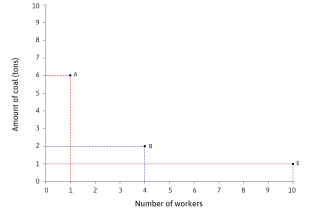
| Technology | Number of workers | Price of workers | Total cost of workers | Coal required (tons) | Price of one ton of coal | Total cost of coal | Total cost |
|---|---|---|---|---|---|---|---|
| A | 1 | 6 | |||||
| B | 4 | 2 | |||||
| E | 10 | 1 |
Exercise 4.7 Figure (I)
The figure shows three of the technologies for producing 100 meters of cloth. The prices for the two inputs are missing, however. Below are three possible combinations of input prices. For each combination, fill out the missing entries in the table and indicate which technology a cloth-producing firm should use.
- price of workers = $10, price of one ton of coal = $10
- price of workers = $50, price of one ton of coal = $50
- price of workers = $5, price of one ton of coal = $30

