3.6 Another hockey stick: Climate change
The interaction of households, firms, and the government in a capitalist economic system takes place within our natural environment and biosphere.
Producing output often involves using up or destroying our natural environment (Figure 3.3), and these costs of output are not accounted for in our measure of living standards. For example, using GDP as a measure of living standards ignores the importance of the biosphere and physical environment for our current and future well-being. The way we produce our livelihoods is now degrading the environment and depleting the stock of natural resources—including clean air and a livable climate.
Climate change is one of several interconnected planetary boundaries that scientists have identified—others include biodiversity loss, ocean acidification, freshwater depletion, and disruption of the nitrogen cycle. In this section, we focus on climate change because it is the planetary boundary for which the evidence of human causation is clearest and the economic consequences best documented.
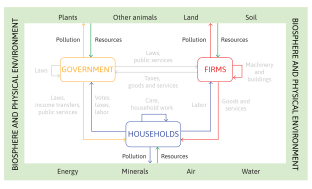
Figure 3.3 Economic interactions take place within our natural environment and biosphere.
Emissions and carbon dioxide in the atmosphere
Figures 3.4 and 3.5 provide evidence that our use of fossil fuels—coal, oil, and natural gas—has profoundly transformed our planet’s natural environment. Both figures have the hockey stick shape.
Figure 3.4 shows two things. First, the amount of carbon dioxide (CO2) in the atmosphere has increased since the late 1800s (the green line). Second, this increase in atmospheric CO2 corresponds to year-to-year increases in carbon emissions from the burning of fossil fuels (orange line). Increased emissions of carbon dioxide from burning fossil fuels into the air during the twentieth and twenty-first centuries have resulted in measurably larger amounts of CO2 in Earth’s atmosphere. It is important to understand the difference between these two measures: Atmospheric CO2 tells us how much CO2 remains sitting in the atmosphere year to year, and it is accumulating over time. Global CO2 emissions (orange line) tell us how much CO2 is being emitted into the atmosphere each year from the burning of fossil fuels. The more CO2 we emit each year, the more CO2 accumulates over time in the atmosphere.
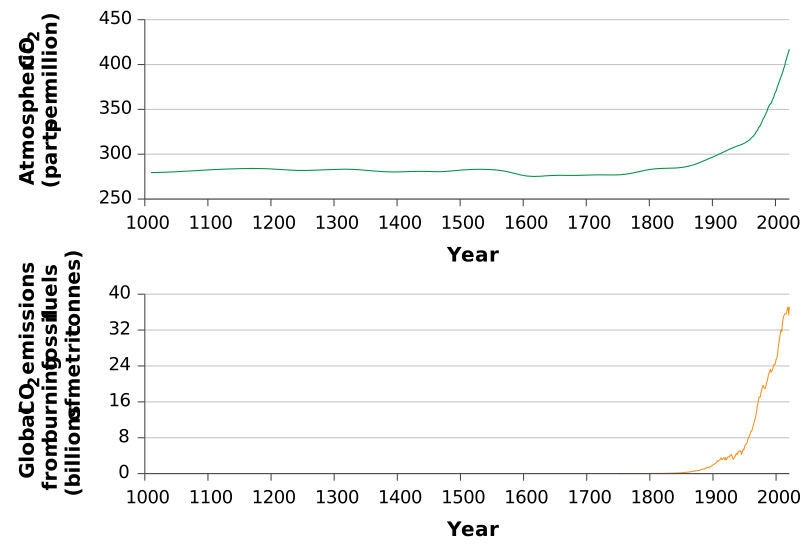
Figure 3.4 Carbon dioxide in the atmosphere (1010–2022) and global carbon dioxide emissions from burning fossil fuels (1750–2021).
Pierre Friedlingstein, Matthew W. Jones, Michael O’Sullivan, et al. 2019. “Global Carbon Budget 2019”. Earth System Science Data 11: pp. 1783–1838.; Pieter Tans and Kirk Thoning, NOAA Global Monitoring Laboratory (2020) and David Keeling, Scripps Institution of Oceanography (1976) “Trends in Atmospheric Carbon Dioxide”.; D. Gilfillan, G. Marland, T. Boden, and R. Andres (2020) “Global, Regional, and National Fossil Fuel CO2 Emissions”. Carbon Dioxide Information Analysis Center (CDIAC) Datasets.
Rising temperatures
Mount Tambora spewed so much ash that Earth’s temperature was reduced by the cooling effect of these fine particles in the atmosphere, and 1816 became known as the “year without a summer.”
Figure 3.5 shows that the mean (average) temperature of Earth fluctuates from decade to decade. The vertical axis measures deviations from the average temperature in the baseline period, which is 1961–1990 for this graph. That is, when the vertical axis value is zero, there is no deviation from the average temperature for the reference period. When the vertical axis value is negative, the temperature during that decade is lower than the reference period on average, and when the vertical axis value is positive, the temperature is higher than the reference period on average. We can see that prior to 1900, Earth’s temperature fluctuated and was generally lower than the reference period. Many factors can cause these fluctuations, including volcanic events such as the 1815 Mount Tambora eruption in Indonesia. After 1900, Earth’s temperature began to increase in a way that corresponds to the increased carbon dioxide that had been emitted into the atmosphere previously (and continues to be generated and emitted).
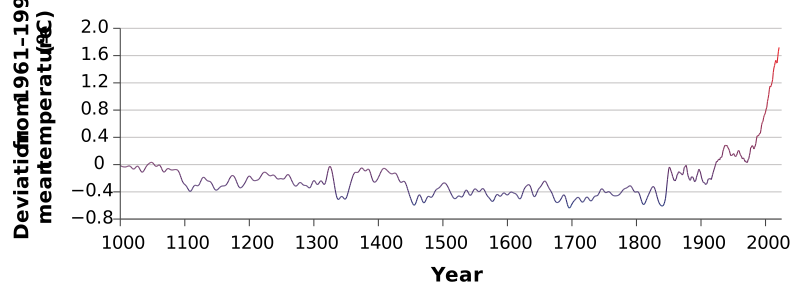
Figure 3.5 Deviation of Northern hemisphere temperatures from the 1961–1990 average over the long run (1000–2019). The figure shows 5-year moving averages.
Michael E. Mann, Zhihua Zhang, Malcolm K. Hughes, Raymond S. Bradley, et al. 2008. “Proxy-based reconstructions of hemispheric and global surface temperature variations over the past two millennia”. Proceedings of the National Academy of Sciences 105 (36): pp. 13252–13257; C. P. Morice, J. J. Kennedy, N. A. Rayner, and P. D. Jones. 2012. “Quantifying uncertainties in global and regional temperature change using an ensemble of observational estimates: The HadCRUT4 dataset”. Journal of Geophysical Research 117, D08101.
Since 1900, average temperatures have risen in response to increasingly high levels of greenhouse gas concentrations, which have mostly resulted from the CO2 emissions associated with the burning of fossil fuels. In each year of the twenty-first century, the average temperature has been higher than at any time in the previous millennium.
Everyday Economics 3.5
Can you think of an example of a production process (or everyday practice) that can increase our living standards without further damaging the environment?
The human causes of and the reality of climate change are no longer disputed in the scientific community. The likely consequences of global warming are far-reaching: melting of the polar ice caps, rising sea levels that may put large coastal areas under water, and potential changes in climate and rain patterns that may make some densely populated parts of the world uninhabitable and destroy some of the world’s food-growing areas.
We can see that the hockey sticks for GDP per capita and for atmospheric CO2 have risen together. Richer countries (and individuals) have, on average, higher emissions per capita than poorer ones.
Question 3.9
Which of the following are likely consequences of global warming as described in the chapter? Choose all that apply.
- Rising sea levels could flood coastal areas.
- While longer growing seasons may occur in some areas, global warming threatens overall food security.
- Climate changes could make some populated regions uninhabitable.
- Global warming’s impacts are uneven and may not benefit all regions; some may suffer from drought or heat stress.
Exercise 3.9 Economic growth and environmental impact
Look at Figure 3.1 and Figure 3.4 again. Describe how the trends in GDP per capita and atmospheric CO2 concentrations compare over time. What do these trends suggest about the relationship between GDP growth and environmental impact?

