4.2 Types of technology
In daily conversation, the word “technology” usually refers to machinery, equipment, or consumer electronics.
- technology
- A process that uses a set of materials and other inputs, including the work of people and machines, to produce an output.
- factors of production
- Any input into a production process is called a factor of production. Factors of production may include labor, machinery, and equipment (usually referred to as capital), land, energy, and raw materials.
In economics, a technology is a process that takes a set of inputs—including materials, tools, and the work of people and machines—and creates an output. For example, a technology for making a carrot cake at home is the recipe specifying the combination of inputs (ingredients such as flour, equipment such as an oven, and activities such as stirring) needed to create the output (the carrot cake). To make a similar carrot cake, a commercial bakery may have a different technology, one that uses large-scale machinery and workers to operate the machines. In other words, these are two different technologies for producing the same output. Because these two technologies do not use the exact same inputs, we say they have different factors of production.
Comparing two technologies
When comparing different technologies, we distinguish between labor-intensive and capital-intensive technologies. As an example, consider olive oil. For olive oil to be made, the olives must be washed, milled to remove the stones, mashed to a paste, and pressed to extract oil and water. Then the oil must be separated from the water.
- labor-intensive technology
- A technology that requires a comparatively large amount of human labor.
For thousands of years, olive oil was produced using simple technologies in which most of the process was done by hand, using a pestle and mortar to mash the olives, and heavy stones to press them. The inputs were raw materials (olives and water), capital goods (pestle and mortar, stones), and labor. The two images below show examples of people using such technologies in the 1800s and early 1900s. With this technology, 2,000 olives had to be combined with many hours of hard work to produce a single liter of olive oil. Because this technology was so reliant on human labor, we describe it as a labor-intensive technology.
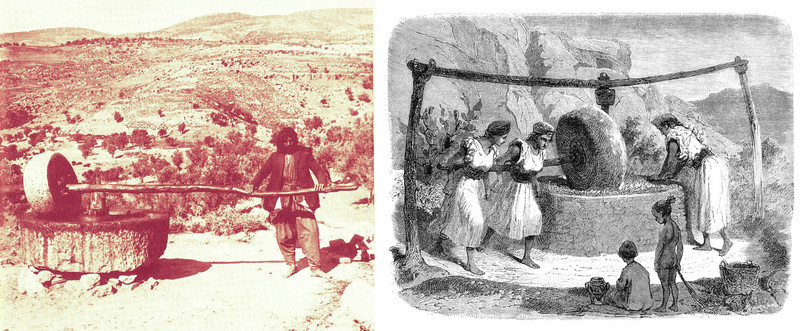
Left: Early 1900s olive press in Palestine when it was a part of the Ottoman Empire. Right: Drawing of women in Algeria working at a stone mill manufacturing olive oil, 1867.
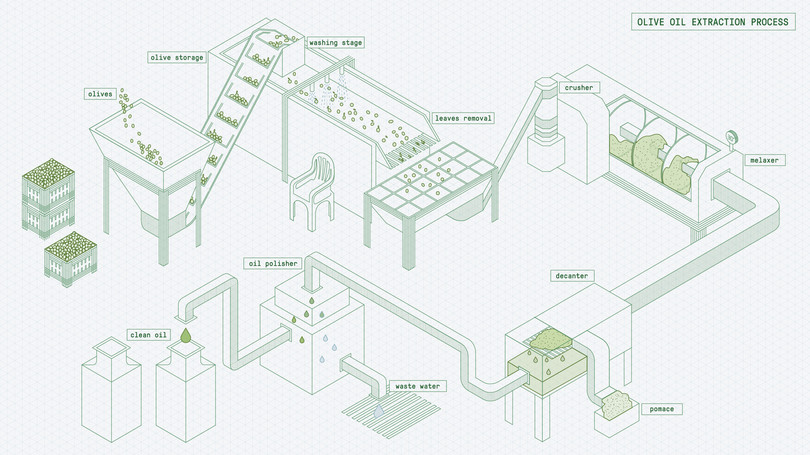
Figure 4.3 Schematic of a modern, capital-intensive method of olive oil extraction.
This video compares how olive oil is made today to how it was made prior to modern, capital-intensive technologies.
- capital-intensive technology
- A technology that requires a comparatively large amount of capital goods, such as equipment, machinery, and buildings.
Everyday Economics 4.2
Think about jobs you or people you know have had. Would you describe them as being labor intensive or capital intensive? In thinking about this question, what are you comparing the work to?
The technology used in modern commercial production employs far less labor and far more capital, as the schematic in Figure 4.3 shows. Its inputs are raw materials, labor, capital goods (milling, mashing, and pressing machines), and electricity to operate the machines. Because modern olive oil–producing technology relies comparatively less on human labor and more on machines, we describe it as a capital-intensive technology.
Now suppose that a new robotic technology is invented for producing olive oil. It can produce 100 liters of olive oil per day with one worker and 400 kWh of energy. Let’s assume that our current technology needs two workers and 160 kWh of energy per day to produce the same output. Table 4.1 compares the inputs needed to produce 100 liters of olive oil for both technologies. Although technology A is capital intensive compared to older technologies, it is labor intensive compared to technology B because it requires double the human labor to produce the same output.
A kilowatt-hour (kWh) is a unit of electrical energy equal to the amount of energy delivered by 1,000 watts over one hour. An average refrigerator in the United States, for example, uses 502 kWh per year, and the average American uses more than 12,000 kWh per year in general. Our fridges use more energy than some people do in an entire year. The average citizen of Haiti, for example, uses only 75 kWh per year. In Tanzania, that number is 123 kWh per year, and in Nepal it is 321 kWh per year. In total, there are at least 26 countries in which the average per capita energy use per year is less than the energy used by the average American fridge. Many of these countries are located in sub-Saharan Africa, which is why that part of the map of Earth at night, which we saw in Chapter 3, was comparatively dark.
| Workers | Energy (kWh) | Total output (liters of olive oil) | Average product of labor | |
|---|---|---|---|---|
| A: Milling, mashing, and pressing machines | 2 | 160 | 100 | 50 |
| B: Robotic technology | 1 | 400 | 100 | 100 |
Table 4.1 Comparing two technologies for producing 100 liters of olive oil.
- average product of labor
- The total amount produced divided by the units of labor.
Table 4.1 also shows the average product of labor for each technology, which measures the amount of output per worker. Because B, the robotic technology, produces the same amount of olive oil with half the workers, its average product of labor is twice that of A.
Imagine you are running a firm that produces olive oil. If you had to choose between technologies A and B, which would you choose: the one that requires fewer workers or the one that requires less energy? How should you compare the two options?
Question 4.2
Imagine we have four technologies for producing one T-shirt. Each requires the same amount of raw material, but differs in how much electricity and human labor it requires. The table below shows the inputs needed for each technology.
| Energy (kWh) | Workers | |
|---|---|---|
| Technology W | 100 | 1 |
| Technology X | 30 | 4 |
| Technology Y | 60 | 2 |
| Technology Z | 30 | 8 |
Which of these technologies is the most labor-intensive?
- Technology Z uses the most workers (8) and the least energy (30 kWh), making it the most labor-intensive option.
- Technology Z uses the most workers (8) and the least energy (30 kWh), making it the most labor-intensive option.
- Technology Z uses the most workers (8) and the least energy (30 kWh), making it the most labor-intensive option.
- Technology Z uses the most workers (8) and the least energy (30 kWh), making it the most labor-intensive option.
Exercise 4.1 Jobs then and now: A century of technological change
Think of a job you or someone you know has done.
- What technology characterizes that job today?
- What do you think the technology for that job looked like 25 years ago? 50 years ago? 100 years ago?
- Has the job become more capital-intensive or more labor-intensive over time?

