Chapter 10 The firm and its workers: Finding a match
Signage for a job fair on 5th Avenue in Manhattan.
10.1 Introduction: Finding jobs
In 2024, The New York Times published an article describing the efforts of some young people in China to find and keep jobs. Let’s look at the story of Tsuki Jin, who grew up in a small city before moving to Shanghai.
Ms. Jin quit the human resources job she had worked for two years and moved to Shanghai, with nothing new lined up and roughly $700 in savings. … She quickly accepted another human resources job, even though it paid only $700 a month, barely higher than what she had earned at home, where the cost of living was much lower. She hunted for part-time jobs, working weekends as a cashier at a games arcade. … She quit her first job after several weeks to look for a higher-paying one, because she knew that she would have no problem turning back to less glamorous work if needed. About a month after that, she switched again to her current job, which pays $1,270 a month—double what she’d earned at home. Even with her new job, though, Ms. Jin is already thinking ahead to her next adventure.
According to a 2023 study from the Bureau of Labor Statistics, individuals born in the latter years of the baby boom (1957–1964) held an average of 12.9 jobs from ages 18 to 56. Nearly half of these jobs were held from ages 18 to 24.
Stories like these are common in capitalist economies: Workers get promoted, fired, and hired; they quit and retire. New jobs are constantly being created, while others are eliminated. In an average month in the United States in 2023, about 3.7 million people quit their jobs, 1.6 million were fired, and 251,000 more jobs were created than eliminated.
Searching for a new or better job can feel like a full-time job in and of itself. But even workers who have a job are often looking around for something better. Employers, too, can spend a lot of time trying to fill an open position and evaluating whether a current worker should be kept on, promoted, or fired. Figure 10.1 shows the results of a 2015 poll that asked people about the methods they used in their most recent job search.
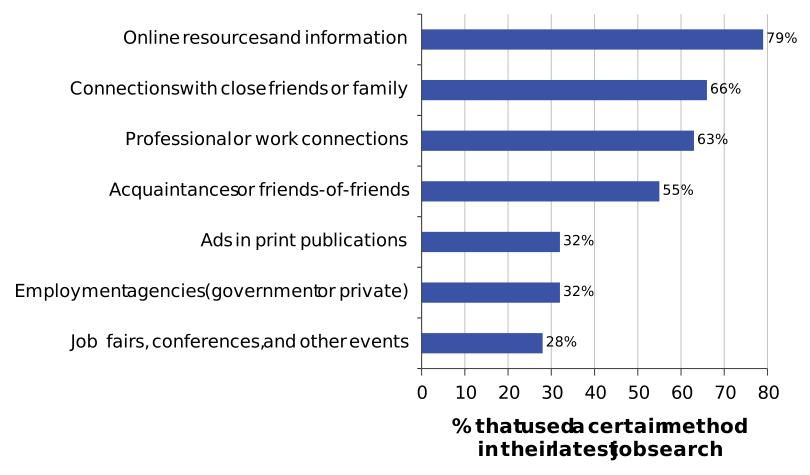
Figure 10.1 The results of a 2015 poll that asked Americans about the methods they had used in their job search.
Pew Research Center. 2015. “Job Search Methods, United States”. Processed by Our World in Data.
Although nearly 80% of the survey respondents used online resources, the next three most common methods—connections with close friends or family, professional or work connections, and acquaintances or friends-of-friends—all depend on social connections. Those doing the hiring, too, often rely on social connections, either their own or their workers’.
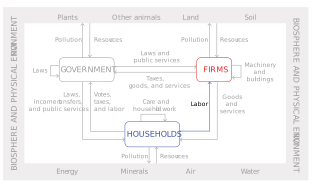
Figure 10.2 Our model of the whole economy, highlighting the interactions between workers in households searching for jobs in firms, and employers in firms hiring workers for job vacancies.
In Chapters 10 and 11, we examine more closely the relationship between workers and firms. Figure 10.2, our model of the whole economy, highlights the parts of the economy we examine in these chapters. In this chapter, we focus on how members of a household find jobs in firms and how employers find workers. This information will help us understand why social connections are such an integral part of the job search and hiring processes, and in turn, how these processes affect economic inequality. Chapter 11 looks at the relationship between a firm and a worker after the worker has been hired.
- market
- A market enables people to exchange goods and services by means of directly reciprocated transfers (unlike gifts), voluntarily entered into for mutual benefit (unlike theft, taxation), in a way that is often impersonal (unlike transfers among friends, family).
We start by looking at what makes the market for jobs different from other markets.
Question 10.1
Which of the following statements accurately describe findings from Figure 10.1 about job search methods in 2015? Choose all that apply.
- Nearly 80% used online resources, making them the most common resources for job search.
- The data show that many survey respondents used online resources, but there is no information about whether they used them exclusively.
- Personal connections were common, second only to online resources.
- Traditional sources such as newspapers and employment agencies were used by relatively fewer people.
Exercise 10.1 Comparing poll results: 2015 vs. today
If a poll like that shown in Figure 10.1 were done today, how do you think the answers would differ compared to the answers from 2015?

