Chapter 13 The firm and its customers: Market power and the benefits of exchange
The pharmaceutical industry is an example of an industry with significant market power driven by patents, regulatory barriers, and inelastic demand for certain drugs. Pharmaceutical companies can set prices well above marginal costs without losing many buyers.
13.1 Rising markups
As we saw in Chapter 12, firms that sell differentiated products can charge a price markup—that is, prices that are above the unit cost. Since the 1980s, firm markups have been rising.
As Figure 13.1 shows, markups increased during the 1960s but then declined as US economic growth slowed. Starting in 1980, markups began rising sharply and have doubled since then. Why have markups been rising?
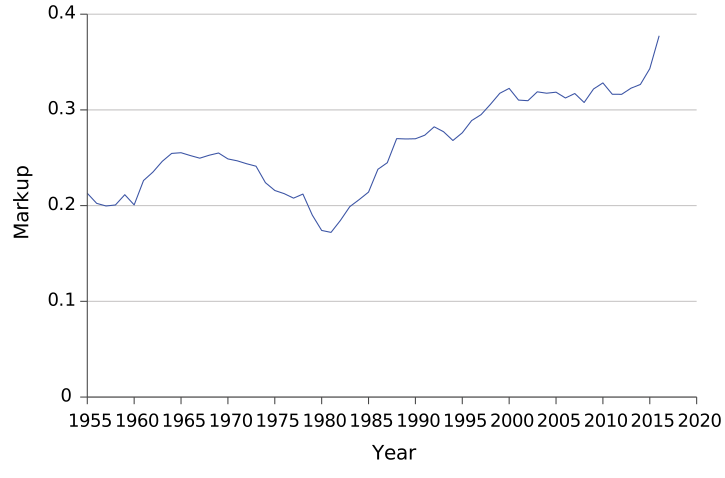
Figure 13.1
The estimated average markup for firms in the United States, 1955–2016.
Note: The measure of the markup in the figure is 1 minus the inverse of the measure used in the source data.
Jan De Loecker, Jan Eeckhout, and Gabriel Unger. 2020. “The Rise of Market Power and the Macroeconomic Implications”. The Quarterly Journal of Economics 135(2): pp. 561–644.
- price markup
- The price markup is the price a firm charges per unit minus the unit costs.
- substitutes
- Two goods (or services) are substitutes when buyers will readily replace one with the other if the prices are similar. If the price of one of the goods increases, buyers will be more likely to choose the other (so demand for it will increase).
- market power
- A firm has market power if it can sell its product at a range of feasible prices without losing many potential buyers to competing firms.
As we saw in Chapter 12, firms that sell differentiated products often charge a price markup. The rise in markups shown in Figure 13.1 could reflect firms either charging higher prices or achieving lower unit costs.
Firms may also face less competition when only a few companies operate in a market, limiting the substitutes available to buyers. In concentrated markets, each firm has more market power because consumers have fewer alternatives. For example, Verizon, AT&T, and T-Mobile serve 99% of all US wireless subscribers. They face little competition simply because they dominate the market.
A lack of close substitutes can also stem from buyers’ perceptions. As an example, consider Apple. Although other companies, such as Samsung and Google, also make smartphones, many buyers view the iPhone as superior in quality and design. As a result, some consumers don’t see the Samsung Galaxy as a viable substitute for the iPhone (see Case Study Extension 13.1: Market power: A tale of two firms).

In 2021, two companies sold 70% of all infant formula in the United States. Abbott Laboratories (brands include Similac) accounted for 49.5% of all infant formula and the Reckitt Benckiser Group (brands include Enfamil) sold 20.6% of all infant formula. These numbers mean that Abbott and Reckitt face little competition from other firms producing infant formula and have quite a bit of market power.
Jackie Yenerall, Andrew Muhammad, Karen DeLong, and Trey Malone. 2024. “Navigating the Challenges of Building a More Resilient Infant Formula Industry”. Applied Economic Perspectives and Policy 46(2): pp. 1–15.
When a firm faces reduced competition, it has market power—that is, sufficient bargaining power to sell its product at a range of feasible prices without losing its buyers to competitors. For example, Apple can charge $799 for the iPhone 15 even though it costs only $423 to produce it. This ability to set prices well above unit costs is a key feature of market power. In the US Department of Justice’s 2024 antitrust lawsuit against Apple, Apple was accused of blocking rival apps and devices, limiting payment options, and making it harder for users to switch to competitors. Apple’s actions reduced competition and gave it more control over pricing, allowing it to charge higher markups.
Case Study Extension 13.1 Market power: A tale of two firms
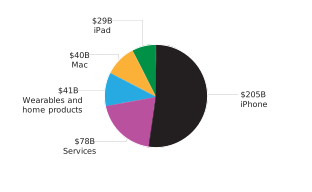
Figure E13.1 Apple’s revenue sources.
“Apple Faces Longest Sales Drop in Decades as iPhone Slumps.” Bloomberg.
Apple is not the only company that sells smartphones. Just look across campus or in your pocket to see that there are alternatives to Apple’s iPhone. Thus, when Apple raises the price of its smartphone, it will lose some potential buyers who are not willing to or cannot pay a high price for an iPhone. Instead, these buyers might purchase a Samsung Galaxy, Motorola Edge, or Google Pixel.
- substitutes
- Two goods (or services) are substitutes when buyers will readily replace one with the other if the prices are similar. If the price of one of the goods increases, buyers will be more likely to choose the other (so demand for it will increase).
- market power
- A firm has market power if it can sell its product at a range of feasible prices without losing many potential buyers to competing firms.
However, Apple won’t lose all of its potential buyers. Buyers who believe the quality and design of the iPhone are superior to the quality and design of other smartphones on the market will pay a high price. Others will pay that price because many of their family and friends use iPhones and they want to take advantage of iPhone features that can only be used with other iPhone users. Apple also uses a different operating system, so its products interface well with each other but not so well with Android products. Some buyers might even pay a high price because they are brand loyalists who buy only Apple products. In other words, for many smartphone users, there are no good substitutes for the iPhone, which means that Apple faces very limited competition from other firms in the smartphone market.
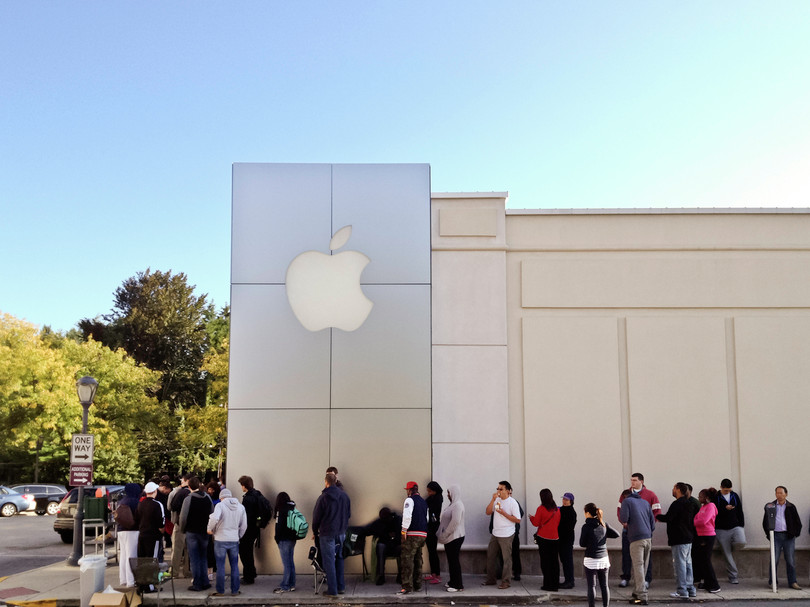
Buyers line up outside an Apple store to purchase the latest iPhone.
As long as Apple doesn’t lose all its potential smartphone buyers when it charges a high price, then Apple has some control over the price of its product. It has market power. In fact, Apple has quite a bit of market power. How do we know this? Despite the high price of the iPhone, Apple continues to sell iPhones to over half of all US buyers shopping for a smartphone (Figure E13.2). The more market power a firm has, the greater its ability to set the price of its product higher and not lose many potential buyers. This means that firms with more market power have the potential to be more profitable than firms with less market power.
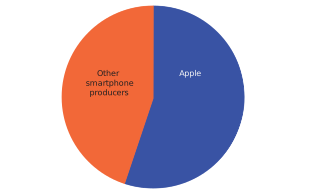
Figure E13.2 Smartphone sales in the United States, 2023 (second quarter).
Kayla Castañeda’s firm, Agua Bonita (Kayla is CEO and co-founder of the company), also has market power. Kayla grew up drinking agua fresca, a traditional Mexican drink made from fresh fruit, water, and sugar. Her family made the drink using ripened fruit that her grandfather brought home after working long days in the fields in Central Valley, California. In 2020, she co-founded Agua Bonita, which produced the first widely available real-fruit, ready-to-drink agua fresca.
If Agua Bonita were to increase the price of its aguas frescas, it would lose some potential buyers, but not all of them. Some buyers might decide not to purchase the drinks at a high price because they believe there are many substitutes to Agua Bonita’s aguas frescas, such as those produced by Minute Maid, BAWI, Celzo, and dozens of other similar, though not identical, fruit-based waters. Other potential buyers would purchase Agua Bonita’s agua fresca at a higher price because they believe the product has unique qualities that are not available in alternative fruit-based waters, such as the use of fresh fruit. While Agua Bonita has market power, its ability to set a high price is more limited than Apple’s because it faces quite a bit more competition from other firms producing similar drinks.
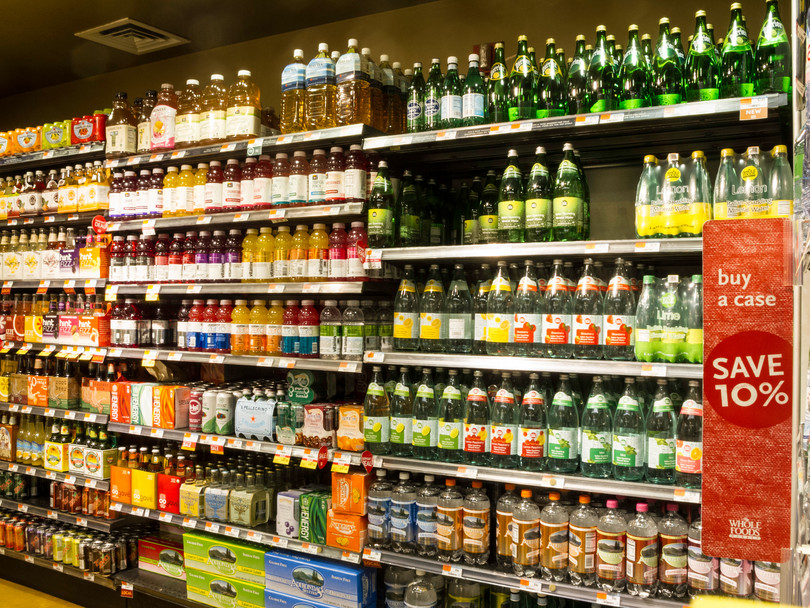
Fruit-based waters, such as aguas frescas, belong to a market with a larger number of producers selling similar but not identical drinks.
Another reason for rising markups is that technological advances can lower firms’ marginal costs of production, but companies don’t always pass those savings on to buyers. Instead, they often maintain higher prices, which increases the markup. Automation, better software, and improved production techniques can improve firms’ productivity and reduce the cost per unit. Even improvements in management play a role. For example, Rafaella Sadun and co-authors (2025) find that when firms merge or one firm acquires another, management quality tends to improve, lowering production costs.
Everyday Economics 13.1
Have you ever ordered food through a delivery platform like Uber Eats or DoorDash and noticed that the cost was much higher than the restaurant’s menu price? This is because, in addition to delivery fees, these platforms often add service fees that push the price well above the cost of providing the meal. In 2024, DoorDash held about 67% of the US meal delivery market, giving it significant market power. DoorDash’s market power might be one reason why it charges customers high service fees. DoorDash also charges restaurants that use its service commission rates as high as 30%. This means that both you and the restaurant pay substantial markups. The prices you pay are far above the marginal cost, which is the cost of preparing and delivering one meal.
However, rising market power can come with downsides. One downside that you, as a buyer, may recognize is that prices might be higher. For example, as Apple gains more market power, you might have to pay more for the iPhone. If you were willing to pay $900 but the price keeps rising closer to that amount, you end up getting less of a “deal” than before. The gap between what you were willing to pay and what you actually pay gets smaller.
In addition, economist Jan Eeckhout has shown that greater market power is associated with lower real wages for workers, as illustrated in Figure 13.2. Eekhout argues that when firms across the economy gain market power, they charge higher prices and produce less output, which means they also need fewer workers. As the demand for labor declines, wages may be slow to increase.
Everyday Economics 13.2
Buyers often line up to purchase Apple products as soon as they are released, and many are willing to pay high prices for iPhones and Mac computers. But does that make Apple a monopoly? Economists use the term monopoly to describe a firm that is the only seller of a product with no close substitutes. In the extreme, a monopolist faces no competition and no threat of new rivals entering the market. Apple has significant market power, but it is not a monopoly because other companies, such as Samsung, also produce smartphones that compete with the iPhone. In some cases, firms can be legally protected from competition, as with pharmaceutical companies holding patents. While the patent lasts, competitors are excluded from selling the same drug. However, once the patent expires, rival companies can enter the market and offer generic versions.
- real wages
- The wage expressed in terms of the amount of goods and services the worker can buy with it.
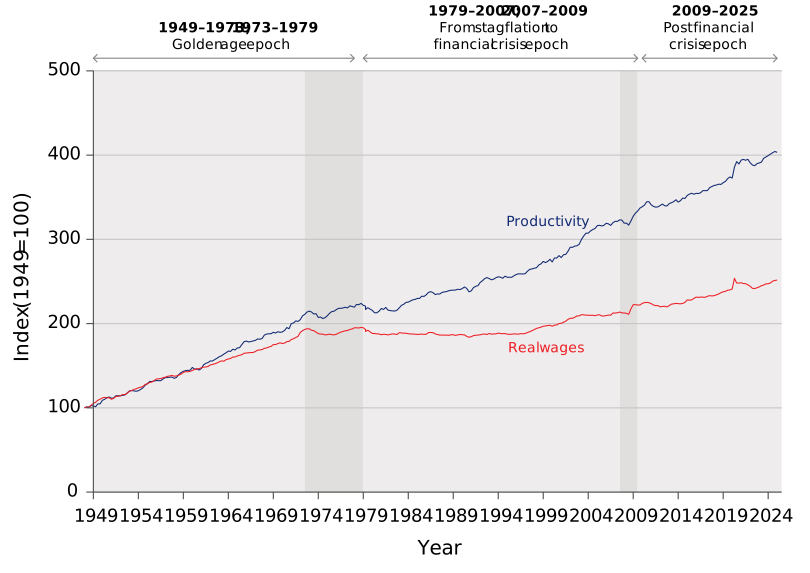
Figure 13.2
Real wages and output per production worker in manufacturing in the United States, 1949–2024.
Note: “Production workers” exclude supervisory employees such as project supervisors and managers.
U.S. Bureau of Labor Statistics. See also the Economic Policy Institute, The Productivity–Pay Gap.
Everyday Economics 13.3
Is your family a Toyota family, a Honda family, or a Ford family? Or does it prefer a different company’s cars? Economists have analyzed how brand loyalty can transfer from one generation to the next. Using data that follow households in the same family over time and a questionnaire that asks families about auto ownership, Anderson et al. (2015) show that children whose parents have recently purchased a given brand are 39% more likely to buy a car of that same brand. How does this intergenerational transmission of brand loyalty affect Honda’s market power? Does it increase or decrease Honda’s market power? Explain.
- interdependence principle, principle of interdepence
- No definition available.
In this chapter, we take a closer look at market power. We explore:
- how buyers respond to price markups
- why some firms have more market power than others and the strategies that firms use to increase their market power
- how the shape of the demand curve and buyers’ responsiveness to price changes influence market power
- how to apply the interdependence principle to understand how a firm’s outcomes depend not only on its own decisions but also on the actions of other firms
- how market power affects the division of the gains from trade between buyers and sellers; for example, who gains the most when Apple sells its iPhone for nearly twice what it costs to produce?
Data Extension 13.1 Market power and market share
Figure E13.3 shows that Apple does have competitors. Samsung, Motorola, and Google all produce smartphones. However, for the time period shown in the figure, Motorola sold only 9% of all smartphones sold and Google sold only 3%. Samsung, a stronger player in the market, sold 23% of all smartphones in that period. Apple’s 53% market share suggests that many potential buyers prefer its iPhone over other smartphones in the market. If Apple decides to raise the price of its iPhone, some potential buyers may decide to buy from Samsung, Motorola, or Google, but Apple’s strong market share tells us that many buyers will still buy an iPhone. As a result, Apple could raise the price of its iPhone and not have to worry about losing many buyers.
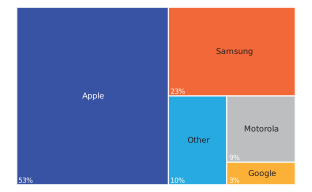
Figure E13.3 US market share of smartphones, second quarter of 2023.
Quarterly Market Share of Smartphone Vendors in the U.S. 2016–2024. Statista. Jun 25, 2025.
It is important to note that market share depends on the market you are focusing on. For example, let’s look at the US car market. Figure E13.4 shows that Tesla had only 4.4% of the US car market in August 2023. In other words, out of all the cars sold to US buyers, only 4.4% of those cars were sold by Tesla.
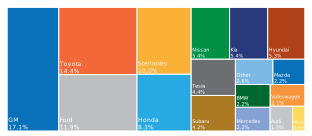
Figure E13.4 Estimated US market share held by automotive manufacturers, August 2023.
USA—New car sales in 2025 by OEM, model, vehicle type. MarkLines. 2025.
If we focus instead on the market for battery electric vehicles (BEVs), which includes only pure electric or full electric vehicles, we see a different story. While Tesla captures only 4.4% of the overall US car market, Figure E13.5 shows that it controls about 82.5% of the BEV market. In other words, out of all the battery electric vehicles that buyers purchased in 2023, Tesla sold about 83% of those vehicles. This example illustrates the importance of defining the market when determining a firm’s market power. Tesla’s market share changed dramatically when we moved from defining the market as the market for all cars to defining the market as the market for BEVs.
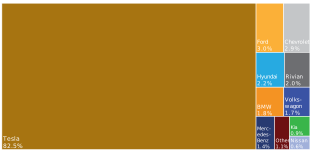
Figure E13.5 Estimated US market share held by BEV Manufacturers, 2023.
Battery Electric Vehicles, Worldwide. Statista. January 2025.
Although market share is a proxy for market power, market share alone doesn’t guarantee market power. Apple and Tesla have a high market share because potential buyers consider their products to be quite different from the products produced by their competitors. Both companies also enjoy a high market share because it is challenging for potential entrepreneurs to enter these markets. Imagine you are trying to enter the smartphone market or the BEV market. Market entry requires significant amounts of capital to produce unique products at large enough quantities that could compete with Apple or Tesla. In addition, buyers are very loyal to Apple and Tesla, making it harder for you to convince them that they should purchase your product instead. If potential entrepreneurs find it challenging to enter the smartphone or BEV market, then Apple and Tesla will continue to have fewer competitors, and having only a few competitors allows for the possibility of a larger market share or more market power. However, market share is not static. It can change over time. For example, Tesla’s share of the market fell to below 40 percent in August 2025 as competition in the EV market increased, Tesla shifted its focus to robotaxis, and its brand declined.
Exercise 13.1 How does a company use its market power to set prices?
- monopsony
- A firm has labour market power if it can reduce the wage it needs to pay its workers by lowering the number of workers that it employs. It is sometimes called monopsony power because it applies, in particular, to a firm that is the only employer in a particular labour market.
- Investigate a company in a market where only a few competitors exist (for example, telecommunications, energy, and so on). How does this company use its market power to set prices? Discuss whether its market power has led to any negative consequences for consumers or workers both at the firm and across the US.
- Tesla dominates the US battery electric vehicle (BEV) market, allowing it to set prices above marginal cost. It is also a major employer of battery technicians and production line workers in regions such as Fremont, California, where Tesla operates a major manufacturing plant. This gives Tesla both market power in the BEV product market and monopsony power in the labor market for BEV-related jobs.
Tesla has also used non-compete agreements for certain positions, which limit workers’ mobility and bargaining power.- Explain how Tesla’s dominance in both the BEV product market and the BEV labor market allows it to use non-compete agreements.
- Suppose the government passes legislation banning non-compete agreements. What impact might this have on workers’ mobility and bargaining power?
Question 13.1
Which of the following are characteristics of a firm with market power? Choose all that apply.
- Firms with market power can charge higher prices because their products are differentiated, allowing them to mark up their prices above marginal costs.
- Firms with many substitutes face high competition and have less market power.
- Market power often arises when firms face little competition.
- Firms with market power can influence prices.

