10.3 Workers finding jobs and firms filling vacancies
Everyday Economics 10.5
As you get closer to graduation, how do you plan on finding a job? If you’ve had a job before, how did you find that job? Imagine you are an employer rather than a job seeker. What strategies other than those listed might you use to find workers?
Employers use many strategies to recruit new workers, including placing ads on employment websites such as Indeed or LinkedIn, and asking current employees to recommend people they know. Similarly, workers have many strategies to seek out jobs, including employment websites and asking people they know about possible job openings.
The variety of strategies both employers and workers use reflects the desire of both sides of the labor market to find and make a good match. The desire for a good match is one reason the labor market differs from most other markets.

Now Hiring sign at the storefront of a local business in Salem, Oregon.
Matching market
LinkedIn, a website used primarily for hiring and job search purposes, features an article titled “How a Job Interview Is Like a First Date”. Similarly, the New York Times published an article in 2024 titled, “What You Can Learn About Job-Hunting From Dating Apps. Really”. What makes dates and job interviews similar? How is looking for a spouse or long-term partner like looking for a job or a worker?
In this article from MIT News, the sociologist Ofer Sharone discusses institutional differences in the job search and matching process between the United States and Israel and how differences affect the experience of searching for a job. This article illustrates how the rules of the game can affect the matching process.
- matching market
- A market for interactions in which participants in the market have different characteristics from others and will benefit from matching with particular participants in the market. Two examples are: (1) firms and workers in the labor market, and (2) people in what is sometimes called the marriage market.
Finding a spouse or long-term partner—often called the “marriage market”—and the labor market are both matching markets. In a matching market, both sides of the market care about whom they are interacting with: one partner cares about their match with the other, and vice versa. In the labor market, an employer cares about their match with the worker, and the worker cares about their match with a suitable employer.
Matching markets differ from most other markets, where neither the buyer nor the seller particularly cares about who is on the other side of the transaction. Imagine, for example, that you want to buy a gallon of milk. How will you decide where to buy it? You can either search online for the best price or visit a nearby store that sells milk at an acceptable price. In either case, your main concerns are likely the price and convenience. But you may not care much, if at all, about the person or firm that you are buying it from. So long as you get the gallon of milk at the price the seller advertises, you’ll be satisfied. Similarly, the person or firm who sells you the milk will not care who you are or why you want to buy it.
In this video, the economist Anna Vitali discusses her research into labor markets in low-income economies where job seekers and employers looking for workers have more limited information about each other. Based on an experiment that she and her colleagues ran in Uganda, Vitali explains how they discovered that providing more information does not necessarily result in better matches for workers. Those workers who were able to get more information learned that, due to the situation in that labor market, their chance of getting a job they wanted was worse than they realized. This discouraged these workers and, even five years later, their labor market outcomes were worse than the outcomes of similar workers.

A woman makes a match on a dating app.
Just as a person does not search for a spouse or long-term partner as if they were shopping for a gallon of milk, firms usually do not look for just any available worker, and workers typically do not look for just any available job. Instead, firms and workers care about the specific characteristics of the other, just as people care deeply about the unique qualities of those they partner with or marry.
Everyday Economics 10.6
What similarities exist between the labor market and college admissions? What are the differences? Are college admissions more similar to the marriage market or to the labor market?
- bargaining power
- The extent of a person or firm’s advantage in securing a larger share of the economic rents made possible by an interaction.
An important difference between the labor market and the marriage market is that the relationship between workers and employers in the labor market involves strategic asymmetry. In the marriage market, either side can “make the first move,” and neither side, on average, has more power or authority than the other or is able to set the rules of exchange. In the labor market, the employer makes the first move, sets the terms of the possible relationship, and has final say over whether a worker gets hired.
Everyday Economics 10.7
In rare cases, workers can have more bargaining power than employers. These are cases where a worker is so unique and sought-after by employers that they can largely dictate the terms of their employment. Can you think of some examples of this situation? What do your examples have in common?
In other words, employers hire workers, but workers cannot hire employers. The institutions of the labor market give the employer substantial bargaining power not typically present in the marriage market.
The extent to which employers and workers care about the quality of the match also varies. A worker seeking extra income for a few months may not devote much time to finding a perfect fit. But employers hiring for a position that requires highly specialized or rare skills may spend substantial time and effort selecting a suitable worker.
Benefits of long-term relationships
Like participants in other matching markets, participants in the labor market tend to benefit from long-term relationships. Recall from Figure 10.4 that most workers have been at their current job for years. There are several key reasons why employers and workers benefit from long-term relationships in the labor market.
First, workers and firms are all different. Workers, even those who do the same or similar work, differ in their abilities, preferences, and personalities. Similarly, employers differ in location, expected hours, culture, working conditions, wages, and nonwage benefits. Both sides do the best they can to find a good match, and once they do, they want to hold onto it and develop it further, which leads to the formation of long-term employment relationships.

This headline from the satirical newspaper The Onion humorously highlights the tendency for workers to befriend coworkers.
Everyday Economics 10.8
Think of a job you’ve had or currently have. What types of skills did you develop that were useful only at that job? What knowledge did you gain that was unique to that job? What social connections did you make that were useful only for that job?
Return to Figure 4.9 to see how Ford’s production of the M20-GBK truck demonstrated economies of scale from learning by doing as a consequence of the workers learning how to produce the truck more efficiently as they produced more of them.
- firm-specific assets
- Any knowledge, skills, or networks that are only valuable to a person while that person remains employed in a particular firm.
Second, both sides tend to benefit from forming long-term relationships because of firm-specific assets, which are the skills, knowledge, and relationships a worker develops that are valuable only while the worker stays at a particular firm. Though a worker could explain some of the skills and knowledge to another person, much of this knowledge becomes second nature, tacit, or instinctive. Learning such tacit knowledge is like learning to ride a bike, in that you can learn it only by doing it. Many firm-specific assets exist because workers learn by doing, which reduces a firm’s costs. Firm-specific assets are lost or diminish in value when a worker moves to another job.
- principle of trade-offs and opportunity cost
- The gains you make by choosing some action typically come at the cost of gains that would have been possible had you acted differently.
The benefits of forming long-term relationships in the labor market mean that workers and firms both incur a large cost in ending the relationship. Both workers and employers are subject to the principle of trade-offs and opportunity costs. An employer who wants to replace a worker with a new hire may face a trade-off between the loss of a mediocre worker with many firm-specific assets and the hiring of an excellent worker with no firm-specific assets. When a worker quits or is fired, the firm also incurs the costs of hiring and training a new worker and the cost of a period of lower productivity as the new worker learns the job. Employers, therefore, care about retaining workers, and they work to manage employee turnover, because they benefit from higher-productivity workers and don’t want to pay the cost of replacing them.
Everyday Economics 10.9
According to this report from the economist Heather Boushey and the sociologist Sarah Jane Glynn, “[B]usinesses spend about one-fifth of an employee’s annual salary to replace that worker.” This cost is even higher, they find, for jobs that are complex or require specialized training. Why do you think that is the case? What kinds of jobs would you like to have after you graduate from college? Do you think those jobs will have more firm-specific assets or fewer firm-specific assets? Why?
Workers also incur costs when they quit or lose their jobs. Just as the costs of breaking up a romantic relationship tend to be higher as a relationship goes on, the cost of ending an employment relationship tends to be higher as time goes on. However, the cost of losing a job is almost always more of a burden for the worker than the cost of finding and training a new worker is for the employer. The cost asymmetry is another important source of employer bargaining power in the labor market.
Everyday Economics 10.10
What other costs of job loss do you think you might experience if you lose a job? We gave some examples in the text, but try to come up with your own. See if you can find studies that support your ideas.
In labor and marriage markets, some people seek short-term, casual relationships, where both sides are less discerning about who is on the other side. But in modern labor markets, long-term relationships are the norm.
Employment flows: Match creation and destruction
Finding a match in the labor market can take a lot of time. Workers need time to search for jobs, apply, and go to interviews. Firms need time to make job seekers aware of an open position, sort through applications, call applicants, interview them, and make final hiring decisions. And with firms continuously being created, expanding, contracting, and dying off, jobs are constantly being created and destroyed.
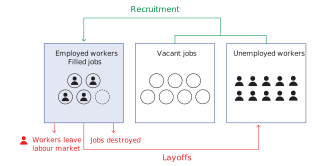
The patterns of seeking jobs and hiring workers create considerable churn in the labor market. Figure 10.5 illustrates the flows of the labor market. If you work through the steps of Figure 10.5, you will follow the path of Avery, the figure in red, through different stages of the labor market.
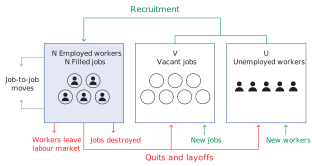
Figure 10.5 Labor market flows: workers and jobs. The constant flow of workers and the creation and elimination of jobs result in much churn in the labor market. Avery, the figure in red, is an unemployed worker upon first entering the labor market.
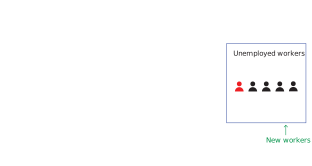
Avery enters the labor market
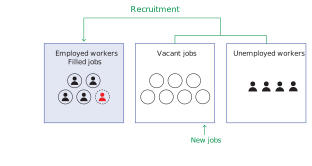
Avery gets a job
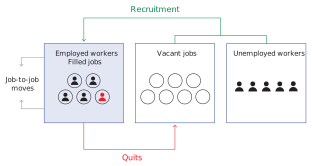
Avery gets promoted
Avery retires; others are laid off
The flows of the labor market
- unemployed worker
- A worker who is not currently employed but is able to work and is currently looking for a job.
Everyday Economics 10.11
Have you tried to find a job, or do you know a friend or family member who has been unemployed? How long did it take you, or did it take them, to find a job? Did finding a job feel like a full-time job? Why? Talk to people about their experiences of job-seeking and see what they say.
When Avery graduates from high school, they go from being inactive in the labor market to being an unemployed worker, meaning they do not have a job but are actively looking for one. After a period of searching for a job, Avery makes a match with a local manufacturing firm and is hired. After seven years, Avery successfully applies for promotion to manager. When they are promoted, they leave their current job to start the new one. In leaving their old job, Avery creates a newly vacant job, which Avery (as a manager) must now find someone to fill. Throughout their career, Avery moves between jobs and/or firms. In their mid-sixties, the firm Avery works for goes bankrupt, and Avery decides to retire and leave the labor market, meaning that they lose their job but do not add to the ranks of unemployed workers. The other workers at that final firm mostly became unemployed and now must find new jobs. Because the firm failed, their old jobs are not vacant, but instead destroyed. Across the economy, firms are being born and are dying, which means some people find a match in a newly created firm and others lose their jobs because their firm shrinks or shuts down entirely.
Everyday Economics 10.12
Have you ever quit a job? If so, why did you quit? Have you ever been terminated from a job? What reasons do you think your employer had for terminating you? Talk to others about their experiences of quitting and being fired. What aspects are similar or different across these experiences?
Avery’s story is one of many possible stories in the labor market. Avery was never fired, unlike other workers who might have been. People have many reasons to quit their jobs and/or move to a different job. With any match made or broken, workers and firms try to do the best they can. Workers do the best they can to find a job suited to their skills, needs, and preferences, and firms do the best they can to find workers who are well suited to the vacant jobs they have open. The principle of interdependence is at play: Firms cannot operate without workers, and workers need firms to hire them. However, workers need a job more than employers need a specific worker. That is one reason why the number of unemployed workers is often greater than the number of vacant jobs.
Though Avery left the labor market to retire, people can permanently or temporarily leave the labor market for other reasons, such as pursuing an education, raising a family, experiencing a disability, or giving up after an unsuccessful job search.
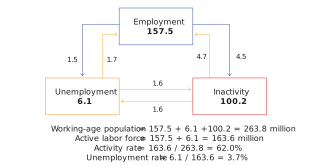
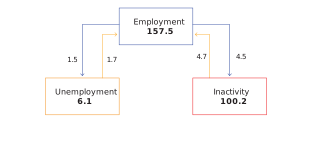
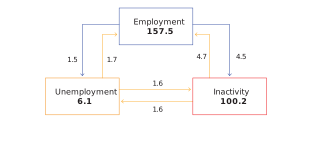
Figure 10.6 Labor market status in the United States, January 2024. Numbers are in millions of people.
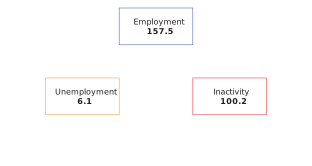
Numbers of employed, unemployed, and inactive in the labor market
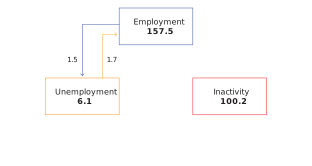
Workers moving between employed and unemployed
Workers moving between employed and inactive in the labor market
Workers moving between unemployed and inactive in the labor market
Labor market measurements
Figure 10.6 shows the employment situation of workers in the United States during the month of January 2024. If you go through the steps of the figure, you will see how many people moved from one status to another over that month.
- labor force
- The number of people in the working-age population who are, or wish to be, working outside the household. They are either employed (including self-employed) or unemployed.
- population of working age
- A statistical convention, which in many countries is all people aged between 15 and 64 years.
- labor force participation rate
- The ratio of the number of people in the labor force to the population of working age.
At the end of the month, 157.5 million people were employed, and 6.1 million were unemployed. The labor force, which is the group of people who are either employed or unemployed, was therefore 163.6 million people (157.5 million + 6.1 million = 163.6 million). There were also 100.2 million people in the population of working age who were neither employed nor unemployed, but inactive in the labor force. These could be students, retirees, or people who have given up looking for work. Of the working-age population, then, 62% were in the labor force. The percentage of the population of working age in the labor force is called the labor force participation rate.
- gross domestic product (GDP)
- A measure of the total output of goods and services produced in an economy in a given period. GDP combines in a single number all the output (or production) carried out by the firms, nonprofit institutions, and government bodies within a country. Household production is part of GDP if it is sold.
- unemployment rate
- The unemployment rate is the fraction of the labor force that is seeking work but is not currently employed.
- recession
- The US National Bureau of Economic Research defines a recession as a period when output is declining. It is over once the economy begins to grow again.
The most commonly reported metric of the labor market, the unemployment rate, is the percentage of the labor force that is seeking work but is unemployed. This figure stood at 3.7% at the end of January 2024. The bottom panel of Figure 10.7 shows the US unemployment rate for each month between 2001 and 2024. The top panel shows the US labor force participation rate for the same time period. The shaded areas indicate periods when the economy was in a recession, which is a period when output, measured as GDP, is declining.
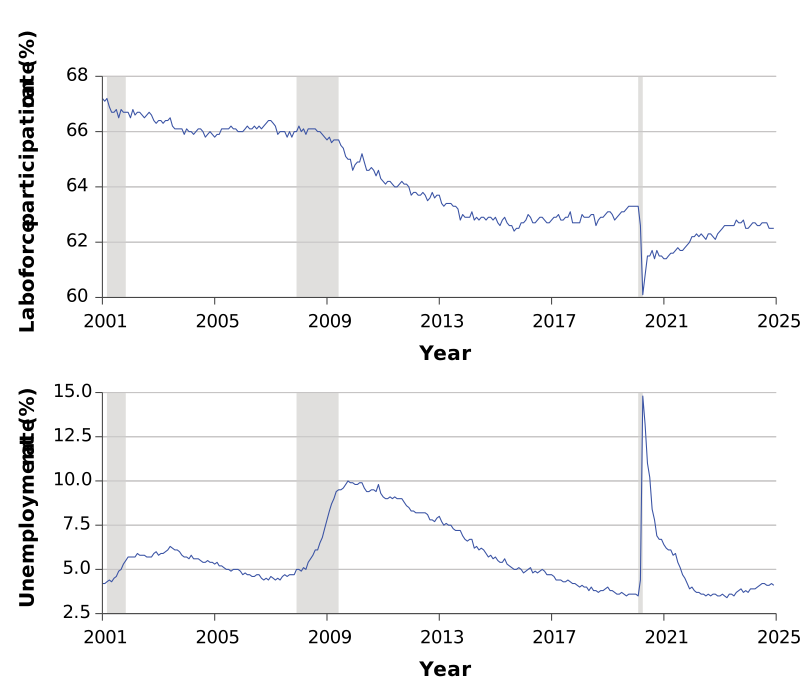
Figure 10.7 The US labor force participation rate (upper panel) and unemployment rate (lower panel) from January 2001 to December 2024.
Federal Reserve Bank of St. Louis, based on the Current Population Survey.
Notice how the labor force participation rate slowly declined for nearly a decade, starting in 2008, before leveling off and suddenly dropping at the beginning of the COVID-19 pandemic. At the end of 2024, it had still not returned to where it was before the pandemic and is considerably lower than it was in the early 2000s.
Whereas the labor force participation rate started declining in 2008, the unemployment rate doubled and then slowly declined until the COVID-19 pandemic, when it rapidly increased to its highest level since the Great Depression of the 1930s. It then declined almost as rapidly.
The data in Figure 10.7 shows the vast and rapid changes in the labor market caused by the COVID-19 pandemic. Many people lost their jobs suddenly and/or left the labor market entirely.
Data Extension 10.3 Disaggregating the data
In a 2020 interview with National Public Radio’s “Marketplace,” the economist Rhonda Sharpe described why such data is important to both economists and policymakers. “The challenge when we don’t have data that has been disaggregated, is it’s harder to craft effective policies,” she said. “You end up proposing policies that are sort of one-size-fits-all, and that might not [fit] the population that is most vulnerable.”
The extent of racial inequality in outcomes is understated in labor market data because of the disproportionately large number of Black people who are in prison. As detailed in this article, these individuals are not counted in labor market surveys, meaning the extent of Black joblessness is understated in the statistics.
Figure E10.1 shows the labor force participation rate disaggregated by racial groups from 2001 through 2024. Although all four groups see declines similar to those in Figure 10.7, there are also some persistent differences between them over this period. If you are an economist trying to understand racial differences in the labor market, or a policymaker trying to address racial inequality, disaggregated data helps you to understand the dynamics across groups and the policies you should consider prioritizing.
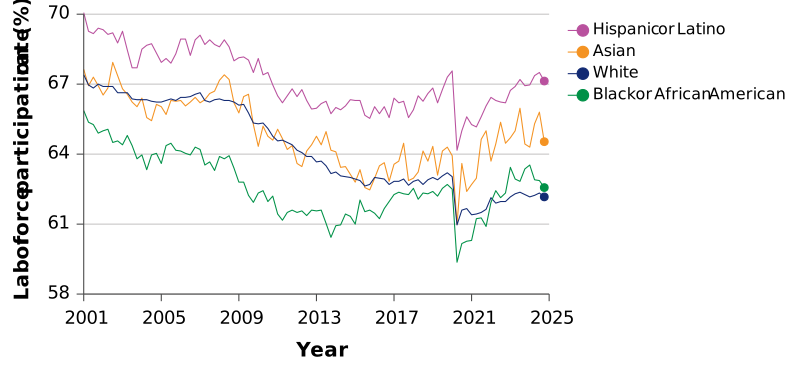
Figure E10.1 Labor force participation rates disaggregated by racial groups, 2001–2024.
US Bureau of Labor Statistics, Labor Force Participation Rate - Black or African American, retrieved from FRED, Federal Reserve Bank of St. Louis; Labor Force Participation Rate - Hispanic or Latino, retrieved from FRED; Labor Force Participation Rate – White, retrieved from FRED; Labor Force Participation Rate – Asian, retrieved from FRED.
One noteworthy change is that the labor force participation rate for white people and Black people has converged in recent years, with the rate for Black people overtaking that for white people for the first time in about 50 years. You can also see that the white labor force participation rate tends to be smoother than the others, suggesting that white people have overall more stable employment.
Figure E10.2 shows the labor force participation rate disaggregated by gender. Figure E10.2 covers a longer time span than Figures 10.7 and E10.1, going all the way back to 1948. The figure shows one of the most dramatic changes in the labor market of the 1900s: the huge number of women entering the formal labor force during the mid-twentieth century.
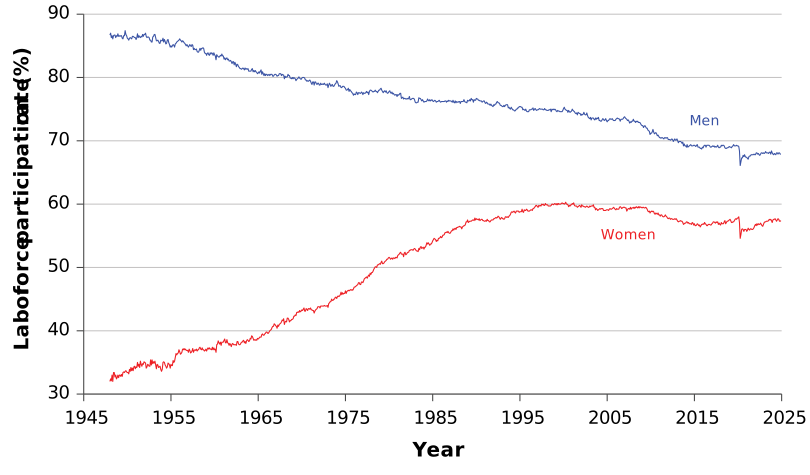
Figure E10.2 Labor force participation rate for men and women, 1948–2024.
US Bureau of Labor Statistics, Labor Force Participation Rate - Men [LNS11300001], retrieved from FRED, Federal Reserve Bank of St. Louis; Labor Force Participation Rate – Women [LNS11300002], retrieved from FRED.
A reminder about percentage points versus percentage differences: Remember that percentage points and percentages are different. In this instance, men’s LFPR is 10.5 percentage points above women’s LFPR. If we wanted to measure the percentage difference, we would compare them as follows: \((LFPR_{men} – LFPR_{women})/LFPR_{women} \\ = (67.9 – 57.4)/57.4 = 18.292\), which is approximately 18.3%. Therefore, with the 10.5 percentage point difference, men’s LFPR is 18.3% higher than women’s LFPR.
Since around the year 2000, women’s labor force participation has leveled off. Men’s labor force participation has slowly declined since 2000, and in December 2024 it remained almost 11 percentage points above that of women (67.9% compared to 57.4%).
Everyday Economics 10.13
Why do you think women’s labor force participation rate increased so much between 1948 and 2000? Why do you think women’s labor force participation rate remains below men’s? Which factors do you think might explain the difference? And what might explain the flatness of the line graph for each group in recent years?
The dramatic change in women’s labor force participation rate over the second half of the 1900s also happened in many other countries, especially high-income countries, around the world.
Question E10.1
Which of the following statements are supported by Figure E10.2 on gender and labor force participation? Choose all that apply.
- The figure shows a steep rise in women’s participation during that period.
- Men’s LFPR has remained higher, with an almost 11 percentage point gap as of 2024.
- Women’s LFPR is still below men’s.
- Women’s LFPR has flattened since around the year 2000.
Exercise E10.1 FRED data: Who’s in the labor force?
Federal Reserve Economic Data (FRED) is a comprehensive, up-to-date data source maintained by the Federal Reserve Bank of St. Louis, which is part of the US central banking system. FRED contains the main aggregate economic statistics for almost all high-income countries going back to the 1960s. FRED also allows you to create your own graphs and export data to a spreadsheet.
To learn how to use FRED to find disaggregated data, follow these steps:
- Visit the FRED website.
- Type “Labor Force Participation Rate Bachelor’s Degree” in the search bar. Select the data series labeled “Labor Force Participation Rate–Bachelor’s Degree and Higher, 25 Yrs. & over.”
- Click the “Edit graph” button, above the top-right corner of the graph.
- Click the “Add line” button. Search for the data series “Labor Force Participation Rate–High School Graduates, No College, 25 Yrs. & over.” Click on it, then click “Add data series.”
- Repeat Step 4. This time search for and add the data series “Labor Force Participation Rate–Less Than a High School Diploma, 25 Yrs. & over.”
You can also watch this short tutorial to understand how FRED works.
Use the graph you created to answer these questions:
- What time span is covered by the years in the graph?
- What is the most recent labor force participation rate for each of the three groups?
- How do the labor force participation rates for each group differ? Have those differences remained the same over time?
- What might explain any differences you see in the data?
Question 10.4
Which of these count as a firm-specific asset? Choose all that apply.
- Knowing the city layout is useful at any delivery job, so it is not firm-specific.
- Learning to anticipate the preferences of specific lawyers is knowledge that is mainly valuable within that firm.
- Having skills in using widely used software is not firm-specific.
- Mastering proprietary software unique to the bank is a firm-specific asset, because it is not valuable elsewhere.
Question 10.5
Imagine that a country has 9 million people employed, 1 million people unemployed, and 5 million people who are inactive in the labor force. What is this country’s unemployment rate?
- The unemployment rate is defined as the percentage of the labor force which is unemployed, not the percentage of the population of working age that is unemployed.
- The unemployment rate is defined as the percentage of the labor force which is unemployed, not the percentage of the population of working age which do not have a job.
- Labor force = employed + unemployed
= 9 million + 1 million
= 10 million
unemployment rate = (unemployed/labor force) × 100
= (1 million/10 million) × 100
= 10% - The unemployment rate is defined as the percentage of the labor force which is unemployed, not the ratio of unemployed to employed individuals.
Exercise 10.4 Why do good workers get fired?
Employers and managers sometimes fire highly competent workers. In answering the questions below, think about examples from your own life or the lives of people you know.
- Besides layoffs or technology, what are some possible reasons employers or managers might fire highly competent workers?
- Are there circumstances where firing highly competent workers could be in the interest of the firm? If so, what might those circumstances be?
- What do your answers to the questions above suggest about a possible conflict of interest between managers and employers? How might employers manage that conflict?
Exercise 10.5 Choosing the right candidate: Expertise vs experience
A company is hiring for a specialized data analyst role that requires advanced statistical expertise. The hiring manager receives two applications:
- Candidate A has a degree in statistics and 5 years of experience in a similar role.
- Candidate B has no formal training in statistics but has worked in a related field for 10 years.
Which factors might the employer consider when deciding between these two candidates? How does this example illustrate some of the challenges of matching workers and firms in the labor market?

