Chapter 4 Innovation, incentives, and technology
Farm equipment at harvest time near Savanna, Illinois, 2019.
4.1 Introduction: What was farmwork like 200 years ago?
Without the dramatic economic and technological changes described in Chapter 3, you would likely be working on a farm, using mainly hand tools, possibly with the help of a few oxen or mules. By today’s standards, such a life was extremely grueling.
Consider what work on a Midwestern farm would have been like around 200 years ago: The father and male children were responsible for feeding the animals, collecting eggs, milking the cows, turning grass into hay, and cleaning up animal waste. During spring, summer, and fall, exposed to weather and insects, they had to plant, cultivate, and harvest the crops. During winter, they prepared the harvest to sell at a market or keep for consumption at home. They also repaired fences, tools, and harnesses for their animals.
The lives of mothers and daughters were no easier: Women did all the cooking, on wood stoves with iron pots. They grew small vegetable gardens, sewed and mended clothes, and did the household cleaning. Because there was no sewage system, women emptied and cleaned the chamber pots. Women also did the majority of work raising the children. To survive, each member of a family depended on the others.
Everyday Economics 4.1
The economist Robert Gordon describes the burdensome process of doing the weekly laundry as follows: “In most of rural America until the 1940s, washday started with carrying in enough water to fill a large pot and heat it on a coal or wood stove, then rubbing clothes on a washboard, turning a hand wringer, and then hanging clothes on a clothesline.”1 How much time do you generally spend on laundry? How is what you do different from what women did 200 years ago? What can you do with your time now instead of washing clothes?
Two hundred years later, a modern American farm is a radically different place. There are far fewer people and far more machines. Instead of planting and harvesting using hand tools and animals, someone sits in an air-conditioned machine guided by GPS. No one has to spend an entire day cleaning clothes. Running a successful farm remains challenging work, but this work is done with far fewer people under much better and safer conditions.
Figure 4.1 shows the extent of this change in harvesting technology by comparing the number of tractors on American farms to the number of horses and mules over the period 1910–1960. In 1910, there were zero tractors and around 25 million horses and mules on American farms. By 1960, only three million horses and mules were left, but nearly five million tractors. On average, then, one tractor replaced about five horses or mules.
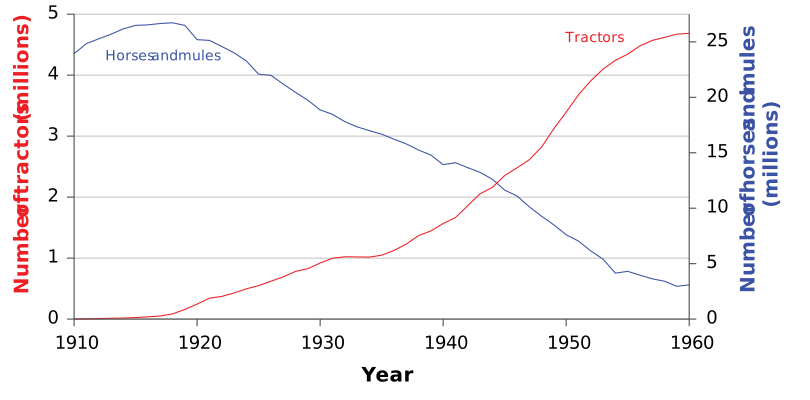
Figure 4.1 Horses, mules, and tractors on American farms, 1910–1960.
Manuelli, Rodolfo E., and Ananth Seshadri. 2014. “Frictionless Technology Diffusion: The Case of Tractors.” American Economic Review 104(4): pp. 1368–1391.
How did we get from a world of drudgery to the world we live in now? Why did farmers, and firms in general, start to adopt new technologies more rapidly than before?
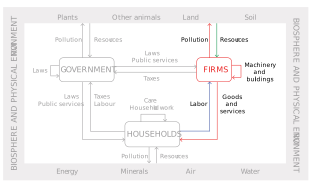
Figure 4.2 Our model of the whole economy, highlighting the interactions involved in how firms choose a technology.
Figure 4.2 is our model of the whole economy with the parts of the economy we examine in this chapter highlighted. Specifically, we focus on how firms decide the mix and type of machines and labor to use. To do so, we build a model to help explain why firms adopt their chosen technologies. This is important for understanding the causes of technological progress in a capitalist economy.
Question 4.1
Which of the following statements is true of work on a typical Midwestern farm 200 years ago? Choose the correct option(s).
- Men and women had very different roles; men worked outdoors (planting, harvesting), while women focused on domestic work (cooking, cleaning, child care).
- Laundry was time-consuming and physically demanding.
- Most tasks were done by hand or with the help of animals; machines such as tractors came much later.
- Farm life was much more physically demanding and tedious than it is today.
-
Gordon, Robert. 2017. The Rise and Fall of American Growth: The US Standard of Living Since the Civil War. Princeton University Press. ↩

