3.4 Capitalist institutions and living standards
Capitalism emerged at the same time as, or just before, the continuous technological revolution, and technological advances coincided with the first upward kinks in the hockey sticks. How could capitalism lead to a world in which each generation has access to more goods, food, and machines than the previous generation?
Competition and cooperation
Capitalism combines centralization with decentralization. In contrast to a market, a firm is a centralized way of organizing production. It concentrates power in the hands of owners and managers, who are then able to secure the cooperation of potentially large numbers of employees in the production process. So, when the owner of a firm interacts with an employee, the owner is “the boss”—for example, the owners of Bunker Hill company and its workers in Chapter 1. But when the same owner interacts with a potential customer, the owner is simply another person trying to make a sale, in competition with other firms.
This combination of competition among firms, and concentration of power and cooperation within them, accounts for capitalism’s success as an economic system. Capitalism works well when the powers of owners and of other individuals are limited by the competition they face when buying and selling in markets.
Everyday Economics 3.3
Producers don’t always sell directly to consumers. Supermarkets, for example, play a role as intermediaries between producers and consumers. Can you think of a good or service you bought recently directly from the producer? Where did you buy it? Do you think the goods or services would cost the same, cost more, or cost less if you bought them in a supermarket?
- capital goods, capital
- Capital goods (sometimes shortened to “capital”) are the durable and costly non-labor inputs used in production, such as machinery, equipment, and buildings. Capital does not include some essential inputs (such as air, water, and knowledge) that are used in production at zero cost to the user.
- technological innovation
- A change in technology that reduces the amount of resources (labor, machines, land, energy, time) required to produce a given amount of the output. Also known as technological progress.
- specialization
- Specialization exists when workers, organizations, or countries concentrate on producing a limited set of goods or performing specific tasks. This often happens through the division of labor—a system where production is broken into smaller tasks and different people or groups take on different parts of production.
The private ownership of increasing amounts of capital goods together with the competition among firms in the market facilitated two transformations—technological innovation and specialization—that enhanced the productivity of individual workers. How so?
Technological innovation
Firms competing with each other in markets have strong incentives to adopt and develop new and more productive technologies. Why? New technologies can reduce the cost of production (by allowing the same number of workers to produce more), increase the quality of products, or allow firms to create entirely new ones. A firm that innovates can earn higher profits—at least until its rivals catch up by innovating themselves, which means the pressure to innovate never stops. The pursuit of profit—and the fear of losing it to competitors—is therefore the engine that drives innovation under capitalism.
Specialization
Firms with large numbers of workers—and the expansion of markets linking the entire world in a process of exchange—allowed specialization in tasks and products at levels never seen before. Specialization enables individuals, firms, and even countries to make the most of their talents and resources. It also fosters learning by doing: Workers can get better at what they do by developing new skills and better ways of organizing the production process.
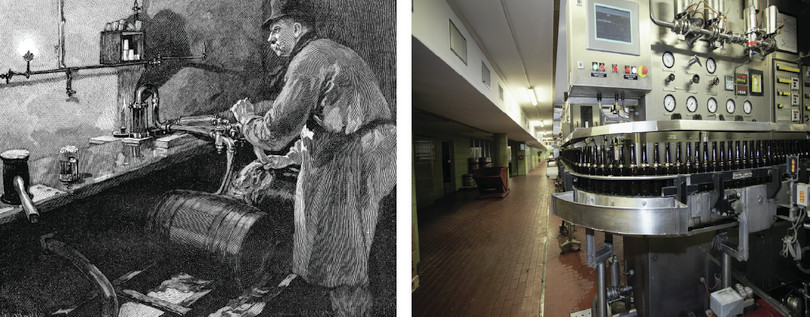
Filling beer barrels in an American brewery, 1885 (left); beer bottling machine in a modern brewery (right).
- causal, causality, causation
- We say that a relationship between two variables is causal if we can establish that a change in one variable produces a change in the other. While a correlation is simply an assessment that two variables have moved together, causation implies a mechanism accounting for the association.
In Chapter 4, we will learn more about how technological innovation and specialization increase workers’ productivity. For now, we have an explanation or causal mechanism for why the institutions associated with capitalism have the potential to make people better off: competition erodes the profits of any firm that falls behind, so firms are under continuous pressure to specialize and introduce new technologies, thereby increasing productivity and GDP growth.
How economists test their theories
We have a causal mechanism—a theory—that capitalism can lead to economic growth and higher standards of living through technological innovation and specialization. But can we conclude that capitalist institutions necessarily caused the upward kink in the hockey stick? For example, the emergence of a free-thinking cultural environment known as the Enlightenment in the seventeenth century also predated or coincided with the upturn, and the free-thinking culture may have stimulated innovation. So what caused economic growth: institutions, culture, both, or some other set of causes?
- causal, causality, causation
- We say that a relationship between two variables is causal if we can establish that a change in one variable produces a change in the other. While a correlation is simply an assessment that two variables have moved together, causation implies a mechanism accounting for the association.
We want to make causal statements in economics—both to explain why things happen and to devise ways to make the economy work better. For example, an economist might claim: “If the central bank lowers the interest rate, more people will buy homes and cars”, which means that a lower interest rate causes people to buy homes and cars. (We will see in later chapters why.)
However, an economy is composed of the interactions of millions of people. We cannot measure and understand them all, and we should dig deeper when anyone claims that something complex (capitalism) “causes” something else (such as increased living standards, technological improvement, or environmental challenges).
In science, we support the statement that \(X\) causes \(Y\) by performing experiments in which we change \(X\) and measure any associated change in \(Y\), keeping all the other variables the same as before. We design the experiments so that we can be confident that the change in \(Y\) was caused by the change in \(X\) (rather than vice versa, or by some other variable). For most important questions in economics, it is not possible to conduct conventional scientific experiments. How, then, can economists study causation?
Economists also use data in other ways to test their theories. In this video, the economist Leonard Wantchekon explains how the institution of slavery can have an impact on living standards through its influence on mistrust, and how he and Nathan Nunn used data to test this causal mechanism of slavery on GDP per capita.
- natural experiments
- An empirical study that exploits a difference in the conditions affecting two populations (or two economies), that has occurred for external reasons: for example, differences in laws, policies, or weather. Comparing outcomes for the two populations gives us useful information about the effect of the conditions, provided that the difference in conditions was caused by a random event. But it would not help, for example, in the case of a difference in policy that occurred as a response to something else that might affect the outcome.
Natural experiments are one way in which economists can use data to test their theories. The example of a natural experiment in Data Extension 3.4 shows how our observations of the world can help us investigate causes and effects. Specifically, it explains why the division of Germany at the end of the Second World War into two separate economic systems—centrally planned in the east, capitalist in the west—can be considered a natural experiment, and what it teaches us about the importance of institutions for understanding differences in income trajectories across countries.
Question 3.5
A researcher notices that in countries where smartphone use is high, GDP per capita is also high. Based on this observation, which of the following statements are correct? Choose all that apply.
- The observation that two variables are correlated does not necessarily imply that one causes the other. Correlation does not prove causation.
- The two variables are associated or correlated.
- Other factors that predated or coincided with the increase in GDP per capita (such as infrastructure and education) may explain the association between smartphone use and GDP per capita.
- Scientific experiments or natural experiments are needed to establish causality.
Exercise 3.6 Institutions, competition, and economic outcomes
Explain why the institutions of capitalism have the potential to facilitate growth in living standards. In other words, describe the mechanisms through which private property, markets, and firms have facilitated the unprecedented growth in living standards.
Exercise 3.7 Untangling correlation and causation
In your own words, explain the difference between association (or correlation) and causation. Why is it important to distinguish between these concepts when evaluating economic outcomes?
Data Extension 3.4 Do institutions matter for growth in income?
In a conventional scientific experiment, the experimenter changes the variable thought to be a cause (\(X\)), keeping all the other variables the same as before, and observes the change in \(Y\) that is associated with the change in \(X\). In an agricultural experiment, \(X\) might be the dosage of fertilizer applied, and the things kept the same (or “held constant”) might be the amounts of water and light. \(Y\) would be the amount of the crop produced.
By contrast, in the social sciences, we can rely on natural experiments to identify causes and effects. Often an accident of history or geography, a natural experiment is a situation in which we use an external event, such as a change in institutions or a natural disaster, to compare the outcomes for those who were affected by this event and those who were not.
The division of Germany at the end of the Second World War into two separate economic systems—centrally planned in the east, capitalist in the west—provided a natural experiment. During this time, a political “Iron Curtain” (a term coined by the British Prime Minister Winston Churchill) divided the country. It separated two populations that until then had shared the same language, culture, and capitalist economy. But for half a century after the Second World War, the two halves of the country differed in the institutions governing them. This natural experiment allows us to study the effect of different institutions on the economy.
Using the language of scientific experiments, central planning under Communist Party rule in East Germany is the “treatment,” and capitalism in West Germany is the “control” that suggests how East Germany would have developed if Germany had not been divided. The control is also termed the “counterfactual” event: what would have happened if, contrary to the facts of history, East Germany had not been organized as a planned economy between 1948 and 1991.
You can read about more examples of natural experiments in the book Natural Experiments of History, written by Jared Diamond, a biologist, and James Robinson, a professor of government.
The validity of this natural experiment relies on the comparability of the two parts of Germany before the introduction of different economic systems. In 1936, before the Second World War, living standards in both parts of Germany were the same. Firms in Saxony and Thuringia were world leaders in automobile and aircraft production, chemicals, optical equipment, and precision engineering. During the war, the entire German economy was organized as a war economy. For example, wages, prices, and the allocation of labor and resources were under central control.
After the war, Communist central planning replaced the war economy in East Germany, where the Soviet Union was the occupying power. Decisions about how and what to produce did not revert to private individuals. Instead, decisions were made by government officials. The officials managing plants, offices, mines, and farms could not produce goods and services that customers would buy at a price above their cost of manufacture, as they would have done under a capitalist economy. Prewar private property, markets, and firms virtually disappeared.
Meanwhile, a capitalist economy re-emerged in West Germany as a result of decisions by the occupying powers (the United Kingdom, the United States, and France). Following currency reform in 1948, which abolished wartime price controls and introduced a new currency in West Germany, rapid growth occurred.
In 1958, the East German Communist Party stated that East Germany’s material well-being would exceed that of West Germany by 1961. The failure of this prediction was one of the reasons the Berlin Wall separating East Germany from West Germany was built in 1961: to prevent East Germans from crossing over to West Germany, where the standards of living were higher. By the time the Wall fell in 1989 and East Germany abandoned central planning, its GDP per capita was less than half that of capitalist West Germany. Figure E3.1 shows the different paths taken by these economies, along with the economies of Spain and Japan, from 1950 to 1989.
Notice in Figure E3.1 that West Germany started from a more favorable position in 1950 than East Germany. In 1936, before the war began, the two parts of Germany had virtually identical living standards; both had achieved successful industrialization. East Germany’s relative weakness in 1950 was not mainly the result of differences in capital equipment or skills. Instead, its industrial structure was more disrupted by splitting the country than was the case in West Germany.1
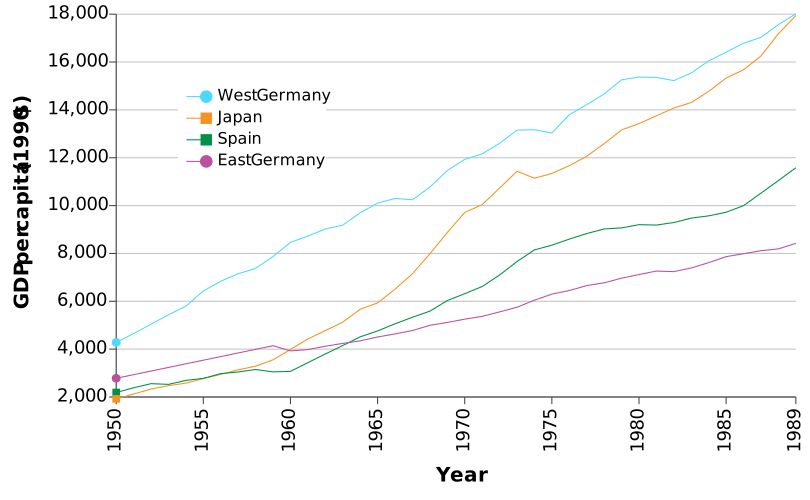
Figure E3.1 The two Germanies: planning and capitalism (1950–1989).
The Conference Board. 2015. Total Economy Database; Angus Maddison. 2001. “The World Economy: A Millennial Perspective.” Development Centre Studies. OECD.
But other capitalist economies that had lower per capita incomes than West Germany in 1950 grew much faster. By 1989, the Japanese economy, which had also suffered war damage, had—with its own combination of private property, markets, firms, and strong government coordination—caught up to West Germany. By 1989, Spain, which until 1975 was ruled by a dictatorship, had closed part of the gap. As the figure shows, Spain’s growth accelerated after market reforms were introduced in 1959.2
We cannot conclude from the German natural experiment that capitalism always promotes rapid economic growth, or that central planning is always a recipe for economic stagnation. What we can infer is more limited: during the second half of the twentieth century, the divergence of economic institutions mattered for the material living standards of the German people. For a longer-run view of comparative performance under central planning (the Soviet Union and Latin American countries), read Data Extension 3.5.
Question E3.2
Which of the following statements about the division of Germany after the Second World War are true? Choose all that apply.
- Similar prewar conditions support the natural experiment’s validity.
- The division resulted from decisions by the occupying powers, not by German policymakers.
- Different economic systems created varying incentives and institutions.
- The natural experiment suggests that divergence in institutions mattered, not that capitalism always guarantees rapid growth.
Question E3.3
Which of the following approaches can help determine whether a policy change (such as a new tax) causes changes in economic behavior? Choose all that apply.
- Historical differences may reflect long-standing factors unrelated to the new tax.
- Stock price reactions might reflect expectations rather than causation.
- If the experiment is valid, the comparison will provide strong evidence for causation by isolating treatment effects.
- Declines in business activity may be due to other factors coinciding with the tax.
Exercise E3.2 Comparing East and West Germany’s growth
Look at this GDP per capita graph that compares East Germany and West Germany.
- Find the GDP per capita values for East Germany and West Germany in 1950, 1965, and 1989.
- Calculate the differences in GDP per capita between East Germany and West Germany for each year.
- Explain how the differences between the two Germanies changed over time, and what they suggest about institutions’ effects on economic growth.
- Can we conclude from these data alone that capitalism always leads to faster growth than central planning? Why or why not?
-
Hartmut Berghoff and Uta Andrea Balbier. 2013. ‘From Centrally Planned Economy to Capitalist Avant-Garde? The Creation, Collapse, and Transformation of a Socialist Economy’. In The East German Economy, 1945–2010: Falling Behind or Catching Up? Cambridge: Cambridge University Press. ↩
-
Leandro Prados de la Escosura, Joan R. Rosés, and Isabel Sanz-Villarroya. 2011. ‘Economic Reforms and Growth in Franco’s Spain’, Journal of Iberian and Latin American Economic History, Vol. 30 No. 1, pp. 45–89. ↩

