4.3 Technically inefficient technologies
To understand how firms choose a technology, we build a simple model to show how firms can eliminate certain options before they look at costs.
Imagine you own a firm that makes cloth. To produce the cloth, you need to decide which technology to use. You ask an engineer to report on the technologies available to produce 100 meters of cloth. The inputs are labor (number of workers) and energy (tons of coal). The engineer reports back to you with the data in Table 4.2. The five letters each represent a different technology for producing 100 meters of cloth. Technology A, for example, requires one worker and six tons of coal to produce 100 meters of cloth. Technology C requires three workers and seven tons of coal to produce 100 meters of cloth.
| Technology | Number of workers | Coal required (tons) |
|---|---|---|
| A | 1 | 6 |
| B | 4 | 2 |
| C | 3 | 7 |
| D | 5 | 5 |
| E | 10 | 1 |
Table 4.2 Five technologies for producing 100 meters of cloth. The technologies are ordered from the technology that uses the fewest workers (Technology A) to the one that uses the most workers (Technology E).
Among these options, E is the most labor intensive. If we assume that more coal usage implies more reliance on machines, then A is a relatively capital-intensive technology.
Figure 4.4 represents the technologies graphically by plotting the amount of inputs required by each technology.
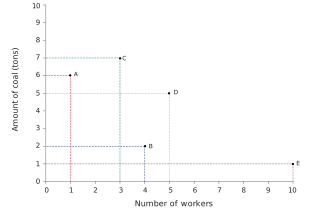
Graph of five technologies for producing 100 meters of cloth.
Figure 4.4 Graph of five technologies for producing 100 meters of cloth.
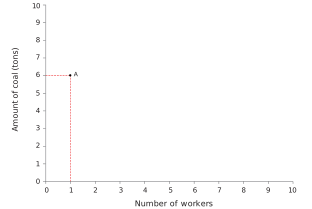
Technology A: capital-intensive
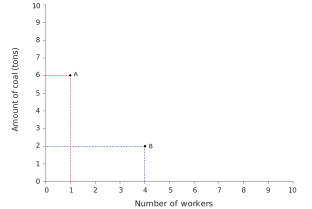
Technology B
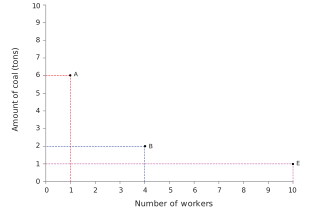
Technology E: labor-intensive
Technologies C and D
Now that you, the firm’s owner, have seen the five technology options, which option would you choose?
Doing the best you can when choosing among technologies
- the principle of doing the best you can
- Doing the best you can means that, from the set of actions available to them, people will choose the action that they believe will result in the outcome that they value the most, taking into account what they believe the other player will do in response to their choice.
- technically inefficient
- Consider two technologies: A and B. If A uses at least the same amount of one or more input(s) and more of another input to produce the same amount of output compared to B, then A is technically inefficient.
Following the principle of doing the best you can, you start by deciding whether any options can be eliminated. Compare A with C. If both technologies are available, you would never choose C, because it uses both more workers and more coal than A. Regardless of the cost of workers and the cost of coal, C will always be more expensive than A. Technology C is technically inefficient compared to A.
In Figure 4.4, any technology that is above and to the right of another available technology is technically inefficient because it requires more of one or both inputs than another technology. D is therefore technically inefficient because it requires more workers and more coal than B. Doing the best you can, you will rule out C and D. Whether A, B, or E is best depends on the cost of each input. A technology can be technically feasible, meaning it can produce the output, while still being technically inefficient if another available technology produces the same output using no more of any input and less of at least one input.
- technological innovation
- A change in technology that reduces the amount of resources (labor, machines, land, energy, time) required to produce a given amount of the output. Also known as technological progress.
We can use this example to define technological progress. Imagine all the cloth-producing firms initially used C. Then a team of engineers created A, and the whole cloth industry switched to A. Because fewer resources are needed to produce the same output, A represents technological progress.
With the choices narrowed down to A, B, and E, how will you choose among them? To do the best you can, you need information about relative prices. In the next section, we model how relative prices shape technology decisions.
Question 4.3
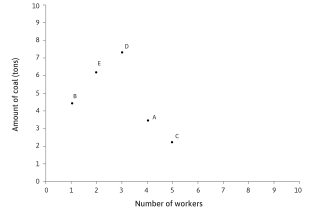
Question 4.3 Figure (I)
The figure shows five different technologies for producing 100 meters of cloth. Which of these technologies are technically inefficient and therefore should be ruled out as an option for any firm that produces cloth? Choose the correct option(s).
- A technology is technically inefficient if there is another option that uses less of both inputs (coal and workers).
- A technology is technically inefficient if there is another option that uses less of both inputs (coal and workers).
- A technology is technically inefficient if there is another option that uses less of both inputs (coal and workers).
- D and E require more of both inputs than B.
- D and E require more of both inputs than B.
Exercise 4.2 Why do firms stick with technically inefficient technologies?
Sometimes firms are slow to abandon technically inefficient technologies. What is being left out of our model that might explain why a firm would continue to use a technically inefficient technology despite the availability of better options?
Exercise 4.3 Tracing technological progress in everyday goods
Look around you right now. Pick an object or good.
- Which factors of production went into producing that good?
- What technological progress has been made over the past 100 years in the production of that object or good? If the object or good is something invented only recently, what technological progress has been made since its introduction?
Exercise 4.4 Comparing inputs: When does a technology become technically inefficient?
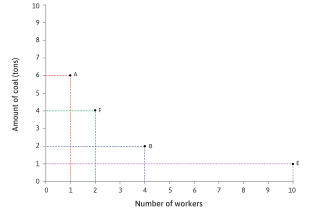
A new technology, F, has been introduced. It requires two workers and four tons of coal to produce the same output as the other technologies. Compare Technology F to the original technologies A, B, and E.
- Are any of the original technologies now technically inefficient compared to F?
- What would need to change in Technology F’s inputs for Technology A to be considered technically inefficient?

