1.8 Predicting what people will do
To predict what people will do when they do the best they can, we need to depict the interaction in an easy-to-understand way.
- game tree
- A game tree shows the players, the actions, the sequence of moves, and the payoffs resulting from each possible pathway through the game that results from the actions the players take.
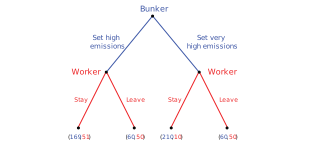
We can represent the game in a figure called a game tree. Game trees are helpful because they show us all the information we need to know about the game: the players, the actions, the sequence of moves, and the payoffs resulting from each possible pathway through the game that results from the actions the players take. Figure 1.6 is the game tree of the Bunker and the Worker interaction we just described, with some crucial pieces of information added. It is called a game tree because it has “branches” that correspond to the actions each player can take in sequence. (But it’s a bit of a strange tree because it looks like it’s growing upside down.)
In Figure 1.6, the players’ actions start at the top and move down in sequence. As the first mover, Bunker is at the top of the tree. Where there is a branch, there is a choice. The name at the branching site is the player who decides which action to take. There is only one set of payoffs at the end of each branch because there is only one way to get there. There is just a single path—that is, a sequence of moves—that leads to the end of any given branch.

To simplify the analysis, we let Bunker’s actions be just the two blue branches shown in Figure 1.6: either Set very high emissions (greater than 190) or Set high emissions (less than 190, but greater than 80). After Bunker moves, the Worker knows the level of emissions that Bunker has chosen and can then choose their action: Stay or Leave. The Worker’s actions are the red branches.
Once Bunker and the Worker have both moved, they reach the end of one or the other of the sets of branches depending on the choices they made. The ends of the branches show the final outcomes of the game that correspond to the sequence of actions each player takes. At each outcome, the players’ payoffs are listed in the order of play (first player, second player). We have also color-coded them to correspond to the colors of the players’ actions so that they are labeled (Bunker’s payoff, the Worker’s payoff). Work through the steps in Figure 1.6 to see the actions and payoffs in the game tree.
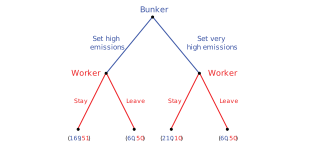
Game tree: actions and payoffs when Bunker moves first.
Figure 1.6 Game tree: actions and payoffs when Bunker moves first. Bunker’s actions and payoffs are in blue, the Worker’s actions and payoffs are in red.
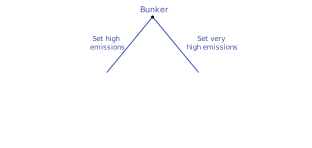
Bunker’s possible actions
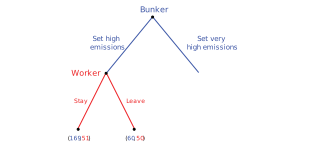
Worker’s response if Bunker sets high emissions
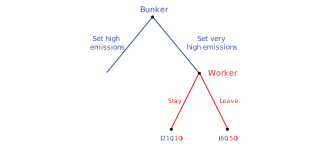
Worker’s response if Bunker sets very high emissions
The game tree
Using the game tree: the Worker’s best response to Bunker’s action. Remember that the Worker’s payoffs are listed second in red.
- If Bunker has played Set high emissions (the left blue branch), then the Worker has two options: Leave for a payoff of 50 or Stay for a payoff of 51. The Worker will choose the best response, which is the strategy that gets the higher payoff. When Bunker plays Set high emissions, the Worker does the best they can by playing Stay because 51 is greater than 50. Stay is the Worker’s best response to Bunker’s choice of Set high emissions.
- If Bunker has played Set very high emissions (the right blue branch), the Worker has the same two options but with different payoffs: Leave for a payoff of 50 or Stay for a payoff of 10. Applying the same principle, when Bunker plays Set very high emissions, the Worker does the best they can by playing Leave because 50 is greater than 10. Leave is the Worker’s best response to Bunker’s choice of Set very high emissions. The steps in Figure 1.7 explain how the game will be played.
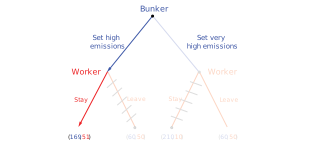
How the game will be played if both Bunker and the Worker do the best they can.
Figure 1.7 How the game will be played if both Bunker and the Worker do the best they can. The strategies that Bunker knows the Worker will not play are “pruned” with the lines through them. The remaining (unpruned) branches are the paths and outcomes open to Bunker, given what the Worker will do in response to their choice or an action. The outcome of the game is shown by the arrows for each player.
Finding a best response
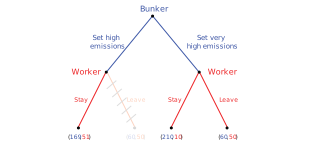
Pruning the Worker’s response to high emissions
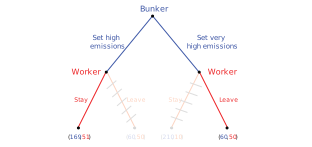
Pruning the Worker’s response to very high emissions
Solving the game by backward induction
To understand how the game will be played we can use the idea of a best response to simplify the game tree. We do so by eliminating any branch of the game that violates the principle of doing the best you can. We do this in Figure 1.7 by eliminating or “pruning” any branch (drawing lines through the branch) that is not a best response. In Figure 1.7, we have pruned the Worker playing Leave when Bunker plays Set high emissions and we have pruned the Worker playing Stay when Bunker plays Set very high emissions because these actions (these branches) are not best responses.
The pruned game tree shows that there are just two paths through the game that are consistent with Bunker thinking that the Worker will do the best they can. If Bunker thinks that the Worker will do the best that they can, then Bunker as first mover has two choices. Remember that Bunker payoffs are listed first in blue.
- Bunker knows that if it plays Set high emissions, then the Worker will play Stay. That means Bunker will get a payoff of 169 given the Worker’s strategy when the Worker does the best they can.
- Bunker knows that if it plays Set very high emissions, then the Worker will play Leave. That means Worker will get a payoff of 60 given the Worker’s strategy when the Worker does the best they can.
Bunker does the best it can by playing Set high emissions because 169 is greater than 60. And so the outcome of the game will be 169 for Bunker and 51 for the Worker.
Why does the Worker accept this outcome? The Worker agrees because the outcome of the game is better than what the Worker gets elsewhere and the Worker obtains a rent. We can compare any player’s allocation after an interaction to their outside option and if they get a payoff greater than their outside option, the player obtains a rent. In the game depicted in Figures 1.6 and 1.7, when the Worker got 51 and Bunker got 169, the Worker received a rent as follows:
- Worker’s rent = payoff after the interaction − payoff at outside option = 51 − 50 = 1
Bunker also received a rent. We calculate Bunker’s rent as follows:
- Bunker’s rent = payoff after the interaction − payoff at outside option = 169 − 60 = 109
Bunker receives a much larger rent than the Worker does.
While each of the players obtained a rent, the environment bears the cost of the emissions—specifically, emissions of 189 units per day. The pollution levels are high and the Worker’s quality of life is barely better than if they had decided, as Bill Yoss put it, “to pull out of the state.” But the Worker’s payoff isn’t that much better than they could do somewhere else, and which leads the Worker to think about what they could do to improve their payoffs.
Exercise 1.8 Making an offer the Worker would accept
Think about the idea of a participation constraint, introduced in Section 1.5. Explain why Bunker would not make an offer to the Worker that would result in the Worker getting a payoff lower than the Worker’s participation constraint. Why does it make sense, therefore, that Bunker chooses a level of emissions at which the Worker’s payoff is 51?
Question 1.9
Look at the following game tree, which depicts an interaction between Bunker and the Worker in a slightly different situation than the one described in the text.
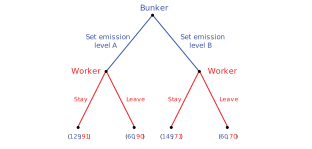
Question Figure 1.9 (I) Interaction between Bunker and the Worker where Bunker chooses between Set emission Level A and Set emission Level B and the Worker chooses between Stay and Leave.
Which of the following statements are true?
- False
- False
- False
- Remember that the higher the emissions that Bunker chooses, the greater Bunker’s profits. What change of wording will make this statement false? At the outcome of the game in Figure 1.5, Bunker’s profits are 169, so the level of emissions must be greater in Figure 1.5 than they are for either the payoff 129 or the payoff 149 in this figure.
- Remember that if a player prefers one outcome to another, then the chosen outcome must have a higher payoff. What change of wording will make this statement false?

